

Silver, with its excellent electrical and thermal conductivity and corrosion resistance, has become a core welding material in the electronics industry, precision instrument manufacturing, and power equipment sectors. The welding quality directly determines the conductive stability, structural strength, and service life of Silver Contact Brazed Assemblies. In actual production, various silver welding methods exist, each with significant differences in process principles, technical characteristics, and applicable scenarios. Choosing the appropriate welding method is crucial for ensuring product quality and improving production efficiency.
Within the silver welding technology system, resistance welding is one of the most widely used and mature methods, particularly suitable for large-scale production scenarios, and is also the core implementation method for Resistive Welding Silver Contact. Its process principle utilizes the Joule heat generated when current passes through the workpiece, instantly melting the silver solder and forming a strong bond with the workpiece. The core advantages of resistance welding are its high welding speed and production efficiency, enabling continuous batch welding, significantly reducing labor costs. Simultaneously, the weld joints have high strength and excellent conductivity, making it well-suited for welding various materials such as silver to copper and silver to silver, and is especially suitable for the mass production of Brazing Electrical Contacts.
However, resistance welding places high demands on equipment and process control. It requires specialized resistance welding equipment to precisely control parameters such as current, voltage, and welding time to avoid defects like incomplete welds or false welds. Simultaneously, operators must possess professional technical skills and be proficient in parameter adjustment techniques to ensure stable weld quality. In the power equipment field, resistance welding is widely used in applications such as brazing contacts for MCCBs and the connection of silver contacts to copper busbars. Among these, Electric Resistance Spot Welding Silver Contact, with its precise positioning and high welding efficiency, has become the preferred method for welding silver contacts in electrical switches.
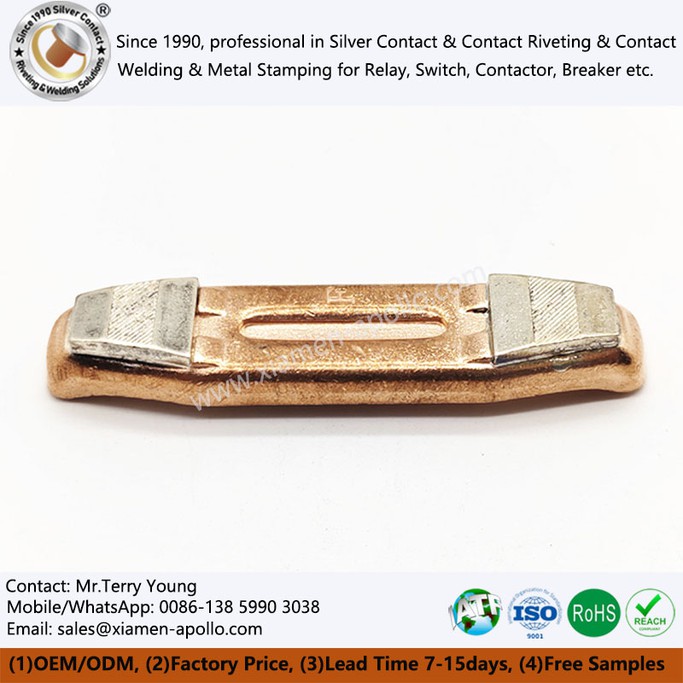
Flame welding is the most flexible method for silver welding, suitable for various complex scenarios, such as welding electrical silver contact tip assemblies. Its process principle involves using the high temperature generated by a flame to heat the silver solder, melting it, and then applying it to the welding area. The heat allows the solder to fully fuse with the workpiece, forming a strong joint. The core advantage of flame welding for Silver Contact Welded to Copper/Brass Stamps lies in its simple equipment and convenient operation; it requires no complex specialized equipment and can flexibly handle workpieces of different sizes and shapes, making it particularly suitable for welding larger silver contact stamped welding assemblies.
Laser welding is the preferred method for silver welding in high-precision fields. With its advantages of high precision and low damage, it is widely used in scenarios with extremely high welding quality requirements. Its process principle involves using a laser beam to irradiate the welding area with high energy density, causing the silver solder to melt instantly and rapidly fuse with the workpiece, forming a narrow, uniform weld. The core characteristics of laser welding are a small heat-affected zone, a narrow weld seam, and minimal deformation. It maximizes the preservation of silver's original physical and chemical properties, avoiding problems such as decreased conductivity and material oxidation caused by high temperatures during welding of Custom Silver Contact Stamping Assemblies. It is particularly suitable for copper/brass stamping with silver contact brazing.
Ultrasonic welding is a low-temperature welding method specifically designed for temperature-sensitive materials and precision applications. It is widely used in silver soldering of electronic components. Its principle utilizes the mechanical energy generated by ultrasonic vibrations to cause plastic deformation and melting of the silver solder at the welding area, thus bonding it to the workpiece. The entire welding process for Brazed Silver Contact Stamped Parts operates at a low temperature, effectively avoiding damage to the workpiece material from high temperatures. The core advantages of ultrasonic welding are low welding temperature, no oxidation, no deformation, excellent protection of silver's conductivity, and a smooth, aesthetically pleasing weld joint that requires no subsequent grinding.
Hot-press welding works by using the synergistic effect of heating and pressurization to melt the silver solder at the welding area and fully fuse it with the workpiece, forming a strong joint. Precise control of heating temperature and pressure is crucial to ensuring weld quality. The core advantage of hot-press welding for MCCB Silver Contact Brazed Assemblies lies in the high strength and good sealing of the welded joint, which can adapt to the welding needs of complex structures and irregular parts.
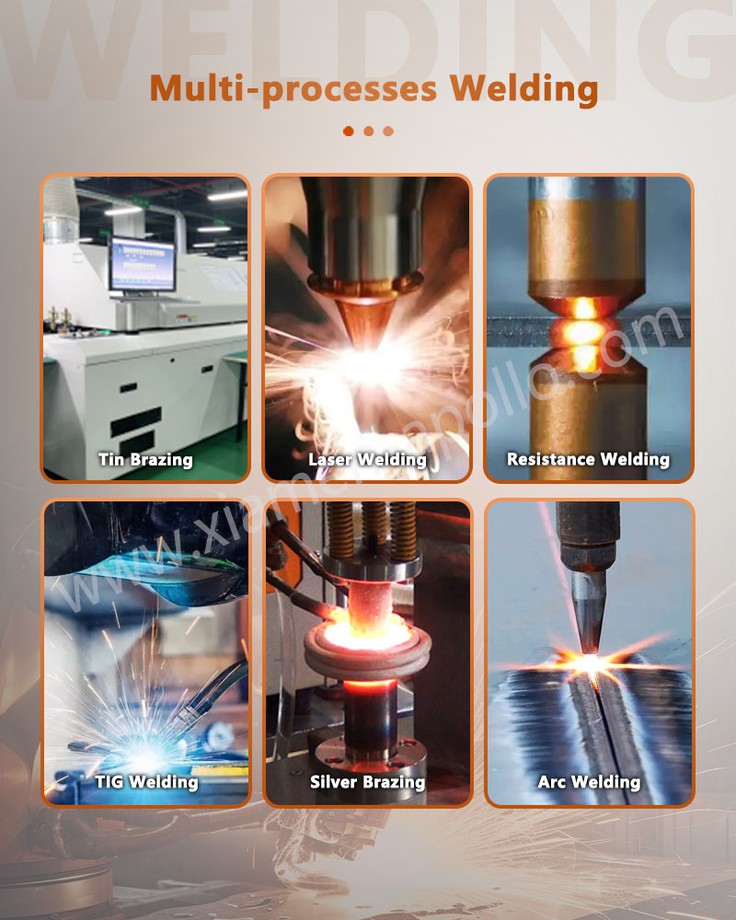
In summary, there are various methods for welding silver, including resistance welding, flame welding, laser welding, ultrasonic welding, and thermoforming welding, each with its own advantages and disadvantages. In practical applications, it is necessary to combine welding requirements, workpiece dimensions, material properties, and production costs to rationally select the welding method and optimize process parameters to ensure both improved welding quality and production efficiency.
As the electronics and power equipment industries develop towards high-end and precision, silver welding technology is also continuously upgrading. Processes such as Contact Welding and Brazing Electrical Contacts are constantly being optimized, and the application of automated and intelligent welding equipment is becoming increasingly widespread, driving silver welding towards high efficiency, precision, and environmental friendliness. Mastering the mainstream silver welding methods and their characteristics can help industry practitioners accurately select and optimize processes, overcome welding quality bottlenecks, and contribute to the high-quality development of related industries.
contact us
If you would like to learn about silver welding method selection, process optimization, and applications of electrical contact welding, or have any needs related to Resistive Welding Silver Contact, please contact us for professional support.
