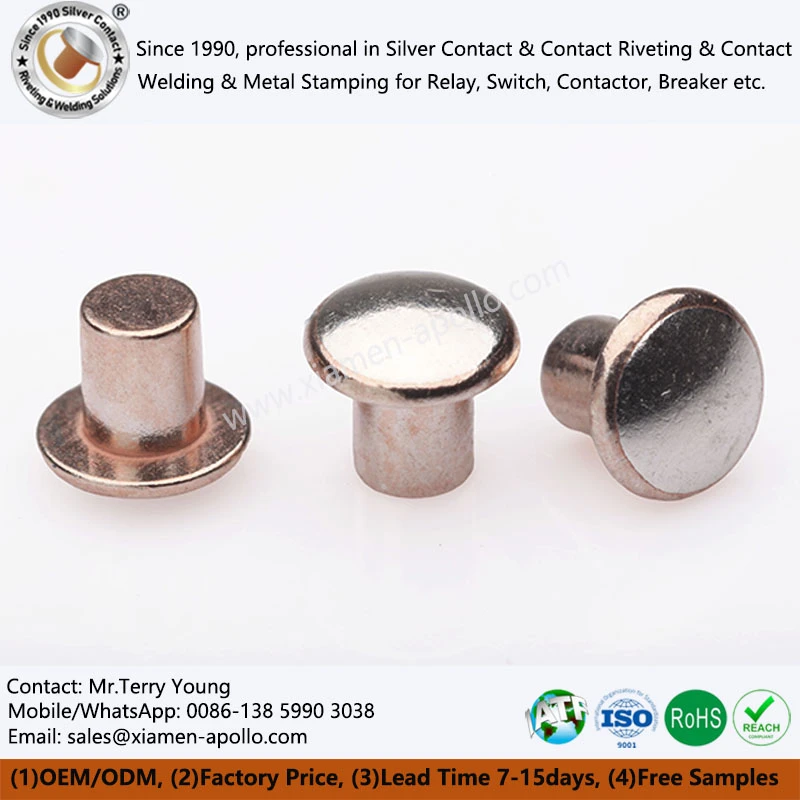
Export packaging for Precision Electrical Contacts must control three primary risks: moisture-induced corrosion, sulfur-related silver tarnishing, and mechanical deformation during transportation. For silver and copper contact components, a suitable packaging system combines dry-condition packing, moisture-barrier materials, validated corrosion inhibitors, individual component separation, and impact-resistant export cartons. Vacuum packaging with desiccants can reduce moisture exposure, while VCI films provide additional corrosion protection for compatible metal surfaces.
Maritime Transportation Risks: Moisture, Salt Contamination and Mechanical Damage
High Humidity and Condensation During Sea Freight
Silver contacts, copper rivets, and Bimetal Silver Contacts are frequently exposed to fluctuating temperature and humidity during international shipping.
During sea transportation, containers may experience significant temperature variations between daytime heating and nighttime cooling. When internal air reaches its dew point, condensation can form on metal components, packaging materials, and container surfaces.
This phenomenon, commonly known as container rain, creates several risks:
- Copper oxidation: Moisture and oxygen promote copper oxide formation, potentially increasing contact resistance.
- Silver tarnishing: Silver reacts with sulfur-containing contaminants, forming silver sulfide (Ag₂S), which causes surface discoloration.
- Interface contamination: Moisture trapped between silver layers and copper substrates can contribute to corrosion of exposed interfaces.
- Electrical instability: Contaminated contact surfaces may exhibit increased or inconsistent contact resistance.
Silver does not behave like copper under ordinary atmospheric exposure. Its main discoloration mechanism is generally sulfur-related tarnishing rather than conventional oxidation. Therefore, packaging materials must be evaluated for both moisture protection and sulfur contamination.
Salt Spray and Chloride Contamination
Marine environments introduce another corrosion factor: chloride-containing aerosols and salt contamination.
When salt particles enter packaging through damaged seals or exposed openings, moisture can dissolve the deposits and create an electrolyte layer on metal surfaces.
Copper components are particularly vulnerable to chloride-assisted corrosion under humid conditions. Silver surfaces may also become contaminated, especially when exposed to unsuitable packaging materials or chemical residues.
For Bimetal Contact Rivets, even relatively small contamination areas can affect subsequent assembly and electrical testing.
The following conditions should be controlled:
| Risk Factor | Affected Material | Potential Consequence | Packaging Control |
|---|---|---|---|
| High humidity | Copper and silver-copper parts | Surface corrosion and oxidation | Moisture-barrier packaging |
| Sulfur contamination | Silver and Ag-based contacts | Ag₂S tarnishing | Low-sulfur packaging materials |
| Chloride deposits | Copper substrates and exposed interfaces | Localized corrosion | Sealed inner packaging |
| Temperature cycling | All precision metal contacts | Internal condensation | Desiccants and moisture barriers |
| Physical impact | Silver contact tips and thin stamped parts | Deformation and surface damage | Individual separation and cushioning |
Mechanical Damage to Soft Silver Contact Surfaces
Bimetal Rivet Contact materials are not always mechanically robust during bulk transportation.
Pure silver has a Vickers hardness typically around 25–40 HV, depending on its condition and processing history. Its relatively low hardness makes the contact surface susceptible to indentation, scratches, and deformation.
Bimetal Electronic Contacts materials such as AgNi and AgSnO₂ have different mechanical characteristics, but their finished contact surfaces can still be damaged by direct metal-to-metal impact.
Typical transportation defects include:
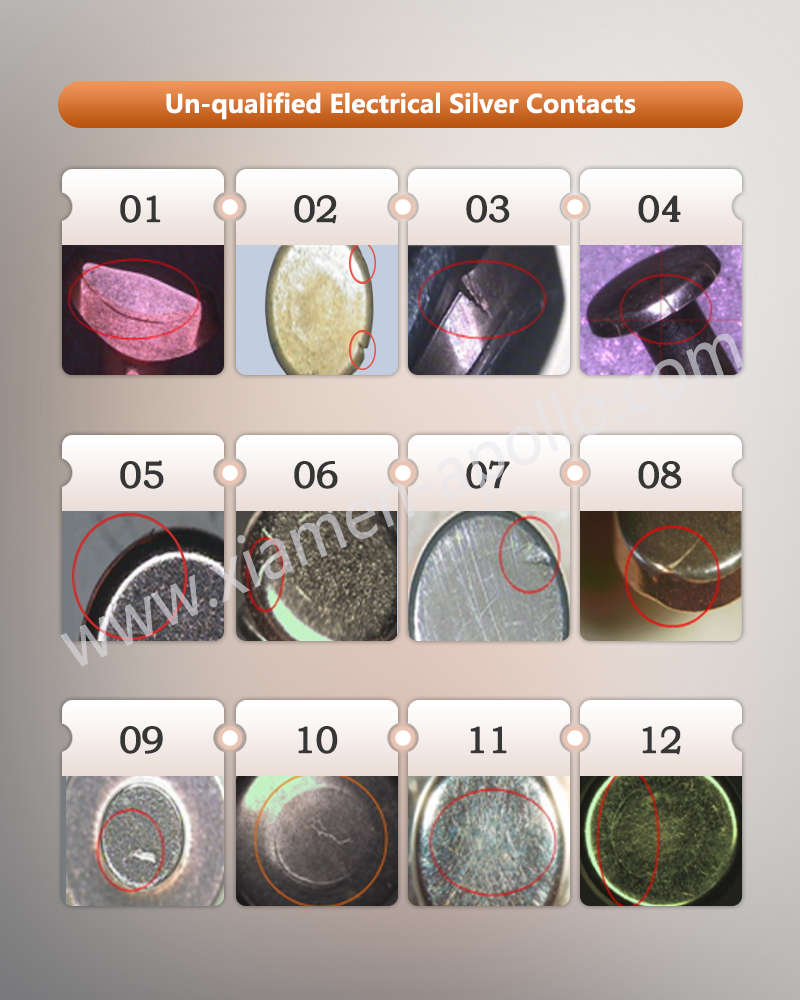
- Scratches on silver contact surfaces caused by friction between components.
- Deformation of contact rivet heads under excessive stacking pressure.
- Bending of thin copper terminals and stamped contact springs.
- Surface dents caused by loose components moving inside cartons.
- Damage to plated or welded contact interfaces during vibration.
For contact assemblies used in relays, circuit breakers, and HVDC contactors, these defects can affect contact alignment, closing force, contact resistance, and assembly dimensions.
Anti-Oxidation Vacuum Packaging: Moisture Barriers, Desiccants and VCI Protection
Vacuum Packaging for Silver and Copper Electrical Contacts
Anti oxidation vacuum packaging is an effective method for reducing the amount of humid air surrounding Bimetallic Contact Rivets during storage and transportation.
The packaging process generally involves placing cleaned and dried components into a moisture-barrier bag, extracting air to the specified level, and heat-sealing the opening.
The objective is to limit moisture exchange and reduce the internal water-vapor content.
A typical packaging configuration includes:
- Clean, dry electrical contact components.
- Moisture-barrier aluminum-laminated or equivalent packaging bags.
- A calculated quantity of desiccant.
- Optional humidity indicator cards.
- Vacuum extraction and heat sealing.
- Outer protective packaging.
The selection of packaging materials depends on component geometry, storage duration, shipping route, and moisture sensitivity.
For silver contact components, packaging materials must also be evaluated for sulfur-containing additives, adhesive residues, and volatile compounds that may cause tarnishing.
Desiccant Selection and Moisture Control
Desiccants absorb residual moisture inside sealed packaging and help maintain a low-humidity environment.
Silica gel is commonly used for industrial metal-component packaging because it is chemically stable and available in different adsorption capacities.
For moisture-sensitive electrical contacts, the required desiccant quantity should be calculated according to:
- Internal packaging volume.
- Initial moisture content of the components and packaging.
- Expected water-vapor transmission through the barrier material.
- Transportation and storage duration.
- Environmental humidity during distribution.
- The moisture-barrier performance of a packaging bag is commonly assessed through its water vapor transmission rate (WVTR).
- A lower WVTR indicates better resistance to water-vapor penetration under the specified test conditions.
The following table provides practical packaging references. Final values should be established through packaging validation rather than applied as universal specifications.
| Packaging Parameter | Typical Engineering Reference | Purpose |
|---|---|---|
| Internal relative humidity | Target ≤30% RH at sealing | Reduce moisture exposure |
| Desiccant type | Silica gel or validated equivalent | Absorb residual moisture |
| Barrier material | Aluminum-laminated moisture-barrier film | Limit water-vapor transmission |
| Vacuum level | Defined according to component geometry and bag strength | Reduce humid air inside the package |
| Seal integrity | No leakage under validated inspection conditions | Maintain package protection |
| Humidity indicator | 10% / 20% / 30% RH indicator cards, as specified | Monitor moisture exposure |
A vacuum level should not be selected solely to achieve the lowest possible internal pressure. Thin stamped components, hollow rivets, and delicate contact assemblies may be deformed by excessive external pressure.
For these parts, controlled vacuum levels or dry-air/nitrogen barrier sealing may be more appropriate.
VCI Film: Additional Corrosion Protection for Compatible Metals
Volatile Corrosion Inhibitor (VCI) film releases corrosion-inhibiting compounds into the enclosed package environment.
These compounds can form a protective molecular layer on compatible metal surfaces, reducing the electrochemical reactions associated with corrosion.
VCI packaging is commonly used for copper, steel, and other corrosion-sensitive metal components.
However, VCI materials must be selected carefully when packaging silver electrical contacts.
Not every VCI formulation is suitable for silver. Certain chemical additives or volatile compounds may cause discoloration, tarnishing, or contamination of silver contact surfaces.
Before introducing VCI film into silver-contact packaging, manufacturers should verify:
- Compatibility with Ag, AgNi, and AgSnO₂ contact materials.
- Absence of harmful sulfur-containing compounds.
- No adverse effect on contact resistance.
- No visible residue after unpacking.
- Compatibility with subsequent welding, riveting, or electrical assembly.
A practical solution is to use a validated VCI system for copper-based components while applying sulfur-controlled moisture-barrier packaging to exposed silver contact surfaces.
VCI film should be considered an additional protection measure, not a substitute for cleaning, drying, moisture-barrier sealing, or proper material selection.
Consult Our Electrical Engineers Today
Export Cartons and ISPM 15-Compliant Pallets for International Shipping
Heavy-Duty Corrugated Cartons for Bimetallic Rivet Contacts
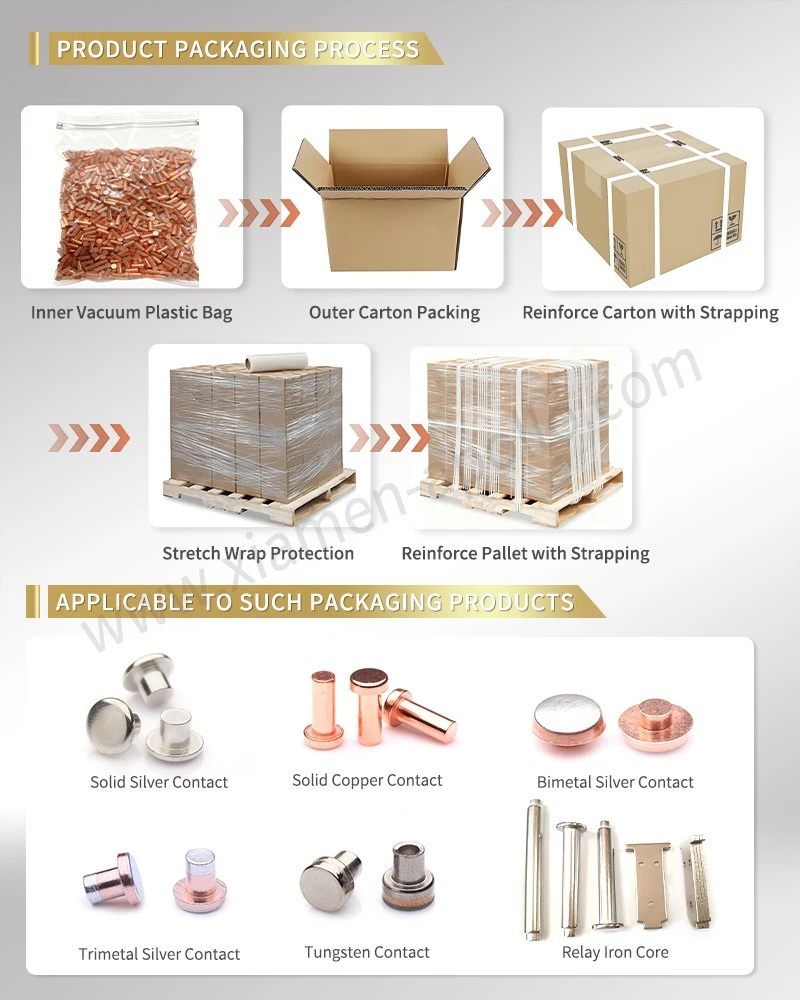
The outer carton provides the primary structural protection against stacking loads, handling impacts, and transportation vibration.
For Bimetal Silver Contacts, the carton should be selected according to the total package weight, internal packaging configuration, transportation distance, and stacking arrangement.
Double-wall or triple-wall corrugated cartons may be appropriate for heavier shipments.
Important carton specifications include:
- Board grade and flute combination.
- Edge Crush Test (ECT) performance.
- Box Compression Test (BCT) capacity.
- Internal cushioning and partition structure.
- Carton dimensions and stacking orientation.
- Moisture resistance of the outer packaging.
For heavy silver contact assemblies, internal dividers should distribute stacking pressure without transferring excessive loads directly onto the contact surfaces.
Packaging should also prevent inner trays, reels, or vacuum bags from moving freely inside the carton.
Export Pallets and ISPM 15 Compliance
Wooden pallets used in international trade must comply with the applicable International Standards for Phytosanitary Measures No. 15 (ISPM 15) requirements.
Heat-treated wood packaging is commonly marked with the recognized IPPC symbol and the corresponding treatment identification.
For international shipments of electrical contact components, pallet selection should consider:
- Pallet load capacity.
- Forklift entry dimensions.
- Carton arrangement and load distribution.
- Moisture exposure during port storage.
- Compatibility with container loading equipment.
Plastic pallets can also be used where export requirements, warehouse conditions, and customer specifications permit.
Regardless of pallet type, the packaging structure must maintain load stability throughout container loading, unloading, and distribution.
Container Loading and Moisture Protection
Correct inner packaging cannot fully prevent transit damage if the cargo is loaded incorrectly.
Electrical Contact Rivet cartons should be arranged to minimize movement and avoid excessive stacking pressure.
Recommended practices include:
- Using stretch film and strapping to stabilize palletized cartons.
- Keeping cartons away from direct contact with container walls where condensation may occur.
- Using container desiccants when justified by shipment duration and humidity exposure.
- Avoiding direct placement of cartons on wet or contaminated container floors.
- Applying clear package labels for orientation, stacking limits, and moisture sensitivity.
For long-distance sea freight, packaging performance should be verified through appropriate transport simulation and environmental conditioning.
Relevant standards include ASTM D4332 for conditioning containers and packages, ASTM D4728 for random vibration testing, and ASTM D5276 for free-fall drop testing.
Packaging Validation and Quality Inspection Before Shipment
Export packaging should be treated as part of the product quality-control process rather than as a final warehouse operation.
For silver contacts, copper rivets, and precision stamped components, inspection should verify both packaging integrity and the condition of the components after simulated transportation.
Pre-Packaging Inspection
Before sealing, the following characteristics should be checked:
- Surface cleanliness and absence of oil residues.
- No visible oxidation, tarnishing, or corrosion.
- Contact-head dimensions and surface condition.
- Burrs, scratches, and deformation on stamped parts.
- Correct component quantity and orientation.
- Packaging material compatibility with the contact alloy.
For Electrical Contacts, cleanliness is particularly important because sulfur-containing contaminants and unsuitable packaging materials can cause tarnishing during storage.
Packaging Performance Testing
A packaging validation plan should be based on product geometry, shipping conditions, and the customer's acceptance criteria.
Relevant test references include:
| Test Standard | Test Purpose | Application |
|---|---|---|
| ASTM D4332 | Conditioning of containers and packaging components | Environmental conditioning |
| ASTM D4728 | Random vibration testing | Transportation vibration simulation |
| ASTM D5276 | Free-fall drop testing | Carton impact resistance |
| ASTM D642 | Compression resistance of shipping containers | Stacking-load evaluation |
| ASTM B117 | Salt spray exposure testing | Corrosion screening of materials and finishes |
ASTM B117 should not be interpreted as a direct certification of packaging performance. It is a controlled salt-fog exposure method for evaluating the corrosion behavior of test specimens.
Likewise, packaging vibration and drop-test acceptance limits should be defined according to the actual shipping profile and product fragility.
Post-Transportation Inspection
After packaging validation or an actual shipment, inspection should focus on the following:
- No visible silver tarnishing or copper corrosion.
- No deformation of contact heads or stamped terminals.
- No loose or damaged riveted interfaces.
- No moisture penetration into sealed barrier bags.
- No damaged trays, reels, or carton structures.
- No component mixing or quantity discrepancies.
Where required, electrical contact resistance can be measured before and after transportation simulation to identify changes associated with surface contamination or mechanical damage.
The measurement method, contact force, test current, and acceptance limits should remain consistent between inspections.

Export Packaging Requirements for Different Electrical Contact Products
Packaging specifications should reflect the material, geometry, surface condition, and downstream assembly requirements of each product category.
| Product Category | Main Packaging Risk | Recommended Packaging Method |
|---|---|---|
| Pure silver contact rivets | Scratches and sulfur tarnishing | Individual separation and sulfur-controlled barrier bags |
| AgSnO₂ and AgNi contacts | Surface damage and contamination | Sealed moisture-barrier packaging with suitable separators |
| Copper contact terminals | Oxidation and chloride contamination | Dry packaging with validated corrosion protection |
| Relay moving springs | Bending and deformation | Individual plastic separator trays |
| Miniature stamped terminals | Feeding damage and component mixing | Tape-and-Reel or precision carrier trays |
| HVDC contact assemblies | Impact damage and interface contamination | Custom protective trays and reinforced export cartons |
For OEM and ODM projects, packaging specifications should be confirmed during the product approval stage rather than after mass production begins.
The packaging drawing should identify:
- Inner packaging material and thickness.
- Component quantity per bag, tray, or reel.
- Desiccant type and quantity.
- Sealing method and inspection requirements.
- Outer carton specifications.
- Pallet dimensions and maximum loading weight.
- Storage conditions and shelf-life requirements.
This approach allows packaging costs, component protection, and automated downstream assembly requirements to be evaluated together.
Frequently Asked Questions About Export Packaging Electrical Contacts
Q1. How can silver electrical contacts be protected against oxidation and tarnishing during sea freight?
Use clean, dry components, sulfur-controlled moisture-barrier packaging, and compatible desiccants. Vacuum sealing or dry-gas barrier sealing can reduce moisture exposure. Packaging materials must be screened for sulfur-containing compounds that may cause Ag₂S tarnishing.
Q2. Can vacuum packaging damage thin stamped electrical contact components?
Yes. Excessive vacuum pressure can deform thin springs, delicate terminals, and unsupported contact assemblies. Vacuum levels should be validated against component stiffness, geometry, and bag strength. Dry-gas sealing may be an alternative.
Q3. How can buyers verify that silver contact components have not been damaged during transportation?
Inspect silver surfaces, contact-head geometry, riveted interfaces, and stamped dimensions after unpacking. For critical applications, compare contact resistance measurements taken before and after transportation simulation.
Q4. Can export packaging specifications be customized for OEM and ODM electrical contact orders?
Yes. Packaging can be specified according to component drawings, material composition, dimensions, monthly volume, automated assembly requirements, shipping route, and storage duration. Custom trays, carrier tapes, vacuum bags, and export cartons can be evaluated during project approval.
contact us
Before releasing your next international shipment, submit your Precision Electrical Contacts drawings, material specifications, and expected order quantities for a packaging assessment. Our manufacturing capabilities cover silver contact rivets, AgSnO₂ and AgNi contact components, copper terminals, precision progressive die stamping, and custom export packaging. Request a factory packaging review to establish the appropriate moisture barrier, component separation, and transportation protection for your next production order.