

In industrial manufacturing, the stability of fasteners is crucial for safety and reliability. Especially in industries such as rail transportation, wind power equipment, shipbuilding, construction machinery, and high-end equipment, vibration and shock conditions are extremely common, and the failure of connectors often leads to serious safety hazards. Therefore, the anti-loosening principle of Hex Lock Nuts and their adaptability to vibration conditions under different structures have become a key focus for engineering technicians.
Core Anti-Loosening Principle of Lock Nuts
Hex Nuts are fasteners that add an anti-loosening structure to ordinary nuts to prevent loosening of threaded connections caused by vibration, load changes, or temperature fluctuations. Their anti-loosening principles mainly include the following:
Friction Anti-Loosening Principle: After the threaded pair is engaged, friction is increased to improve the resistance to loosening. For example, Nyloc Nuts utilize the elasticity and high coefficient of friction of nylon material to continuously apply pressure to the thread surface after tightening, thereby achieving anti-loosening.
Mechanical Anti-Loosening Principle: This prevents rotation by providing additional mechanical barriers or positioning structures, such as Coupling Nuts or spring washers. This method is widely used in mechanical equipment, but may be limited by material fatigue under strong vibration environments.
Pre-tightening Anti-Loosening Principle: By pre-tightening the Prevailing Torque Nut and bolt beyond the working load range, relative slippage occurs during use, thus preventing loosening. This method is widely used in high-strength bolted connections and structural steel engineering.
Self-Loosening Anti-Loosening Principle: This achieves a lasting and tight thread engagement by utilizing the deformation of the nut material itself. Self-locking Nuts typically possess advantages such as high temperature resistance and corrosion resistance, making them suitable for extreme environments such as aerospace and engines.
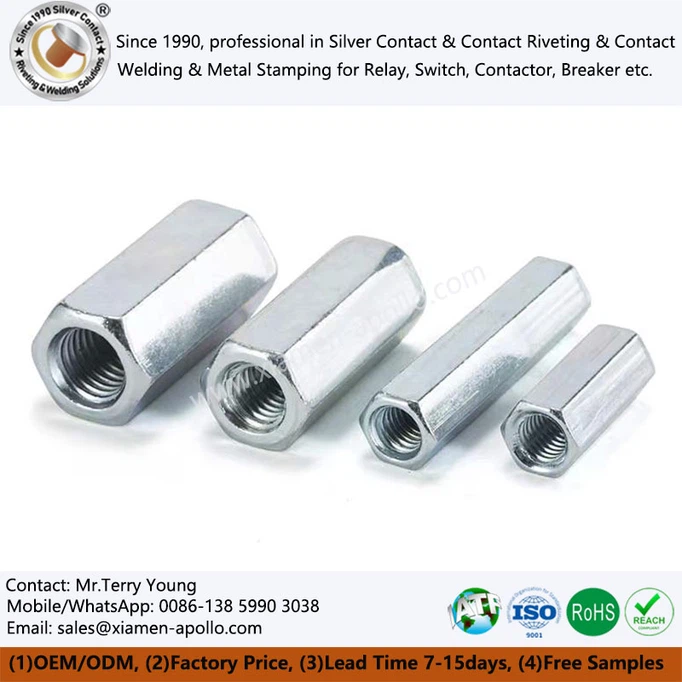
The structural differences of Hexagonal Nuts directly determine their anti-loosening effect and adaptability to vibration conditions. Common structures include:
Self-locking Nut: Clamps the thread using a metal elliptical ring or eccentric ring. It offers high temperature resistance and good corrosion resistance. It performs stably in high-temperature (>300℃) vibration environments, such as boilers and steam turbines. Its disadvantage is that the locking force decreases after repeated assembly and disassembly, requiring strict control over the number of reuses.
Nyloc Nut: Relies on the high-friction interface formed by the nylon ring and thread, offering strong adaptability and lower cost. It performs well in medium-to-low temperature vibration conditions (such as automotive suspensions and general machinery). However, the nylon ring is prone to aging and failure in high-temperature or strongly chemically corrosive environments.
Wing Nut: Enhances locking force through the radial movement of a wedge block, automatically compensating for loosening under vibration and impact, making it ideal for high-impact environments such as bridges and mining machinery. Its complex structure and high cost are its main limiting factors.
Coupling Nut: Uses two interlocking nuts to create damped locking under preload. This method is widely used in structures subject to cyclic loads, such as rail vehicles and large cranes, and is easy to install, but requires additional space and assembly time.

The anti-loosening principle and structural differences of Hex Lock Nuts play drastically different roles under various vibration conditions. A scientific understanding and appropriate selection based on the actual environment are key to ensuring the long-term stable operation of mechanical equipment.
In today's manufacturing industry, where safety and efficiency are equally important, scientifically analyzing the anti-loosening principle of Standard Hex Nuts and selecting structures that match vibration conditions is essential knowledge for every engineering technician.
contact us
For detailed specifications and compatibility solutions for Metal Screw products, please feel free to contact us. We sincerely invite you to place an order; we will provide you with reliable fastening solutions and excellent service.
