

Trimetal Silver Alloy Contacts consist of a cylindrical, integrally formed connector and contact body. The radius of the contact body is larger than the radius of the connector body, and its opposite end face bulges outwards to form a convex surface. This convex surface has a silver coating, and an annular flange runs along its edge. The axial height of the convex surface is greater than the axial height of the annular flange. This product provides stable contact, preventing poor contact or open circuits.

How to Distinguish Between Copper and Silver Contacts?
Due to the unique requirements of some switching electrical products, there are many factories manufacturing contacts on the market. Some unscrupulous merchants might use cheap copper instead of silver to maximise profits. When purchasing, laypeople often cannot distinguish between copper and Tri-metal Electrical Contact Rivet.
Actually, copper and brass can be identified by sight. Copper is softer, while brass is harder. The same applies to silver alloys; silver alloys are much harder than pure silver. However, colour is not a strong differentiator. Additionally, circuit contacts prone to arcing typically use Electrical Tri-Metal Rivets. These are copper-plated with a thin layer of silver. This is because when silver is arced through the contact, it forms an oxide layer like other metals. Silver oxide has better conductivity than pure silver, so this type of contact is used when arcing cannot be avoided.
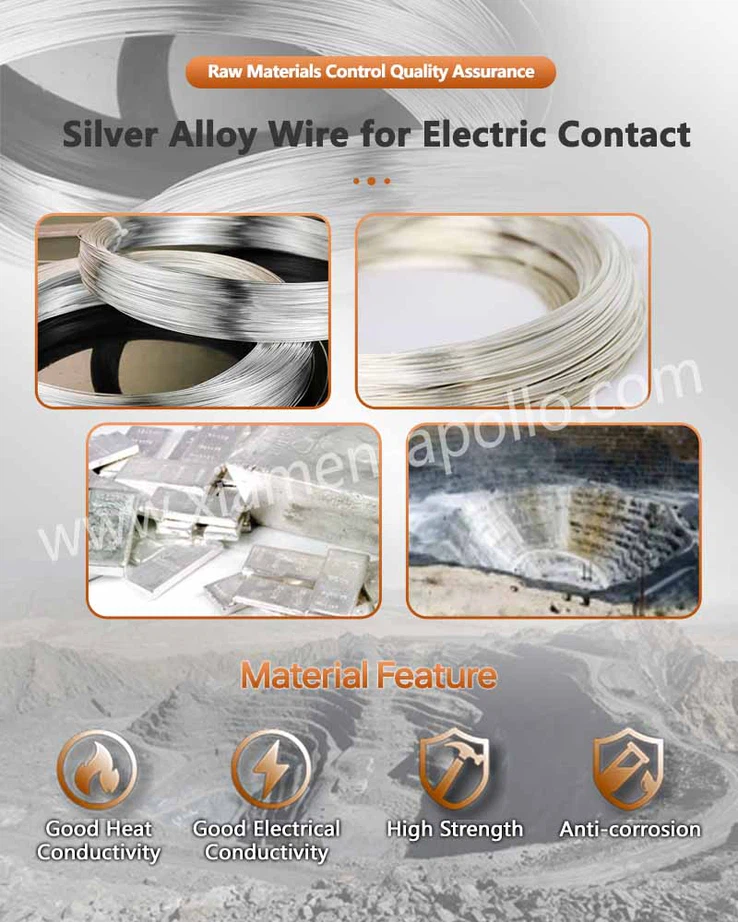
Trimetal Silver Contact Rivets broadly refer to the points where electronic devices separate and connect during opening and closing. Because metal conductor terminals easily generate instantaneous heat and sparks upon contact, these contacts are prone to oxidation and electrolysis during high-frequency use. Therefore, these contacts are often enlarged and thickened, or made of polymer metals (most commonly copper and silver). Thus, this type of contact made of polymer metals is used.
about us
Ordinary silver plating on the market is thin, easily worn and oxidised, while pure silver is expensive and easily damaged. To solve these problems, we have independently developed Trimetal Silver Alloy Contacts. The base is solid and wear-resistant, and the surface silver alloy has excellent conductivity and oxidation resistance. It maintains stable contact performance under ignition conditions, eliminating the risk of loose connections or open circuits. The materials used are genuine, without inferior copper imitations or silver substitutes. The structural design is tailored to the needs of various electrical switches. We welcome new and existing customers to inquire about details and place custom orders.
contact us
