High-quality vacuum brazing products rely on meticulous control throughout the entire process. As the core process for Composite Welding Contact, every parameter and operation in vacuum brazing directly determines the forming effect and performance of the composite welded joint.
Vacuum brazing is a precision process highly sensitive to details. Minor oil contamination, tooling deviations, and temperature fluctuations can all cause joint failure. The stability of Welding Contact relies on a comprehensive quality control system covering incoming materials, pre-treatment, assembly, welding, post-treatment, and inspection, ensuring that processed parts meet stringent usage requirements.
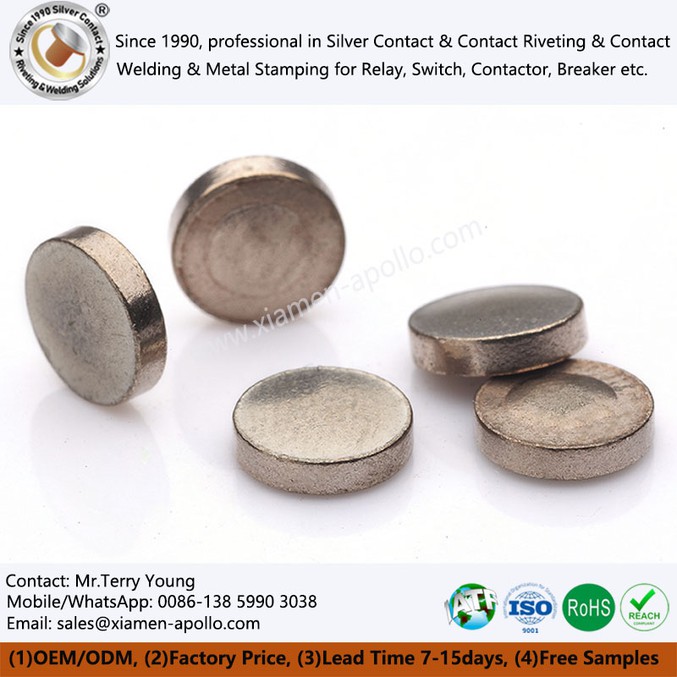
Pre-Welding Preparation: Quality Begins with Details
Raw material inspection is the foundation of Button Silver Contacts. Parts to be welded must be checked for dimensions, surface condition, and material. Aluminum plate warpage must meet standards, and weld plates must be free of scratches, dents, oil contamination, and oxide layers, preventing joint defects from the outset.
Precise cleaning is crucial to the success of the weld. First, machining burrs are removed, followed by ultrasonic cleaning with a specialized cleaning agent to remove oil and particles. Drying then removes any remaining water stains, providing a clean bonding interface for the Brazed Electrical Contacts.
Oxide layer removal directly improves joint reliability. For easily oxidized materials such as aluminum and titanium, polishing is required after cleaning to remove the natural oxide film, allowing the fresh metal surface to fully wet the brazing filler metal and strengthening the bonding strength of the Welding Electrical Contact.
Tooling Design and Assembly: Ensuring Precise Positioning
During vacuum brazing, parts expand due to heat. Inappropriate tooling can cause misalignment and deformation, compromising the positional accuracy and structural integrity of the Welding Component.
Tooling inspection requires strict control of deformation, oil, and solder residue. The flatness of the upper and lower pressure plates is controlled within 0.2mm, providing stable assembly support for the Resistance Welding Contacts.
Gap control is precisely designed based on the material's coefficient of thermal expansion. The joint gap is reduced from 100μm to 30μm, increasing shear strength by over 25% and optimizing the mechanical properties of the Contact Tips.
Uniform pressure is applied using a diagonal fastening method to ensure balanced force, prevent uneven loading that alters the gap, and maintain the uniformity of the Silver Brazing Products.
Aging control requires rapid furnace placement after assembly to avoid prolonged exposure to moisture absorption and ensure the Silver Brazing Contact is not affected by environmental impurities.
Welding Process: Precise Monitoring of Every Degree
Vacuum monitoring is a core aspect of welding. The temperature is raised from room temperature to 10⁻² Pa, reaching below 5×10⁻³ Pa at 260℃ and maintained throughout the process, creating a pure welding environment for the Silver Cadmium Oxide Contacts.
Multi-point temperature measurement involves placing thermocouples at the upper, middle, and lower parts of the furnace and at key locations on the workpiece, avoiding direct contact between the thermocouples and the weldment. This allows for precise temperature control and stable forming conditions for the AgCdO Contacts.
Segmented temperature control employs multi-segment heating curves, with holding steps at 380℃, 480℃, and 540℃ to minimize the temperature difference between the furnace and the workpiece, achieving uniform heating and ensuring consistent heating of the Brazed Composite Rivet Electrical Contacts.
The parameter recording system automatically saves data such as vacuum level, temperature, and time, ensuring full traceability and providing data support for process optimization of Brazed Contact on Terminal.
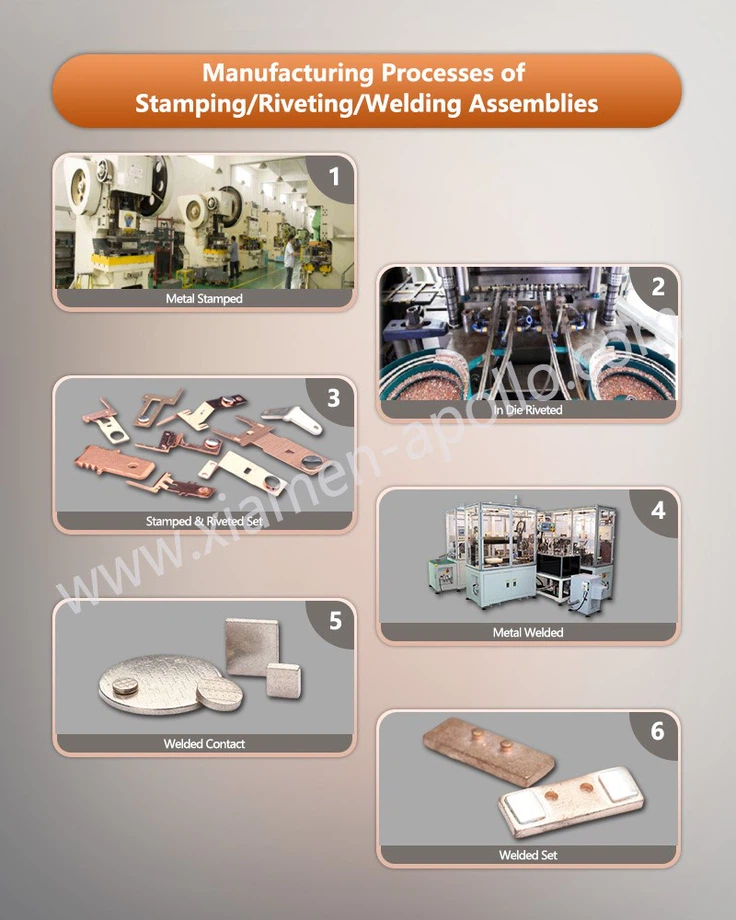
Post-Welding Inspection: Verifying Quality with Data
After welding, the quality of the Welding Button Contact needs to be verified from multiple dimensions to ensure the joint meets usage standards.
Visual inspection checks whether the weld is full and continuous, free of cracks, incomplete fusion, and solder flow, providing a visual assessment of the surface forming quality of the Silver Contact Welding.
Dimensional inspection measures key dimensions to control welding deformation and ensure the assembly accuracy of the Welded Silver Contact Components.
Non-destructive testing uses X-rays, ultrasound, and fluorescent penetrant testing to check for internal and surface defects, verifying the internal integrity of the Welding Contact.
Air tightness testing, for vacuum and pressure vessel components, uses helium mass spectrometry for leak detection or pressure testing to confirm the sealing performance of the Button Silver Contacts.
Metallographic analysis observes the interface bonding, diffusion layer thickness, and microcracks to evaluate the microscopic bonding state of the Brazed Electrical Contacts.
Mechanical property testing, including tensile, shear, and fatigue tests, verifies the strength and durability of the Welding Electrical Contact.
Comprehensive quality control throughout the vacuum brazing process is the core guarantee for the stable achievement and reliable performance of the Welding Component. Every parameter and operation directly affects the final quality of the composite welded joint.
about us
Our Composite Welding Contact, relying on precise pre-welding preparation, scientific tooling assembly, meticulous welding control, and comprehensive post-weld inspection, possesses excellent bonding strength, sealing performance, and dimensional accuracy, adaptable to various complex working conditions.
If you have any purchasing or customization needs for Resistance Welding Contacts, please feel free to contact us. We will provide you with high-quality products and professional solutions. We sincerely invite you to place an order and cooperate!
contact us