

In the fields of modern electrical engineering and high-end manufacturing, electrical contacts serve as critical actuating components for making and breaking circuits; their performance directly determines the reliability and service life of the entire device. Among the vast array of contact materials available, tungsten-based contacts occupy a pivotal position due to their exceptional physicochemical properties. Specifically, Tungsten-Copper (WCu) and Tungsten-Silver (WAg) contacts are collectively recognized as the archetypal Tungsten Contact Rivets. Since both utilize refractory tungsten as their base matrix, they exhibit a high degree of similarity in terms of fundamental physicochemical properties, manufacturing processes, and application scenarios. However, when considering raw material costs-given that the price of silver is significantly higher than that of copper-tungsten-copper contacts offer a distinct competitive cost advantage. This allows them to maintain excellent performance while remaining more economically viable, making them the preferred choice for a wide range of electrical equipment.
One of the most remarkable characteristics of tungsten-copper material is its "sweating-cooling" effect. When the operating temperature surges rapidly to levels exceeding 3000°C, the copper embedded within the continuous matrix of the solid tungsten contact rivet undergoes liquefaction and rapid evaporation. This physical phase transition absorbs and dissipates a substantial amount of thermal energy, thereby effectively lowering the temperature of the contact surface and preventing the contact from softening or failing due to overheating. This inherent self-cooling mechanism enables these contacts to perform exceptionally well in devices subjected to massive short-circuit current surges-such as high-voltage circuit breakers and ultra-high-pressure switches. Furthermore, the performance of tungsten-copper contacts can be flexibly customized by adjusting the copper content; typically, increasing the copper proportion significantly enhances the material's electrical conductivity and ductility, thereby satisfying a diverse spectrum of electrical performance requirements.
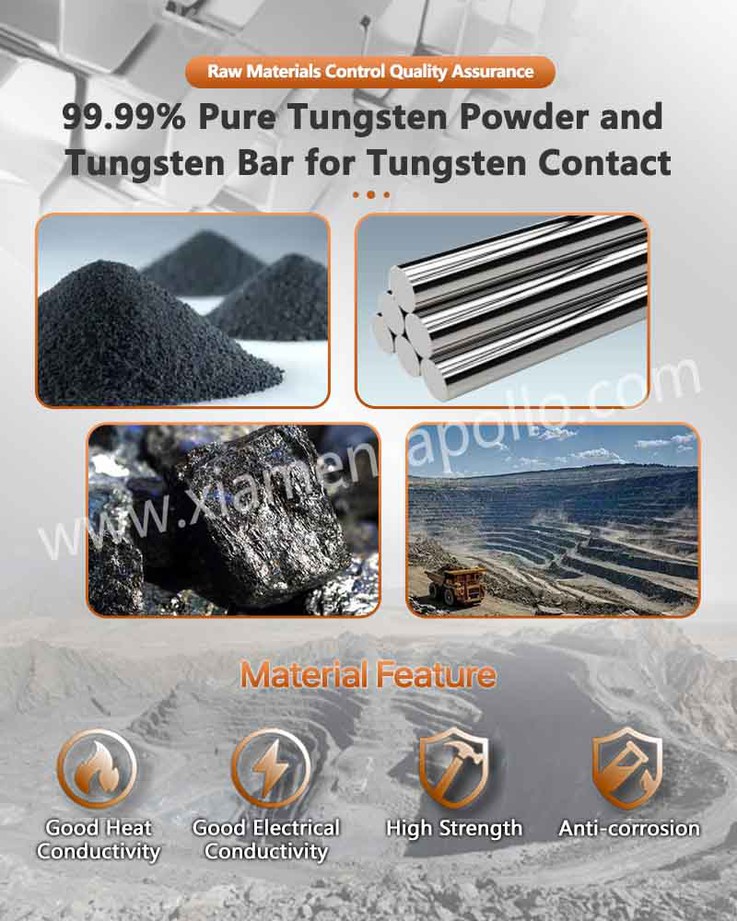
Regarding manufacturing processes, the production of industrial tungsten-based contacts relies primarily on powder metallurgy techniques. Common methods include infiltration, the copper oxide powder method, and injection molding. The infiltration method is one of the most widely adopted processes: high-purity tungsten powder is first compacted into a preform of the desired shape; this preform undergoes high-temperature sintering to create a porous tungsten skeleton with a specific porosity; finally, molten copper is infiltrated into the pores of the skeleton to yield a dense, composite tungsten-copper material. This method is particularly well-suited for the fabrication of tungsten-copper products with low copper content, as it ensures both the structural integrity of the tungsten skeleton and the overall strength of the material.
The copper oxide powder method is a process in which the copper matrix is generated in situ through chemical reactions. This process begins by reducing copper oxide powder into metallic copper powder; this is then uniformly mixed with tungsten powder and subjected to a sintering treatment. During sintering, the copper forms a continuous matrix structure, while the tungsten particles are uniformly dispersed throughout it, serving as a reinforcing framework. This method allows for precise control over the material's microstructure, fostering a tighter bond between the copper and tungsten phases, thereby further enhancing the material's comprehensive mechanical properties as well as its electrical and thermal conductivity.
The injection molding method (also known as injection forming) is particularly suitable for manufacturing miniature electrical contacts characterized by complex shapes and precise dimensions. This process involves uniformly mixing nickel powder, copper-tungsten powder, and tungsten powder of various particle sizes; an organic binder is then added to create a feedstock, which is subsequently injected into a mold using an injection molding machine to form the desired shape. After a debinding step to remove the organic binder, the material undergoes high-temperature sintering to yield high-density tungsten-copper alloy products. This method significantly improves material utilization efficiency and reduces the need for subsequent machining operations, making it highly suitable for large-scale automated production.

In practical applications, pure tungsten contacts are widely fabricated into various forms of precision components, such as electrical tungsten contact rivets. These rivets typically serve as core conductive elements, installed within a wide range of high-voltage and low-voltage electrical switches. They are required not only to withstand frequent mechanical impacts but also to conduct massive currents during the instant of circuit closure. Thanks to their high hardness and exceptional resistance to contact welding, tungsten-copper rivets are able to maintain stable contact resistance over tens or even hundreds of thousands of operational cycles, serving as a cornerstone for ensuring the safe operation of power systems.
The automotive industry also represents a key application sector for copper-tungsten contacts, particularly in the form of tungsten contacts for motorcycle horns. The interior spaces of motorcycle and automobile horns are confined, and their operating environments are characterized by frequent vibration and significant fluctuations in humidity. Traditional silver contacts are prone to electrical erosion or adhesion under frequent high-current surges-issues that can result in the horn failing to sound or becoming stuck in a continuous blare. In contrast, contacts manufactured from tungsten-copper materials leverage their outstanding resistance to arc erosion to ensure that the horn continues to emit a crisp, steady sound even under harsh conditions, thereby significantly enhancing the vehicle's signaling safety performance.
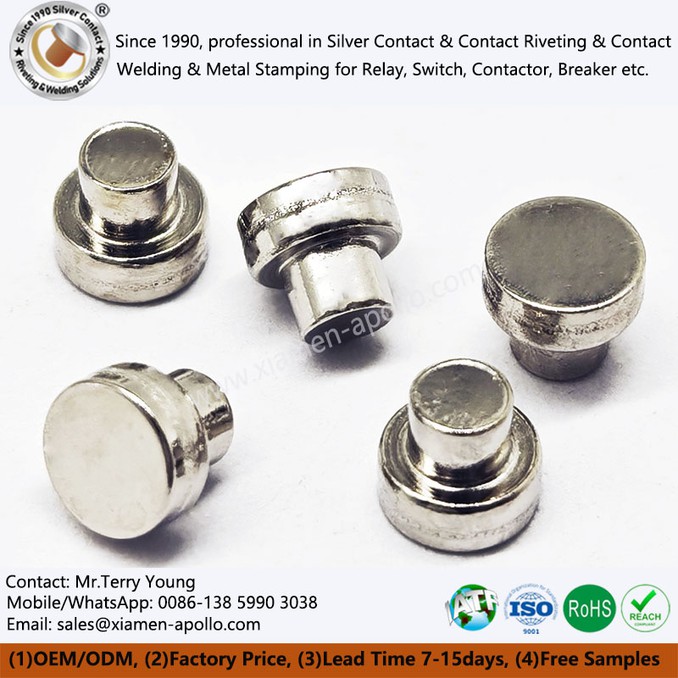
In summary, AC Contactor Tungsten Contacts-distinguished by their unique structural design-seamlessly integrate the high-temperature resistance and ablation resistance of tungsten with the superior electrical and thermal conductivity of copper. Produced through a range of advanced processes-including infiltration, copper oxide powder reduction, and injection molding-these contacts are widely utilized across diverse electrical systems, ranging from household appliances to high-voltage power grids.
If you are currently seeking tungsten contacts for circuit breakers, we invite you to contact us at any time. Our expert team is ready to provide comprehensive technical support-spanning material selection, process design, and precision manufacturing-to help your electrical products achieve exceptional levels of reliability.
contact us
