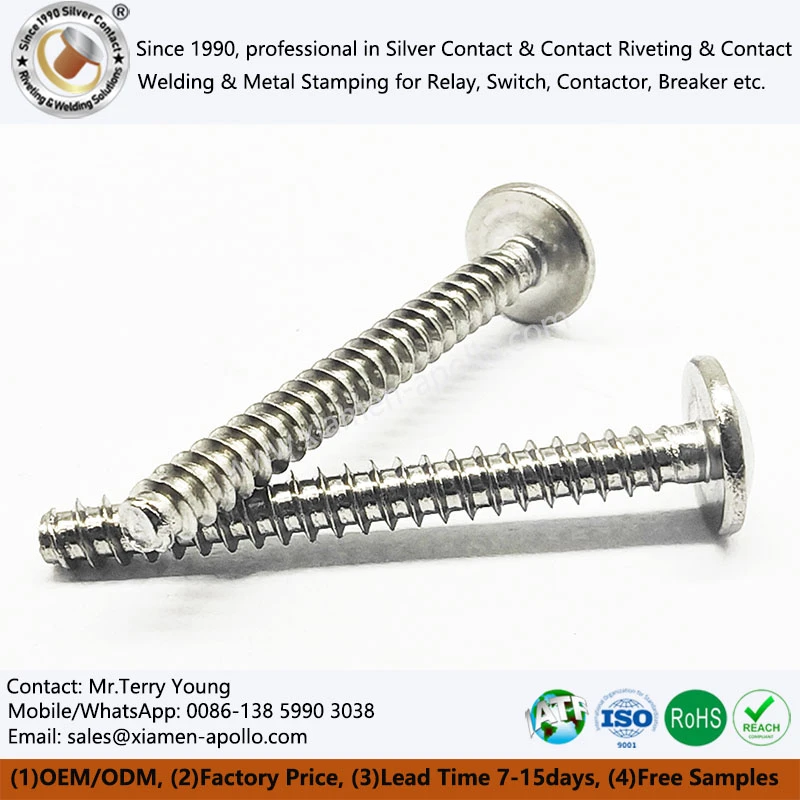
These fasteners are suitable for non-metallic or soft metal substrates and require no pre-drilled holes or tapping before assembly. Their pointed tip can cut directly into materials, unlike standard flat-head machine screws, which feature a flat head with uniform dimensions and require tapping before installation. Self-Drilling Self-Cutting Screw has a sharp tip and a large thread pitch. Its cutting behavior is similar to a chip-free tap, enabling direct thread forming on metals and plastics. When used on wooden substrates, the thread relies on its geometry to press into and embed within the material, and the clamping strength comes from the rebounding force of the substrate material against the thread profile.
Structural Components
A complete fastener consists of three primary parts: the shank, the tip, and the main body. Its specific configuration is defined by four key elements: head shape, drive type, thread profile, and tip design.
There is a wide range of head shapes available, including round (semi-round), pan, round with washer, pan with washer, countersunk, semi-countersunk, cylindrical, domed-cylindrical, bugle, hexagonal, hex-flange, and hex-with-washer.
Drive types are categorized into external and internal drives. External drives include hexagonal, hex-flange, hex-boss, and external Torx (hexalobular) configurations. Internal drives encompass a variety of recesses, such as slotted, Phillips (H-type), Pozidriv (Z-type), Frearson (F-type), square (Robertson/Scrulox), combination, internal spline, internal hex (Allen), internal triangle, internal 12-point (double-hex), clutch, six-lobe (Torx), and high-torque cross-recesses. The choice of drive type for a self-tapping fastener is determined by the specifications of the assembly tool bit, rather than by aesthetic preference.
In terms of thread profiles, common types include coarse threads, machine screw threads, drywall screw threads, and plywood screw threads. Based on the lead, they can be classified as single-start, double-start, or multi-start. The tip is typically either serrated or flat, though it can also be machined with a scraping groove, chip-clearing groove, or a drill-point tip, depending on assembly requirements. Since the head style, drive type, thread profile, and tip configuration can be combined in various ways, there is an extensive range of available specifications.
Fasteners with a drill-point tip offer significant advantages when used on thin sheets or laminated panels, as they can perform both drilling and thread formation in a single pass. Self-drilling screws fall into this category; they combine drilling and fastening into one operation, which shortens cycle times. Furthermore, the hole position is controlled by the tool's guidance, eliminating the need for manual alignment.
Key Characteristics
While there is a wide variety of such products, they share five common characteristics:
1. Material: The vast majority-approximately 99%-are made from case-hardened (carburized) steel, with the remainder consisting of stainless steel or non-ferrous metals.
2. Heat Treatment: Carbon steel components undergo case hardening (carburizing/nitriding), while stainless steel components undergo solution hardening to ensure they meet the required mechanical properties.
3. Performance Profile: They feature a hard surface combined with a tough core. If the surface is not hard enough, the threads cannot cut into the substrate; if the core lacks sufficient toughness, the screw may fracture during installation. Both requirements must be met simultaneously.
4. Surface Protection: Electroplating is the most common method, while screws intended for drywall or wall panels are frequently phosphated.
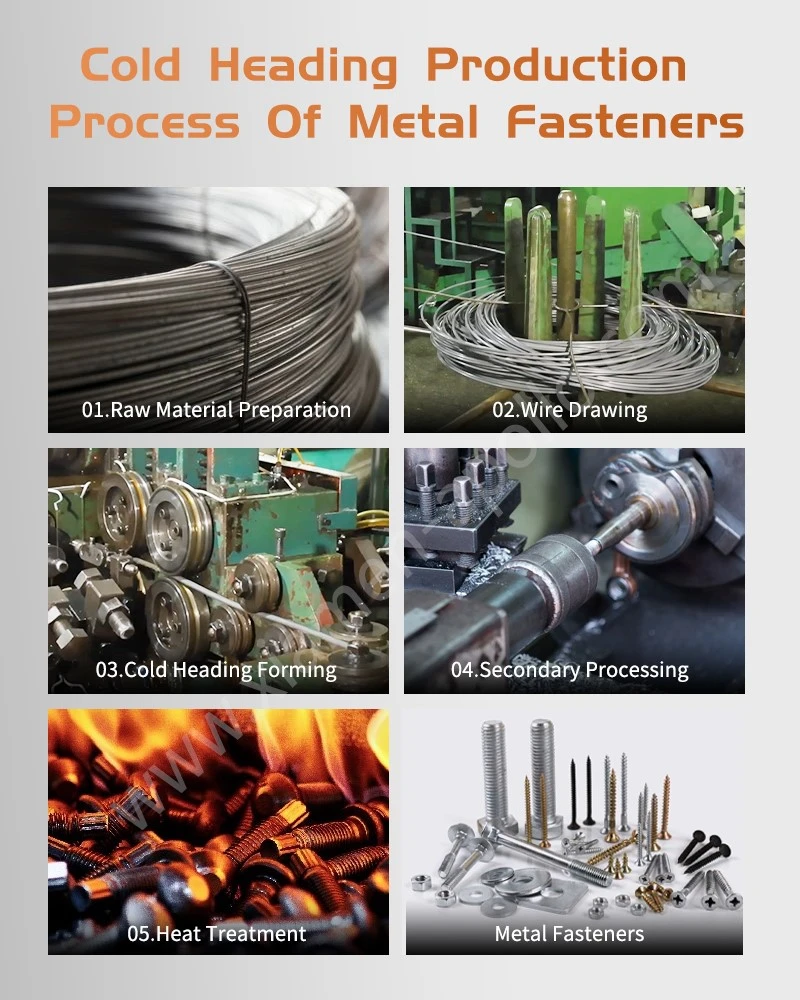
5. Manufacturing Process: These are produced via cold heading followed by thread rolling, with high-speed machinery ensuring consistency in head shape and dimensions.
The heat treatment stage is critical to success. For self-tapping, thread-forming screws, the surface hardness must be calibrated against the hardness of the substrate: the case-hardening depth is increased when the substrate is harder, and controlled (limited) when the substrate is softer, in order to prevent the threads from becoming brittle and fracturing. If the case-hardened layer is too thin, the thread crests will wear down rapidly, causing the fastener to fail after just a single assembly. Conversely, if the case-hardened layer is too deep, the toughness of the core is compromised; under high torque, the fastener may snap off inside the hole, making removal both difficult and costly.
Applications and Advantages
The primary advantage of these fasteners is that they eliminate the need for pre-drilling pilot holes or tapping threads. They are available in a wide range of specifications, accommodating various material thicknesses and load requirements. Their limitation lies in their maximum engagement capacity; if the load exceeds their rated limit, they may loosen or even detach, meaning they are not suitable for every type of connection.
These fasteners feature high hardness and wear resistance, allowing them to be driven directly into soft substrates-such as wood, plastic, or thin copper sheets-where they cut their own matching threads during installation. This simplifies the assembly process and reduces labor time. They are particularly useful for assemblies where the reverse side of the component is inaccessible, a common requirement in furniture manufacturing and electronics assembly. Advancements in materials, combined with specialized surface coatings and heat treatments, have further improved their corrosion resistance and vibration tolerance.
Fasteners designed for wood differ from those intended for metal in terms of thread pitch and thread angle; therefore, they must be selected based on the specific substrate and are not interchangeable. Drilling screws (self-drilling screws) are frequently used with sheet metal and structural profiles; they offer fast drilling speeds and minimal debris, making them ideal for automated assembly lines with fixed cycle times.
- Electrical Industry: Used for securing internal components and wiring within junction boxes, where hole diameters are small and torque requirements are low.
- General Manufacturing: Used for the rapid assembly and disassembly of lightweight materials; in such cases, thread wear resulting from repeated assembly/disassembly is the primary mode of failure.
- Woodworking: The cutting edge penetrates the material, forming threads in situ to join wooden components together.
Self-tapping fastening nails represent a smaller category of these fasteners, typically used for the quick attachment of thin sheets or decorative surface materials. These fasteners have limited tensile strength and are not intended for primary structural load-bearing; they serve primarily for positioning and securing components in place.
For thicker components or applications subject to high loads, a bolt-and-nut combination is a more appropriate choice. These types of fasteners lack a preload reserve; under overload, displacement accumulates incrementally, eventually leading to loosening or detachment-a failure mode that offers no ductile warning signs. While eliminating the tapping process reduces both time and tooling costs, it comes at the expense of a lower upper limit for connection strength; therefore, selection must account for the direction of applied loads.
Applications in Various Settings
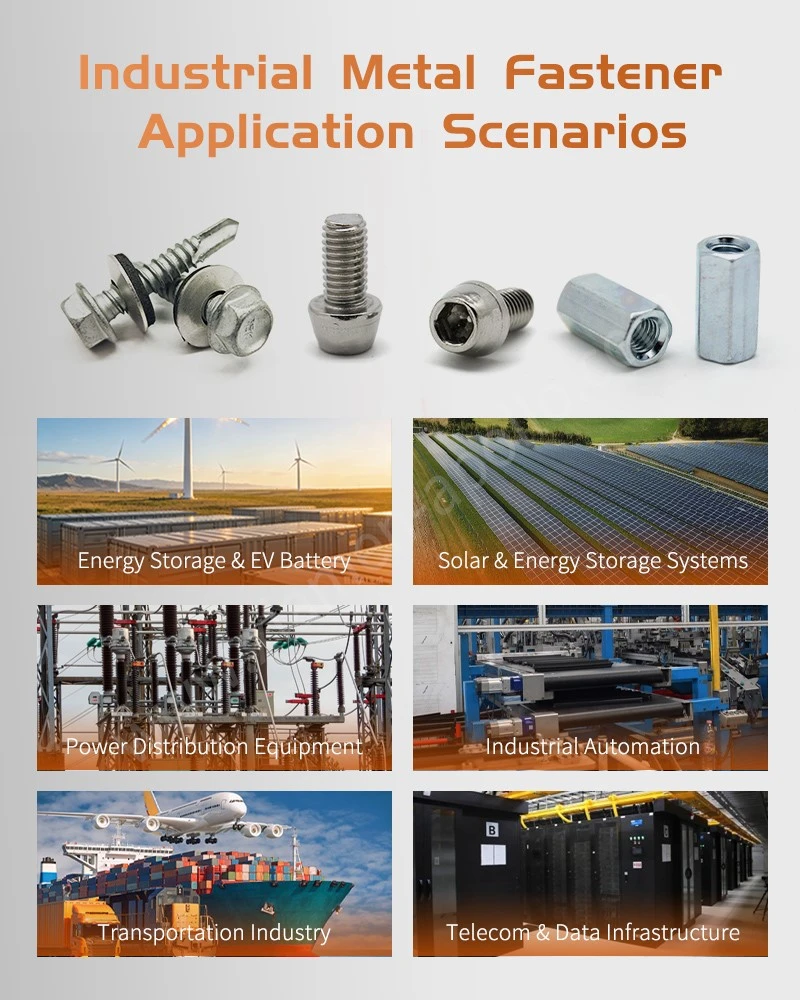
In residential environments, these fasteners are suitable for securing curtain tracks, wall art, shelving units, and cabinetry (such as wardrobes or kitchen cabinets). They are compatible with a wide range of base materials, including wood, plastics, and thin-gauge metals. Countersunk versions allow for concealed installation, balancing structural integrity with aesthetic appeal.
In industrial manufacturing, these fasteners are extensively used in automated production lines, machinery, automotive and electronics assembly, and aerospace components. Certain specialized versions feature applied adhesives or modified thread profiles to provide vibration resistance and anti-loosening properties, ensuring that the tightening torque is maintained even under conditions of vibration or fluctuating temperatures.
In the construction industry, they are used to connect steel structures and panels; when the load is primarily shear-based, they are best paired with washers for added stability. In the electronics and telecommunications sector, miniature versions are employed to secure circuit board components. The primary advantage of self-drilling, self-threading screws in confined spaces is the elimination of the need for pre-drilling, which reduces the number of holes required and minimizes the accumulation of alignment tolerances between layers.
In the aerospace sector, high-wear-resistant, specialized versions are used for the assembly of critical components. These composite-design, self-drilling and self-tapping fasteners are frequently utilized in maintenance and on-site assembly; by performing drilling and thread-forming in a single operation, they reduce the need for tool changes and streamline field-operation workflows.
Industry trends are increasingly driven by environmental regulations, encouraging the use of recyclable raw materials and low-pollution surface treatments. Self-drilling, thread-forming screws utilize a "dry" forming process that generates minimal swarf (metal chips), thereby reducing the need for subsequent cleaning. Furthermore, their high-efficiency fastening capabilities contribute to lower overall material and energy consumption.
Quality control focuses primarily on batch-to-batch consistency. The consistency of auto-tapping screws depends on the control of thread-rolling die wear and the verification of dimensions on the first piece produced. If die wear exceeds tolerance limits, the thread pitch may drift, causing fluctuations in assembly torque. The fit between the screw threads and the hole diameter in the substrate determines the upper limit for tightening torque: an oversized hole results in insufficient torque, while an undersized hole can cause the substrate to crack. Since plastic components are particularly sensitive to stress concentrations, the installation speed and rotational velocity of self-threading fasteners must be carefully controlled to prevent localized temperature increases that could lead to thread seizure (galling). In applications involving thin sheets, self-threading fasteners with pointed tips can create their own holes; they require minimal feed force, making them ideal for use with handheld tools or low-power electric screwdrivers.
These types of fasteners are versatile, serving applications ranging from residential furniture to high-end industrial sectors. The key factors for selection are the substrate material, material thickness, and the applied load. As materials and manufacturing processes continue to evolve, the performance capabilities of these fasteners will continue to expand.
contact us
Should you require samples for testing or technical support for volume production, please contact us. We possess comprehensive capabilities-from mold development to mass production-and can rapidly provide customized self-threading fastener samples.