AgZnO and AgSnO₂ are silver-metal-oxide electrical contact materials used in motor starters to withstand high inrush current, arc erosion and contact welding. Under IEC 60947-4-1 AC-3 and AC-4 operating conditions, where motor starting current can reach 6–8 times the rated current, contact material selection depends on oxide dispersion, electrical conductivity, arc resistance and contact resistance stability. AgSnO₂ is widely used in medium- and high-current switching applications, while AgZnO requires application-specific validation to determine its suitability for repeated starting, inching and plugging operations.
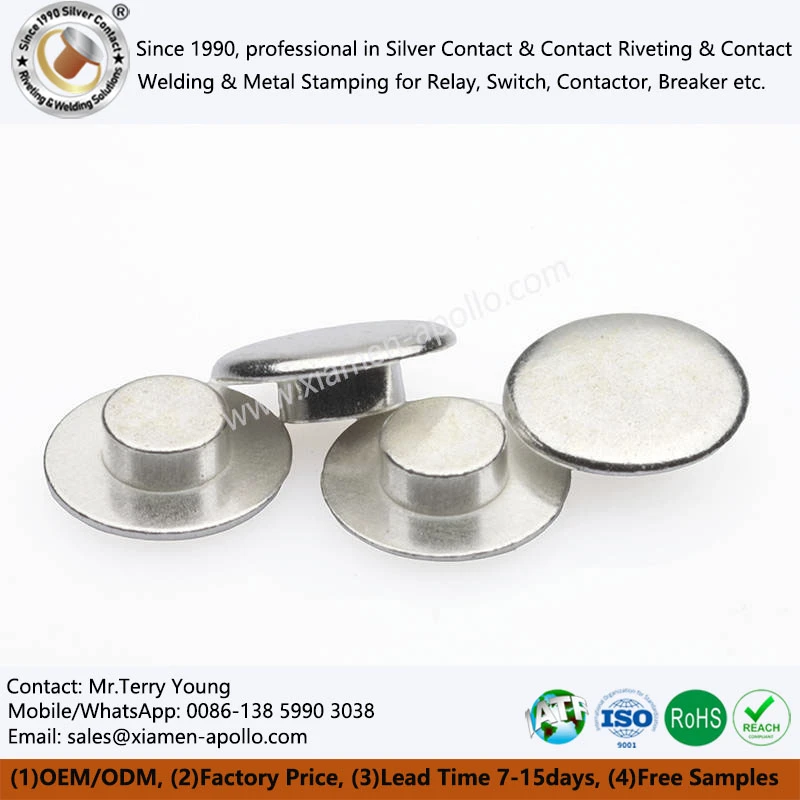
AC-3 and AC-4 Motor Starting: How 6–8× Inrush Current Causes Contact Erosion
AgZnO and AgSnO₂ are silver-metal-oxide contact materials designed to withstand electrical arcing, contact welding and material transfer during switching operations. In AC-3 motor starting, the initial motor current can reach approximately 6–8 times the rated operating current, depending on motor design and starting conditions. During AC-4 inching and plugging operations, repeated current interruption and reconnection create more severe electrical and thermal stress on the contact interface.
The selection of motor starter contact materials must therefore consider more than initial conductivity. Arc duration, contact temperature, oxide distribution, material transfer and resistance to welding determine the contact's service life.
Electrical Stress Under IEC 60947-4-1 AC-3 and AC-4 Conditions
AC-3 and AC-4 represent different switching duties for contactors under IEC 60947-4-1. Their differences directly affect silver contact material selection.
| Parameter | AC-3 Duty | AC-4 Duty |
|---|---|---|
| Typical operation | Starting and switching off a running squirrel-cage motor | Starting, plugging and inching |
| Starting current | Commonly 6–8 × rated motor current | High current during repeated starting and plugging |
| Switching stress | High starting stress, followed by normal running interruption | Repeated high-current interruption and reconnection |
| Arc exposure | Concentrated around starting and opening events | Repeated arc exposure during frequent operations |
| Main contact failure risks | Contact erosion, welding and resistance increase | Accelerated erosion, material transfer and contact welding |
The 6–8× current range is a typical motor-starting reference, not a universal value specified for every AC-3 contactor. Actual current depends on motor characteristics, supply voltage, starting method and load inertia.
Arc Erosion Mechanism During High-Current Interruption
When a contactor opens an energized motor circuit, the separating contacts create an electrical arc. The arc concentrates thermal energy within a small contact area, producing localized temperatures sufficient to melt and vaporize silver and other contact constituents.
Three physical processes contribute to contact degradation:
- Localized melting: High arc temperature produces molten pools on the silver contact surface.
- Material evaporation: Silver and alloy constituents evaporate or are transported through the arc plasma.
- Material transfer: Repeated arc movement causes material migration between the anode and cathode, creating uneven contact surfaces.
These processes change the contact geometry and effective contact area. Surface craters, raised deposits and local material depletion can increase contact resistance and temperature during subsequent switching operations.
Why AC-4 Requires Greater Resistance to Repeated Arc Exposure
In AC-4 applications, plugging and inching operations interrupt current under conditions that produce repeated electrical arcs. Unlike conventional motor starting, these operations do not allow the contact surface to experience only occasional high-energy switching events.
The resulting failure mechanisms include:
- Progressive loss of silver contact material.
- Localized oxide accumulation and surface roughening.
- Contact welding caused by concentrated thermal energy.
- Increased dynamic contact resistance after repeated switching.
- Mechanical instability caused by uneven material loss.
For this reason, selecting an AgZnO electrical contact supplier requires evaluating material composition alongside actual switching duty, contact pressure, opening velocity and electrical endurance test results.
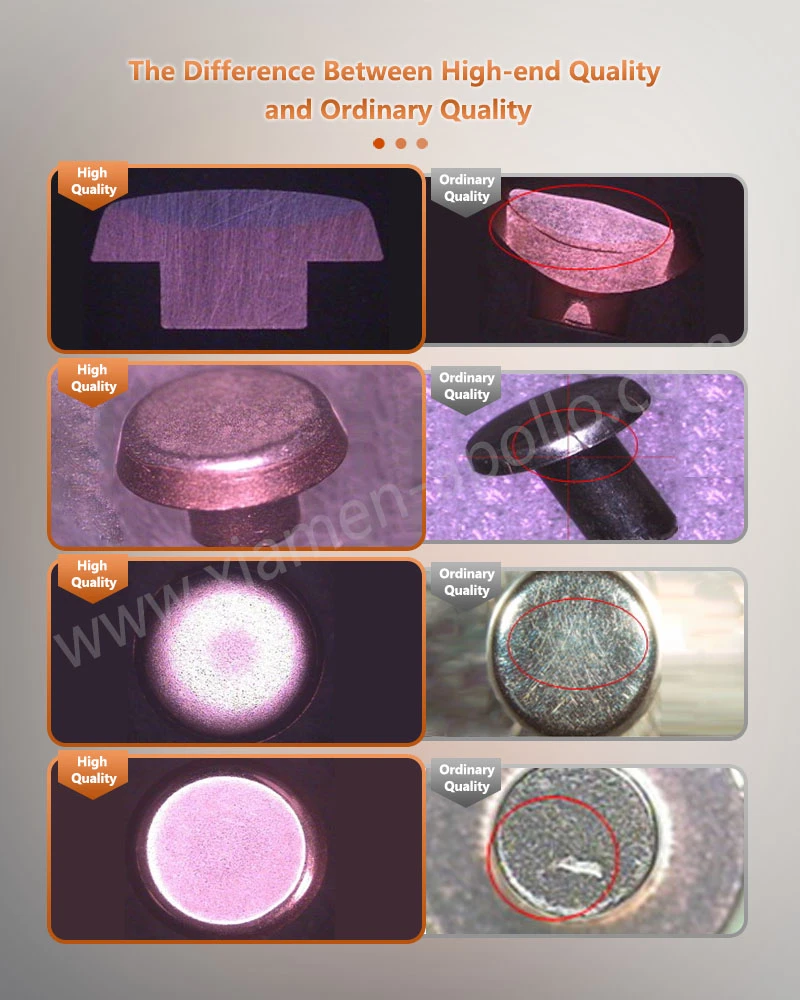
AgZnO vs. AgSnO₂: Oxide Chemistry and Arc-Erosion Behavior
AgZnO and AgSnO₂ both use a silver matrix containing dispersed metal oxides. Their electrical behavior depends on oxide type, concentration, particle size, interfacial bonding and manufacturing density. Although both materials are cadmium-free alternatives for electrical contacts, their performance under high-current switching is not identical.
AgZnO Contact Material: Silver Matrix and Zinc Oxide Dispersion
AgZnO consists of a conductive silver matrix reinforced with zinc oxide (ZnO) particles. The silver phase provides the primary electrical conduction path, while the dispersed oxide phase influences hardness, resistance to welding and arc-induced surface changes.
Its main engineering characteristics include:
- Electrical conductivity: Primarily determined by silver content, oxide fraction and microstructural continuity.
- Mechanical hardness: ZnO particles strengthen the silver matrix and influence resistance to contact deformation.
- Arc response: Arc exposure changes the surface distribution and chemical state of the oxide phase.
- Contact welding: Dispersed oxide particles can reduce direct metal-to-metal bonding, depending on composition and contact conditions.
AgZnO should not automatically be classified as having superior arc endurance. Research on Ag-11 wt%ZnO reports electrical resistivity of approximately \(2.1 \times 10^{-8}\ \Omega \cdot m\) and hardness of 102.8 HV. Comparative research also indicates that AgZnO can exhibit greater arc erosion than AgSnO₂ under surge-current conditions. The actual result depends on the specific material formulation and test circuit.
AgSnO₂ Contact Material: Thermal Stability and Surface Oxide Effects
AgSnO₂ consists of silver and dispersed tin oxide particles. Common nominal compositions include AgSnO₂ 90/10 and AgSnO₂ 88/12, where the figures represent the silver and tin oxide weight percentages.
Its contact behavior is influenced by the following mechanisms:
- Oxide dispersion: SnO₂ particles reinforce the silver matrix and affect surface deformation during switching.
- Arc-induced surface enrichment: Repeated arcing can produce SnO₂-rich regions on the contact surface.
- Contact resistance: Excessive oxide accumulation can reduce effective metallic conduction paths and increase contact voltage drop.
- Welding resistance: The oxide phase helps interrupt continuous metallic bonding between opposing contact surfaces.
The formation of a high-resistance oxide-rich surface layer is an important issue in Agsno2 Silver Alloy Electrical Contact design. Material additives and controlled microstructures can improve oxide distribution and reduce the electrical penalty associated with surface accumulation.
Engineering Comparison: AgZnO vs. AgSnO₂
| Evaluation factor | AgZnO | AgSnO₂ |
|---|---|---|
| Main oxide phase | ZnO | SnO₂ |
| Conductive matrix | Silver | Silver |
| Mechanical strengthening | ZnO particle dispersion | SnO₂ particle dispersion |
| Arc-related behavior | Sensitive to oxide distribution and surge conditions | Good arc resistance in many medium- and high-current applications |
| Surface degradation | Oxide redistribution and material loss | SnO₂-rich surface accumulation and material transfer |
| Main design concern | Arc erosion and welding under the specified duty | Contact resistance and oxide-rich surface layers |
| Material selection | Requires application-specific endurance validation | Requires resistance and temperature-rise validation |
Important engineering distinction: AgZnO is not universally superior to AgSnO₂ for AC-4 motor starters. The choice must be based on actual switching tests, rather than assuming that ZnO decomposition provides a sufficient endothermic cooling effect. Neither oxide chemistry alone nor nominal composition can establish contact endurance.
How to Evaluate the Thermal Response of Silver Metal Oxide Contacts
The thermal response of AgZnO and AgSnO₂ should be evaluated through the complete switching process, not solely through the melting point or decomposition temperature of individual oxides.
Relevant measurements include:
- Arc duration and arc voltage during contact separation.
- Contact surface temperature and temperature-rise distribution.
- Mass loss per switching cycle.
- Contact voltage drop and static contact resistance.
- Surface morphology and oxide distribution after endurance testing.
- Material transfer between the moving and stationary contacts.
A controlled test should record initial contact geometry, contact force, opening speed, electrical load, power factor and switching frequency. Without these variables, comparisons between AgZnO and AgSnO₂ can produce misleading conclusions.
Selecting AgZnO and AgSnO₂ for Frequent Starting and AC-4 Inching Operations
Frequent switching changes the dominant contact failure mechanism. In applications involving motor jogging, reversing and plugging, material selection must prioritize cumulative arc erosion, welding resistance and contact resistance stability rather than initial conductivity alone.
AC-3 Motor Starter: Balancing Conductivity and Arc Resistance
For conventional AC-3 motor starting, the contact material must withstand the initial motor inrush current and subsequent interruption of the running motor.
AgSnO₂ is commonly considered for medium- and high-current switching applications because of its resistance to arc erosion and contact welding. AgZnO can also be evaluated where its specific electrical and mechanical properties meet the application requirements.
The selection process should include:
- Rated operational current Ie and voltage Ue.
- Motor starting current and power factor.
- Contact size and effective contact area.
- Contact spring force and closing velocity.
- Electrical endurance under the declared AC-3 duty.
A material with higher initial conductivity does not necessarily provide longer electrical life. Contact erosion and surface condition after repeated interruption must be included in the evaluation.
AC-4 Motor Starter: Repeated Arcing and Material Transfer
AC-4 covers starting, plugging and inching of squirrel-cage motors under IEC 60947-4-1. These operations impose repeated electrical and thermal loads on the contact interface.
For AC-4 service, engineers should pay particular attention to:
- Arc erosion rate: Measure cumulative contact mass loss after a defined number of switching cycles.
- Welding tendency: Record contact sticking and the force required to separate welded contacts.
- Surface stability: Examine crater depth, raised deposits and oxide accumulation.
- Contact resistance: Monitor resistance changes throughout electrical endurance testing.
- Thermal behavior: Record contact temperature rise at the specified operating current.
Neither AgZnO nor AgSnO₂ should be selected solely based on oxide decomposition or theoretical arc-quenching properties. A complete contactor test is necessary to establish suitability for repeated AC-4 operation.
Material Selection by Operating Duty
| Application condition | Primary engineering requirement | Recommended evaluation |
|---|---|---|
| Standard AC-3 starting | Conductivity and resistance to arc erosion | AgSnO₂ and AgZnO comparative endurance |
| Frequent AC-3 switching | Stable contact resistance and low material loss | Resistance and mass-loss tracking |
| AC-4 inching | Resistance to repeated arc exposure | Full AC-4 electrical endurance |
| AC-4 plugging | Welding resistance and thermal stability | Contact sticking and temperature-rise tests |
| High-frequency operation | Consistent surface condition and contact force | Dynamic resistance and cycle-life testing |
The table provides an engineering evaluation framework, not a universal material ranking. Final selection depends on rated current, voltage, power factor, contact geometry and required electrical life.
Consult Our Electrical Engineers Today
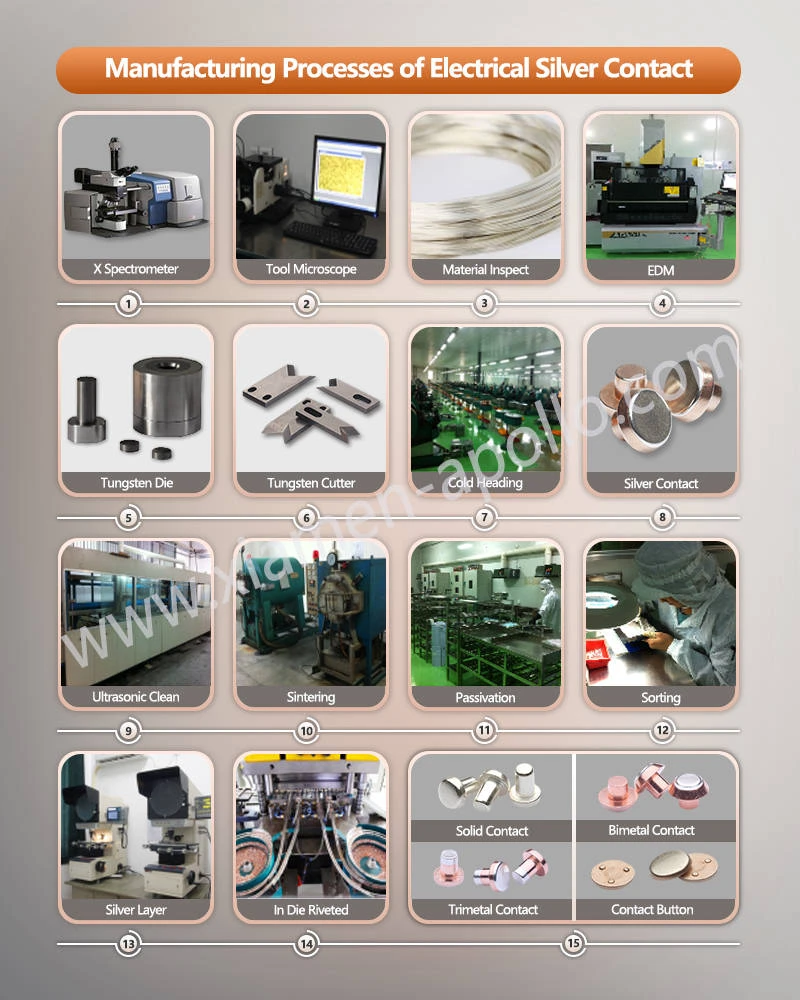
Powder Metallurgy and Cold Heading: Controlling Oxide Dispersion in Silver Contacts
The electrical performance of AgZnO and AgSnO₂ depends not only on chemical composition but also on the distribution of oxide particles within the silver matrix. Powder metallurgy, extrusion and subsequent contact forming operations determine material density, interfacial bonding and the consistency of the finished contact.
Powder Metallurgy: Controlling ZnO and SnO₂ Particle Distribution
Powder metallurgy provides a manufacturing route for producing silver-metal-oxide contact materials with controlled oxide content.
Key manufacturing variables include:
- Powder particle size: Differences in silver and oxide particle sizes can cause segregation during mixing and forming.
- Mixing uniformity: Insufficient dispersion produces oxide-rich and silver-rich regions.
- Compaction pressure: Inadequate compaction leaves residual porosity and weak interparticle bonding.
- Sintering conditions: Temperature and holding time affect densification and the silver-oxide interface.
- Extrusion parameters: Deformation conditions influence material continuity and the distribution of the dispersed oxide phase.
For silver contact materials, residual pores can reduce the effective conducting cross-section and create localized thermal concentration during switching.
Extrusion and Densification: Reducing Internal Defects
After powder preparation and sintering, extrusion can improve material consolidation and produce stock suitable for subsequent contact manufacturing.
The process should control:
- Material density and residual porosity.
- Oxide distribution along the extrusion direction.
- Surface cracking and internal discontinuities.
- Dimensional consistency of the extruded stock.
- Microstructural stability between production batches.
Metallographic examination, SEM/EDS analysis and density measurement can be used to verify the resulting microstructure.
Cold Heading: Maintaining Silver Contact Geometry
Cold heading converts prepared silver-metal-oxide stock into contact components with specified head diameter, thickness and shank geometry.
The principal process variables include:
- Blank diameter and cutting accuracy.
- Forming pressure and deformation ratio.
- Die alignment and punch concentricity.
- Lubrication and tool surface condition.
- Finished head dimensions and surface integrity.
Excessive deformation or poor tooling alignment can introduce cracks, dimensional variation and localized structural defects. For AgZnO and AgSnO₂, the forming process must preserve the integrity of the oxide-reinforced silver structure.
Manufacturing Quality Control and IATF 16949 Traceability
A qualified silver contact manufacturing process should establish measurable inspection points throughout material preparation, forming and final inspection.
| Manufacturing stage | Quality control item | Verification method |
|---|---|---|
| Raw material | Silver purity and oxide composition | Supplier certificates and chemical analysis |
| Powder preparation | Particle size and mixing uniformity | Particle analysis and SEM/EDS |
| Sintering and extrusion | Density and internal porosity | Density measurement and metallography |
| Cold heading | Head dimensions and surface defects | Optical measurement and visual inspection |
| Finished contact | Hardness and microstructure | Micro-hardness and metallographic analysis |
| Electrical validation | Contact resistance and arc endurance | Electrical switching test |
For OEM and ODM procurement, material traceability should connect raw-material batches, production parameters, inspection records and finished-product identification. IATF 16949 quality-management requirements can provide a framework for process control where applicable to the customer's automotive supply chain.
Frequently Asked Questions
Q1. How can buyers verify the ZnO or SnO₂ content in silver electrical contacts?
Buyers can request material composition certificates and independent chemical analysis. SEM/EDS can identify the distribution of ZnO or SnO₂-related elements, while quantitative chemical analysis should be used to verify the specified oxide concentration.
Q2. Which is better for AC-4 motor starters, AgZnO or AgSnO₂?
Neither material is universally superior. AgSnO₂ has established use in medium- and high-current switching, while AgZnO requires application-specific evaluation. The final choice should be confirmed through AC-4 endurance, contact resistance and welding tests.
Q3. What information is required to request an OEM silver contact quotation?
Provide the contact drawing, AgZnO or AgSnO₂ composition, dimensions, rated current, operating voltage, switching category, annual demand and required inspection standards. These details allow the manufacturer to evaluate tooling, material processing and production feasibility.
contact us
Send your AgZnO or AgSnO₂ contact drawings, material specifications and AC-3/AC-4 operating requirements now. Request a manufacturing feasibility assessment and production quotation before finalizing your motor starter contact design.