Relay performance, load‑carrying capacity, and operational lifespan depend directly on the structural integrity and surface micro‑geometry of the Silver Contact Riveted with Copper Terminal. Operating within smart grids, electric vehicles (EV/HVDC), and industrial automation infrastructure, these bimetal components manage high‑voltage circuit making and breaking under severe thermal and mechanical stress. Achieving low contact resistance (≤ 0.5 mΩ) and high arc erosion resistance requires stringent micron‑level control during cold heading, riveting, and edge finishing.
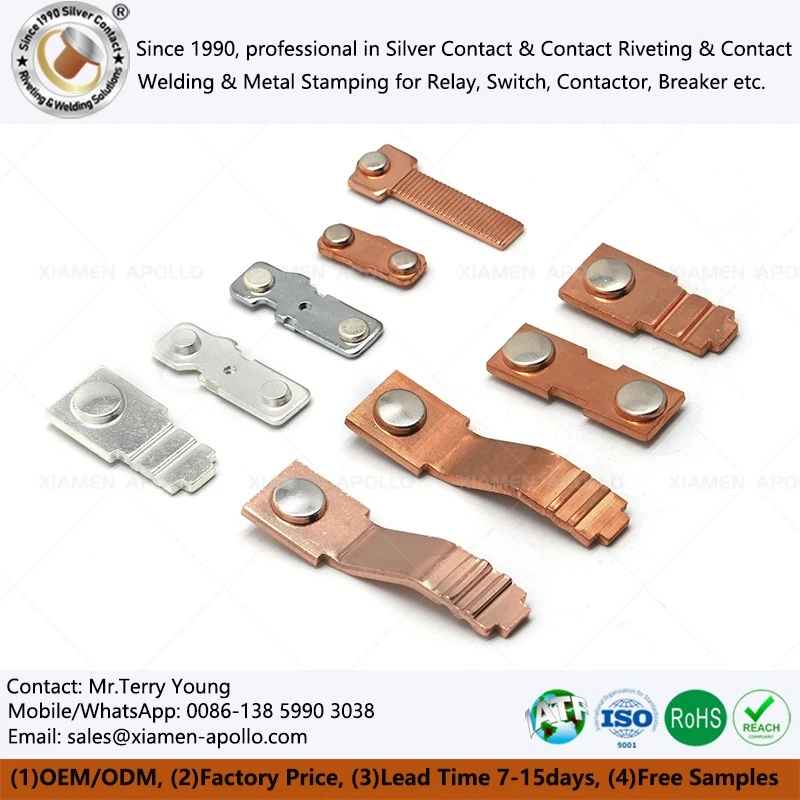
Why the Silver Contact Riveted Copper Assemblies Dictate Relay Reliability
The electrical make‑break action relies entirely on the interface between the copper substrate and the precious metal contact tip. The copper terminal provides mechanical support and high thermal‑electrical conductivity, while the silver‑based contact layer withstands continuous arcing and prevents oxidation.
Micro‑defects in the Electrical Riveted Contact Sub‑Assemblies lead to catastrophic field failures:
- Edge Burrs and Sharp Corners: Unprocessed burrs create localized electric field concentrations. During high‑voltage switching, these points initiate high‑intensity arcs, resulting in contact welding, material erosion, and terminal deformation.
- High Interfacial Contact Resistance: Poor mechanical co‑planarity and high surface roughness (Ra > 1.6 μm) restrict the actual current‑carrying contact area, accelerating Joule heating, thermal runaway, and copper oxidation.
- Non‑Standard Chamfering: Irregular edge profiles cause mechanical binding, misalignment, and micro‑vibrations during actuation, accelerating mechanical wear over millions of switching cycles.
Micron‑level deburring, controlled chamfering, and mirror polishing are mandatory to eliminate electrical stress concentrations and extend mechanical endurance beyond 10⁷ cycles under IEC 60947 compliance.
Consult Our Electrical Engineers Today
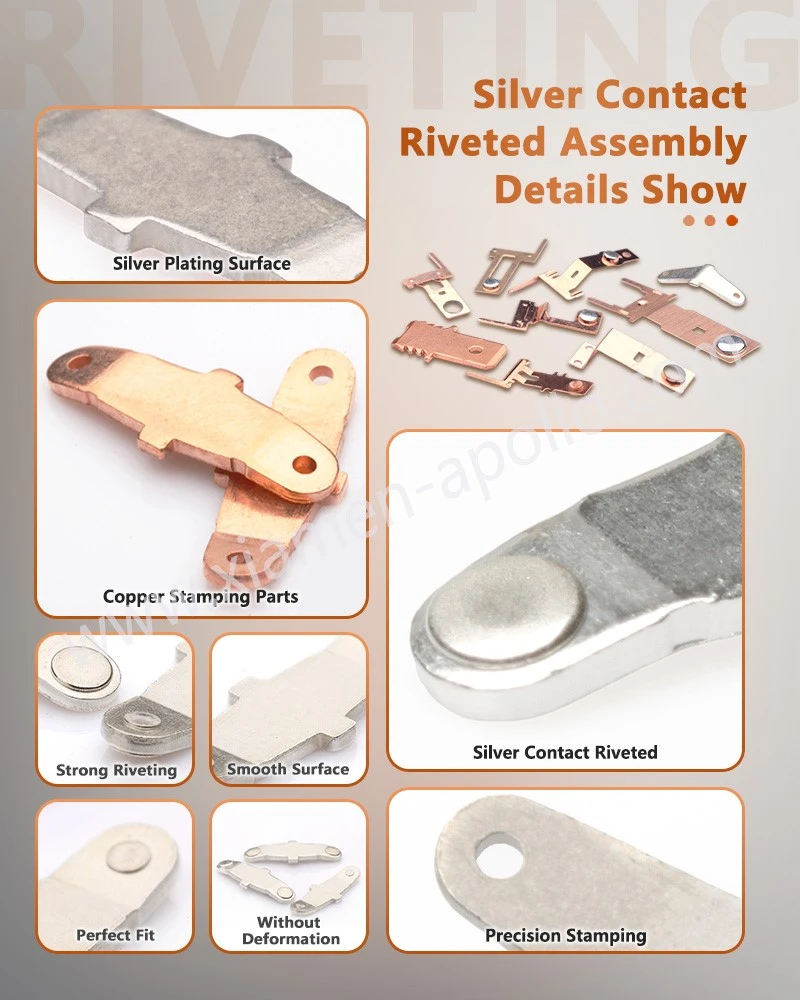
Differentiated Micro‑Finishing Processes for Silver Bimetal Rivet Stamping Part
Because the Copper Carrier Riveted Silver Contact Assemblies combine dissimilar metals-soft precious metal contact tips and ductile copper alloys-fabrication requires material‑specific finishing to preserve the mechanical bond strength of the cold‑headed rivet.
Material Comparison and Processing Parameters
| Component Layer | Primary Material Options | Typical Hardness | Core Processing Method | Key Quality Metric |
|---|---|---|---|---|
| Copper Terminal | C1100, C2680, C5190 | 80–120 HV | Centrifugal vibratory finishing & electrolytic polishing | Deburred edges, Ra ≤ 0.4 μm |
| Pure Silver Contact | AgFine, Ag99.9 | 45–70 HV | Chemical‑mechanical soft polishing & ultrasonic cleaning | Zero micro‑scratch, clean interface |
| Alloy Silver Contact | AgSnO₂In₂O₃, AgNi10, AgCdO | 90–150 HV | Pulsed laser micro‑machining & plasma etching | Enhanced arc erosion resistance |
Copper Terminal Precision Treatment
Copper terminals (brass, oxygen‑free copper, phosphor bronze) form the conductive structural skeleton. Stamping and riveting produce ductile burrs along the shear edges.
Utilizing low‑abrasion ceramic media in centrifugal disc finishing removes edge burrs without altering critical dimensional tolerances (± 0.005 mm).
Electrolytic polishing generates a passive protective oxide layer, enhancing corrosion resistance in accordance with ASTM B117 salt spray standards.
Pure Silver and Alloy Contact Refinement
Pure silver tips require gentle chemical‑mechanical polishing to smooth microscopic surface asperities without reducing the minimum silver layer thickness (≥ 0.3 mm). For heavy‑duty industrial relays utilizing AgSnO₂ (such as AgSnO₂In₂O₃ 88/12) or AgNi10 alloys, non‑contact laser ablation and plasma surface activation eliminate mechanical deformation while optimizing the metallurgical bond interface.
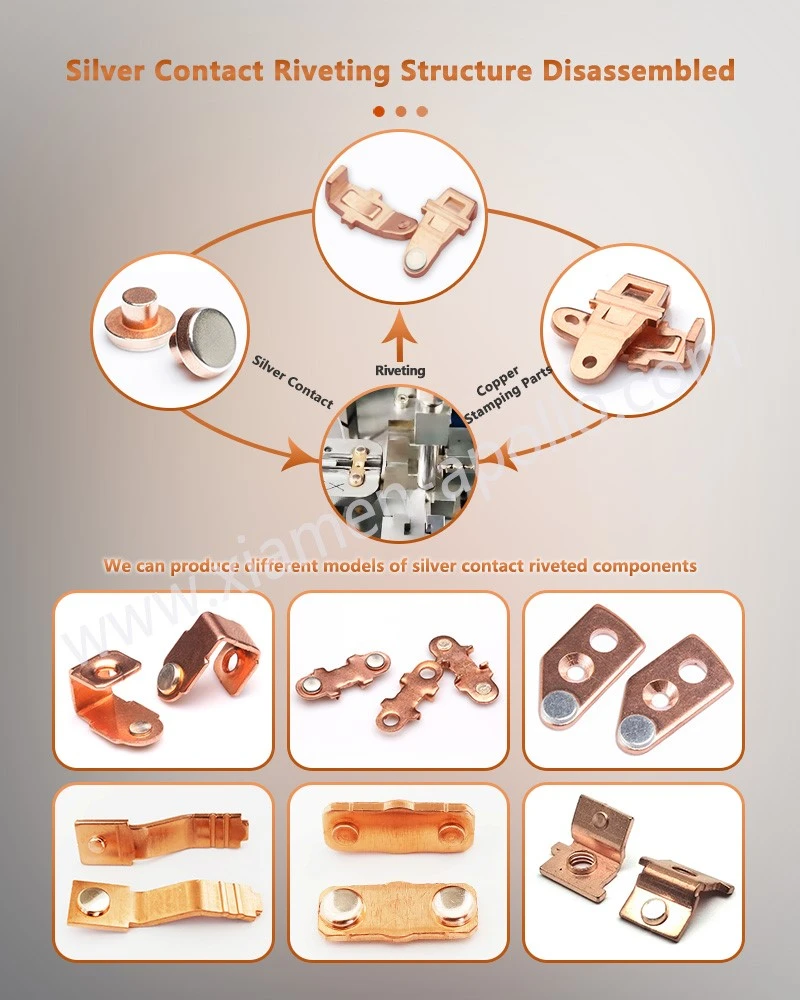
Systematic Quality Control and Process Verification of Copper Contact Element
Optimizing the Silver Alloy Contact Riveting Parts requires an integrated reliability framework covering finite element analysis (FEA), automated inline inspection, and rigorous laboratory testing.
- Simulation and Design: FEA models simulate thermal‑electrical coupling during high‑current surges, optimizing rivet shank diameter and contact crown radius to mitigate mechanical stress fatigue.
- Automated Inline Vision: High‑resolution machine vision systems inspect 100% of production output, detecting micro‑cracks, positional offset, and plating anomalies before assembly packaging.
- Destructive & Nondestructive Testing: Batches undergo shear strength testing (≥ 150 MPa), dynamic contact resistance measurement, and temperature rise verification under IATF 16949 quality management protocols.

Frequently Asked Questions about Silver Contact Riveted Copper Stamping Parts
How is the bond strength verified between the silver contact and the copper terminal?
Bond strength is verified using destructive push‑out and shear testing fixtures. Per internal quality standards, the minimum acceptable shear strength across the rivet interface is ≥ 150 MPa, ensuring the joint withstands severe mechanical shock and vibration without delamination.
What is the standard lead time for custom bimetal rivet prototypes?
Standard prototype samples utilizing existing tooling configurations are dispatched within 7 to 10 business days. Custom progressive die tooling and specialized alloy formulations typically require 15 to 25 business days, backed by full material test reports (MTR) and RoHS/REACH compliance documentation.
Can your facility provide full material traceability under IATF 16949 standards?
Yes. Every production batch of the Copper Stamping With Riveted Silver Contact is fully traceable from raw material ingot (e.g., certified fine silver and electrolytic copper cathodes) through stamping, cold heading, and final packaging, supported by complete lot numbering and digital inspection archives.
contact us
Ready to upgrade your relay architecture with high‑reliability electrical components? Please contact our engineering team to discuss custom material requirements, request official material test reports, or arrange for sample evaluations of Silver Contact Riveted with Copper Terminals.