

Definition and working principle
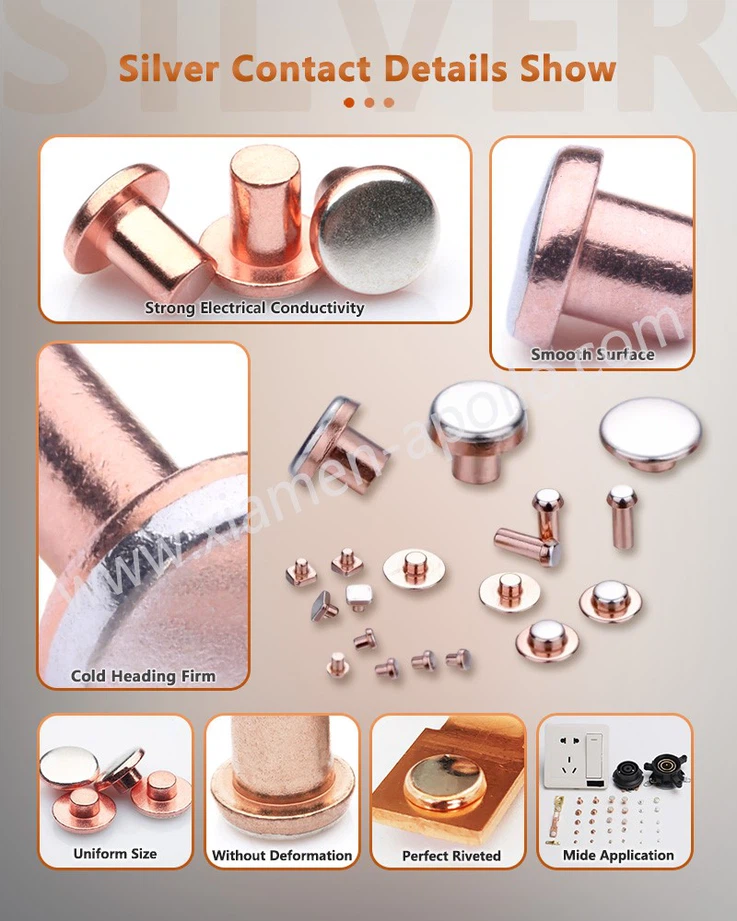
Silver contact is a key component used to connect and disconnect current in a circuit. It is usually installed in the contact system of electrical appliances such as relays, contactors, and circuit breakers. Its working principle is to use the excellent electrical conductivity and thermal conductivity of silver or silver alloy materials. When the circuit is closed, the silver contacts contact each other to form a conductive path, allowing the current to pass smoothly; when the circuit is disconnected, the Solid Silver contacts separate and cut off the current flow path, thereby realizing the control and protection function of the circuit.

Classification
Classification by material composition:
1. Pure silver contact: It has the highest electrical conductivity and thermal conductivity, as well as very low contact resistance. It is easy to process and weld. It is often used in small-capacity low-voltage electrical appliances, such as automatic switches, thermal relays, computers, etc.
2. Silver alloy contact: Other elements such as nickel, cadmium oxide, and tin oxide are added to silver to form an alloy to improve the performance of the contact. For example, silver nickel contacts have good electrical and thermal conductivity, low and stable contact resistance, small and uniform electrical erosion, and are suitable for thermostats, protection switches, low current contactors, automatic switches, precision instruments, relays, etc.; silver cadmium oxide contacts are widely used in various contactors, molded case air switches, leakage switches, etc.; silver tin oxide contacts are environmentally friendly and non-toxic, with excellent resistance to welding and arc erosion, and are widely used in medium and large capacity AC and DC contactors, AC and DC power relays, etc.
3. Classification by shape: There are wire, sheet, granular, rivet, etc. Different shapes are suitable for different electrical products and installation methods.
4. Classification by use: It can be divided into relay silver contacts, contactor silver contacts, circuit breaker silver contacts, switch silver contacts, etc. Various types of silver contacts play a key role in different electrical equipment.

Material selection and performance requirements
High electrical and thermal conductivity: Silver has excellent electrical and thermal conductivity, which can effectively reduce the contact resistance and temperature rise of the contacts, reduce energy loss, and improve the efficiency and reliability of electrical appliances.
Good wear resistance: During the frequent on-off process of the circuit, the contacts will generate arcs and thermal shocks, resulting in wear and erosion of the material. electrical spring contacts need to have good wear resistance to maintain stable contact performance and long service life.
Corrosion resistance: In some harsh working environments, such as humidity, high temperature, corrosive gases, etc., electrical contact switches are easily corroded and affect performance. Therefore, it is necessary to select silver alloy materials with corrosion resistance or surface treatment of silver contacts, such as nickel plating, silver plating, etc., to improve their corrosion resistance.
Appropriate mechanical strength: Contacts need to withstand certain mechanical stresses in electrical equipment, such as vibration, impact, contact pressure, etc. Silver contacts for Relay materials should have appropriate mechanical strength to ensure that deformation, breakage, and other problems will not occur during use.

Production process
Smelting and casting: After silver and the required alloy elements are mixed in a certain proportion, they are melted at high temperatures, and then the molten alloy liquid is cast into the required shape, such as contact blanks or semi-finished products.
Wire drawing and stamping: For linear or sheet silver contacts, the ingot needs to be drawn or rolled to achieve the required size and shape. After that, contact parts of various shapes are made through stamping and other processing techniques.
Sintering and welding: In the production process of some Bimetal Silver Contacts, the silver powder needs to be mixed with other material powders and sintered to form silver contact materials with special properties. In addition, silver contacts can be connected with other parts by welding to improve the integrity and reliability of the product.
Surface treatment: In order to improve the performance and life of Bimetal Contact Rivets, the contact surface is usually treated, such as cleaning, polishing, plating, etc. The plating can be electroplated or chemically plated to form a protective film on the surface of the silver contact to prevent oxidation and corrosion, and at the same time improve the conductivity and wear resistance of the contact.

Application field
Household appliances: Various switches, relays, contactors, and other components such as refrigerators, washing machines, air conditioners, microwave ovens, etc., all use Bimetal Rivet Contacts to achieve circuit control and protection.
Industrial electrical equipment: In industrial electrical systems such as motors, transformers, and power transmission and distribution equipment, State Contact Rivets are indispensable key components used to control the start, stop, speed regulation, and other operations of the equipment to ensure the normal operation of industrial production.
Electronic information equipment: Relays, connectors, and other components in electronic products such as computers, servers, and communication equipment require the use of high-performance Electrical Fixed Contacts to ensure fast and accurate signal transmission and stable operation of the equipment.
Automotive electronics: With the continuous improvement of the degree of automotive electronics, various electronic control systems in automobiles, such as engine control units, body electronic control systems, and airbag systems, use a large number of Movable Contact Rivets to achieve circuit connection and control.
Medical devices: In some medical devices with high requirements for precision and reliability, such as pacemakers, defibrillators, and medical monitors, Electrical Contacts for Photovoltaic Relays are used for circuit connection in key parts to ensure the normal operation of the equipment and the safety of patients.

Market status and development trends
Market status: The global silver contact market is large, and with the continuous development of the electronic and electrical industry, its market demand continues to grow. At present, there are many kinds of Fixed Silver Contact for Solar Power Relay products on the market, and there are certain differences in quality and performance between products of different manufacturers. Some well-known foreign brands occupy a certain share in the high-end market, while domestic enterprises have strong competitiveness in the mid-and low-end markets, and continue to increase R&D investment, improve product quality and performance, and gradually enter the high-end market.
Development trend: With the continuous advancement of science and technology, the silver contact industry presents the following development trends:
1. High performance: To meet the requirements of high performance, miniaturization, and high reliability in electronic equipment, Bimetal Rivet for PV Inverter Relay materials will continue to develop in the direction of high performance, such as developing silver alloy materials with higher conductivity, wear resistance, corrosion resistance, and arc erosion resistance.
2. Green environmental protection: In the context of increasingly stringent environmental protection policies, environmentally friendly silver contact materials such as cadmium-free and lead-free will become the mainstream direction of future development. For example, silver tin oxide contacts will gradually replace silver cadmium oxide contacts in some fields due to their environmentally friendly and non-toxic characteristics.
3. Miniaturization and Integration: As electronic products continue to undergo miniaturization and integration, Moving Contact for PCB Photovoltaic PV Relays will also evolve in the same direction. This requires higher performance and reliability in a smaller size and puts higher requirements on the manufacturing process and material properties of silver contacts.
4. Intelligent and Automated Production: The use of advanced intelligent production and testing equipment to improve the production efficiency and quality stability of Bullet Type Solid Copper Contacts and reduce production costs is an inevitable trend for the future development of the silver contact industry.
contact us
