

In the electrical and power control fields, Solid Silver Contacts are not only "bridges" for current but also key components determining equipment reliability, lifespan, and energy efficiency. Their performance depends not only on material composition but also on their structural form, geometry, surface condition, and manufacturing process. As high-end applications such as Silver contacts for Relays and Silver contacts for MCCBs place higher demands on miniaturization, high load capacity, and long lifespan, the structural design of Silver Alloy Rivets has shifted from experience-based to system-engineered matching.
Currently, mainstream Pure Silver Contacts can be categorized into three main structural types based on their connection method: riveted, welded, and embedded. Riveted structures firmly bond Silver Solid Contact Rivets to a copper substrate through mechanical cold forging or hot pressing. Widely used in Silver contacts for Switches and Relays, their advantages include high connection strength, good vibration resistance, and the elimination of additional welding processes, making them suitable for automated mass production. Welded types are mostly used in applications with extremely high requirements for electrical continuity, such as high-current Silver contacts for breakers. They achieve a metallurgical bond between the silver layer and the substrate through brazing or resistance welding, ensuring low contact resistance and high thermal conductivity. Embedded structures are commonly found in precision control modules. Through precision stamping or in-mold embedding processes, tiny Silver Alloy Contacts are precisely positioned in specific locations to meet high-density deployment requirements.
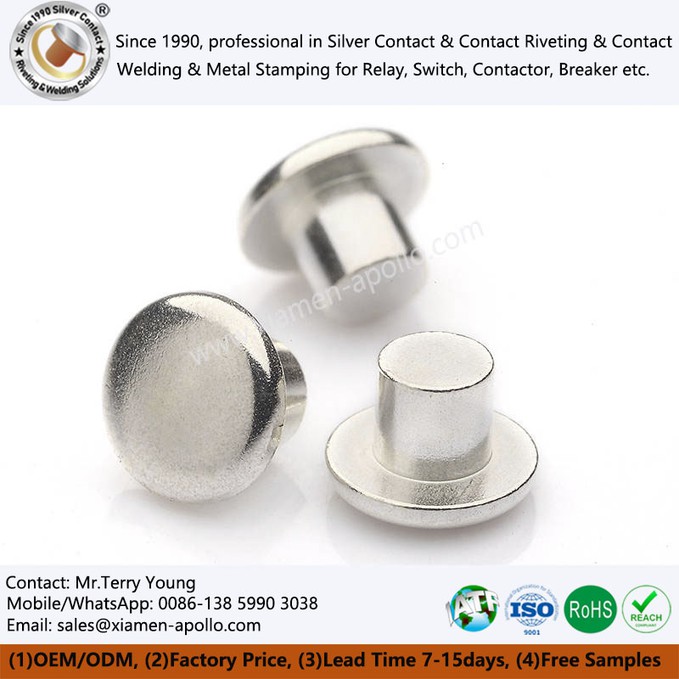
In terms of geometry, circular solid silver contacts dominate the market due to their uniform stress distribution and ease of manufacturing, making them particularly suitable for frequent switching applications like Silver Nickel contacts and Silver Tin Oxide contacts. Square or rectangular silver contacts are often used in static connection scenarios requiring increased contact area; triangular or other irregularly shaped structures serve special arc guiding or heat dissipation designs and are commonly found in high-breaking-capacity circuit breaker products.
The choice of size and thickness directly relates to electrical load capacity. Small-sized (1–2 mm diameter, 0.3–0.6 mm thickness) pure silver solid contacts are often used in signal relays or miniature switches, emphasizing low contact resistance and fast response; while large-sized (3–5 mm diameter, 0.8–1.2 mm thickness) Silver tin oxide solid contacts or Silver cadmium oxide solid contacts are used in industrial-grade MCCBs or contactors to withstand continuous currents of hundreds of amperes and short-circuit surges. Thicker alloy silver contacts not only improve current carrying capacity but also delay material loss caused by arc erosion, extending service life.
The material system and structure need to be optimized synergistically. For example, silver alloys such as Ag-Ni and Ag-SnO₂, while harder than pure silver, are also more brittle. Therefore, stamping speed and pressure must be controlled in riveted structures to prevent cracking. While soft, pure electrical contacts facilitate tight contact interfaces, they require a suitable elastic support structure (such as springs or elastic supports) to maintain stable contact pressure and reduce contact resistance.
Surface treatment is crucial for improving the environmental adaptability of silver contact points. Although silver itself has good chemical stability, it can still form silver sulfide films in sulfur-containing, humid, or industrially polluted environments, leading to increased contact resistance. Therefore, nickel plating is often used on the edges or non-working surfaces of silver electrical contacts to prevent substrate oxidation and silver migration; tin plating is mainly used for components requiring subsequent soldering to improve solderability and wettability. It is worth noting that the working surface is usually left bare silver to ensure optimal conductivity.
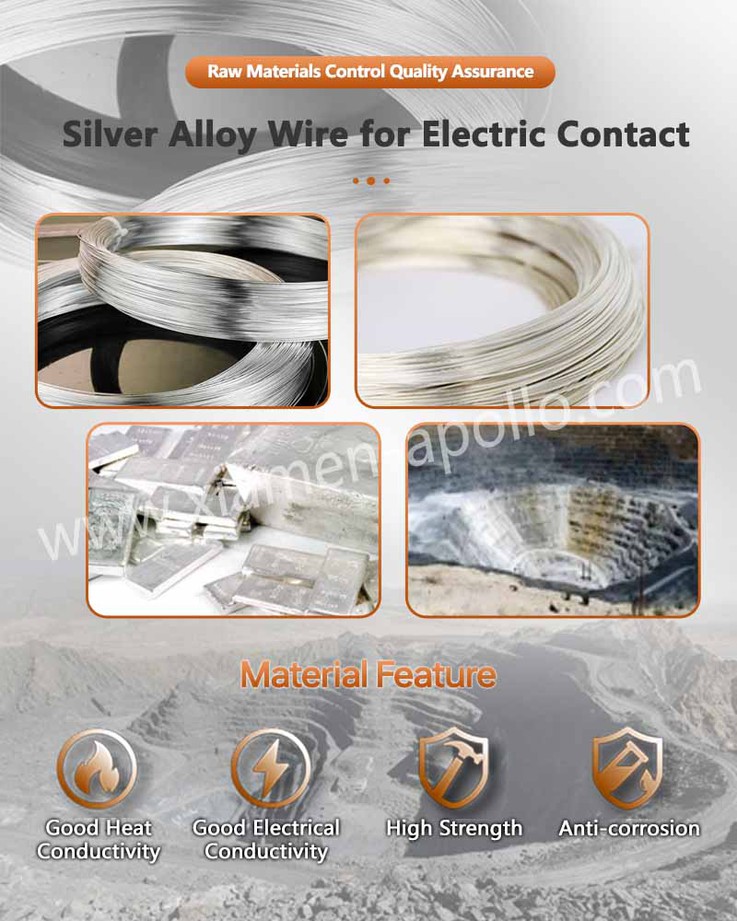
Thermal stability and corrosion resistance are equally important. In high-temperature conditions (such as electric vehicle charging contacts), new environmentally friendly materials like Silver zinc oxide solid contact are gradually replacing traditional cadmium-containing products due to their excellent thermal stability. In coastal or chemical-industrial areas, solid contacts require higher corrosion resistance, often achieved through material densification or composite coating techniques.
The manufacturing process has a profound impact on the final performance. Advanced cold heading, powder metallurgy, internal oxidation, and precision stamping technologies ensure uniform microstructure and strong interfacial bonding in composite materials such as Silver Cadmium Oxide Contact. While traditional casting or simple pressing processes are lower in cost, they are insufficient for high-reliability applications.
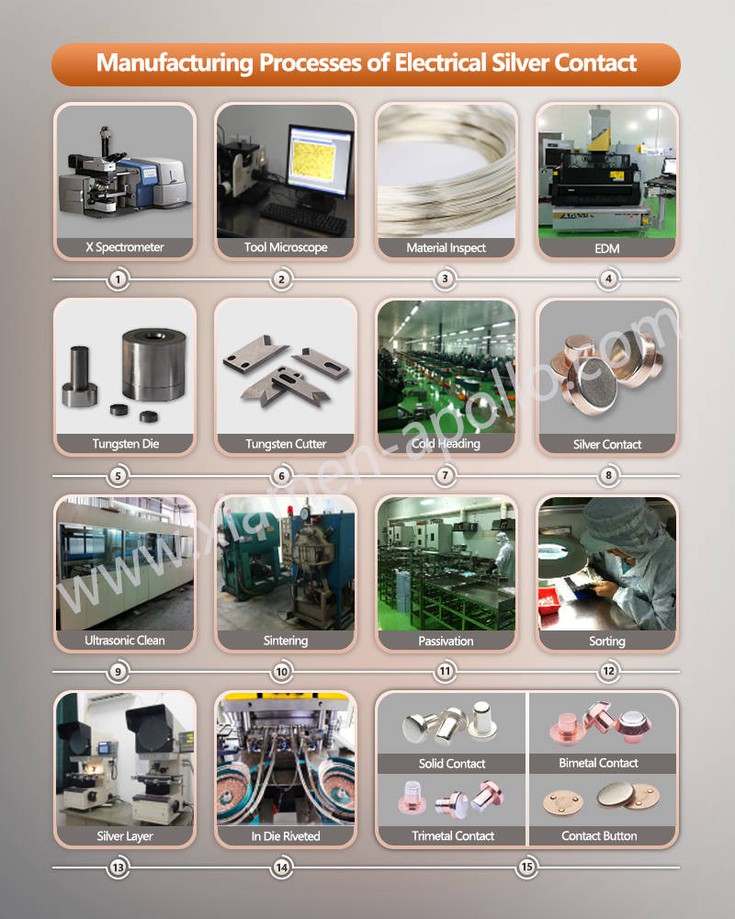
In conclusion, the structural design of Silver electrical contacts is a comprehensive technology integrating materials science, mechanical engineering, and electrical properties. Whether for high-current breaking in Silver contacts for MCCBs or high-frequency switching in Silver contacts for relays, only by rationally matching the structural form, material system, and process path according to load characteristics, environmental conditions, and assembly methods can the performance potential of Silver electrical contacts be truly realized, ensuring the safe and efficient operation of the electrical system.
contact us
If you would like to learn more about the selection criteria or failure analysis methods for different structural electrical contacts in specific electrical appliances, please feel free to contact us.
