

In modern home appliance systems, the thermostat, as one of the core control components, plays a crucial role in regulating temperature, controlling the compressor's start and stop, and maintaining stable system operation. Especially in refrigerators, the thermostat's performance directly affects cooling efficiency and energy consumption. Structurally, the thermostat typically contains critical silver electrical contacts. These highly conductive contacts ensure stable circuit connection during frequent switching, which is fundamental to achieving precise temperature control.
From a classification perspective, thermostats can be mainly divided into three categories: expansion thermostats, mechanical thermostats, and electronic thermostats. Expansion thermostats rely on the principle of thermal expansion and contraction of materials for control, such as a bimetallic strip structure. They typically incorporate highly reliable silver contacts to ensure electrical stability during frequent operation. Mechanical thermostats, on the other hand, drive contact action through pressure changes. Their structure is relatively simple but highly reliable, and they are widely used in traditional refrigerator products.
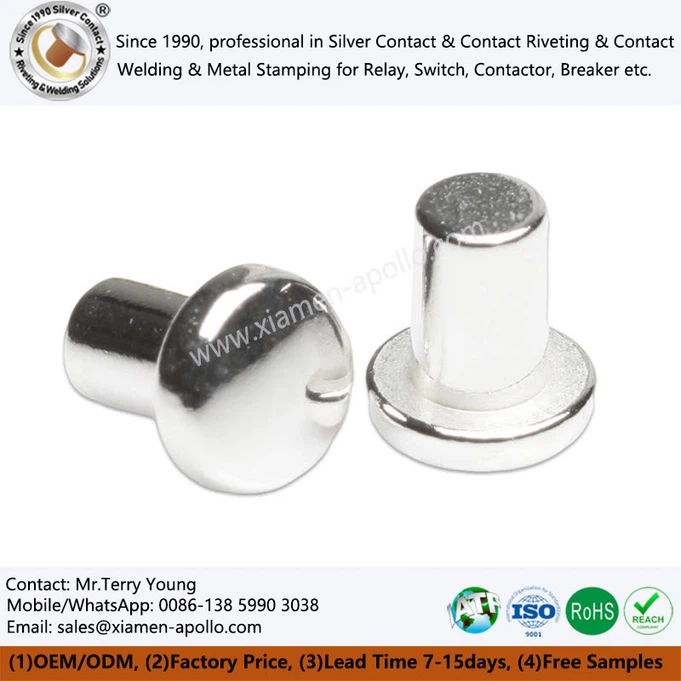
In mechanical thermostats, vapor pressure and gas adsorption types are typical examples. These thermostats drive the opening and closing of contacts through changes in the pressure of the medium within the sensing tube; their core strength lies in the stability of the contact system. Silver alloy contacts or alloy silver contacts are typically used to enhance arc resistance and oxidation resistance, thereby extending service life and improving control accuracy.
Electronic thermostats represent the current trend. Their core is based on a temperature sensor and circuit control module for precise adjustment. Common temperature sensing elements include thermistors, platinum resistance thermometers, and thermocouples. In the circuit control section, relays or semiconductor devices are responsible for performing the switching action, and the relays still rely on silver contact points to achieve highly reliable electrical connections, ensuring stable system operation.
In refrigerator applications, temperature control systems can be categorized into several types based on their structure and control methods. Single-temperature, single-control systems are often used in single-door refrigerators, controlling the compressor's start and stop with a single thermostat. In these systems, the contact switching frequency is high; therefore, solid silver contacts or pure silver contacts are typically used to reduce contact resistance and improve conductivity.
Dual-temperature single-control systems were primarily used in early two-door refrigerators, controlling both the refrigeration and freezing zones simultaneously with a single thermostat, resulting in relatively limited control precision. Dual-temperature dual-control systems, on the other hand, achieve zoned control through two independent thermostats. This structure places higher demands on the reliability of the contact system, typically employing silver alloy rivets or silver solid contact rivets for contact fixation to enhance mechanical strength and conductivity stability.
From a working principle perspective, mechanical thermostats rely on pressure changes within a temperature-sensing tube to drive contact action. When the temperature decreases, the pressure decreases, and the contacts open under spring pressure; when the temperature increases, the pressure increases, and the contacts close again. During this process, the contact material must possess good conductivity and arc resistance; therefore, solid contacts or high-performance silver-based materials are often used to ensure long-term stable operation.
Semi-automatic defrosting thermostats add a defrosting function to the traditional mechanical system, achieving evaporator defrosting through manual triggering. During defrosting, the contacts need to frequently switch states, thus requiring higher durability of the contact materials. Optimized design using electrical contacts effectively extends contact life and reduces contact problems.
Fixed-temperature reset thermostats feature a fixed start temperature and adjustable stop temperature. Their simple structure results in high control stability. In these products, the contact system typically uses silver electrical contacts or electronic contacts to ensure stable operation under fixed control logic.
In damper thermostats, temperature control not only affects compressor operation but also directly regulates the cold air flow path. These thermostats control the damper opening through a temperature-sensing element to regulate the refrigerator compartment temperature. In their structural design, the contacts and control mechanism work together, typically employing a contact-in-electrical structure optimization to improve response speed and control accuracy.
Electronic thermostats operate based on bridge balancing and signal amplification. When temperature changes cause a change in the thermistor's resistance, the circuit becomes unbalanced, driving a transistor to conduct or cut off, thereby controlling the relay's operation. The relay section still relies on electrical spring contacts to switch the circuit on and off. These contacts possess good elasticity and conductivity, making them suitable for high-frequency operation scenarios.

In practical applications, the testing and maintenance of thermostats are equally important. By measuring the on/off state and resistance changes of the silver contacts for the switch, it's possible to determine if the thermostat is functioning correctly. Damaged or degraded thermostats should be replaced promptly. During replacement, special attention should be paid to matching the contact structure and electrical parameters to ensure stable system operation.
Overall, as a key component integrating mechanical, material, and electronic technologies, the performance of a refrigerator thermostat depends not only on its control principle but also on the material and structural design of the silver contacts for the relay. From traditional mechanical to modern electronic thermostats, the development of thermostats has consistently revolved around improving control accuracy and reliability, and high-performance silver contact materials play an irreplaceable role in this process.
Frequently Asked Questions
1. Why do refrigerator thermostats use silver electrical contacts?
Silver electrical contacts have excellent conductivity and arc resistance, reducing contact resistance and improving the stability and lifespan of the thermostat under high-frequency switching.
2. What are the commonly used materials for solid rivet contacts in thermostats?
Common materials include pure silver, silver tin oxide (AgSnO2), and silver alloys. Different materials are suitable for different loads and switching frequencies.
3. What role do solid rivet contacts play in electronic thermostats?
In electronic thermostats, silver contacts are typically used in relays to control circuit switching, ensuring the reliability of signal and load switching.
contact us
If you are looking for a highly reliable thermostat or a pure Silver solid contact solution, please contact us for professional technical support and customized services to help improve product performance.
