


From a material structure perspective, contact size is a crucial factor affecting performance. Theoretically, larger contacts have a stronger ability to withstand arc energy, effectively dispersing heat and reducing localized ablation. Therefore, larger Copper Tungsten Contacts typically exhibit better resistance to burn-off. However, in practical applications, contact size is often limited by the available space in the equipment structure. To improve service life, the industry is increasingly adopting hollow structures, insert structures, and designs with arc-starting devices to improve heat dissipation and maintain long-term stable contact performance.
Manufacturing process is also a key factor determining material performance. Currently, Tungsten Copper Electrical Contacts are primarily produced using powder metallurgy processes, including mixing, pressing, sintering, and infiltration. During production, process parameter control directly affects the material's microstructure uniformity, density, and conductivity. For Tungsten Copper Electrical Contacts, a high-density structure effectively reduces contact resistance, improves resistance to welding, and enhances mechanical strength. With the continuous advancement of manufacturing technology, advanced processes such as isostatic pressing, sintering and rolling, and fiber reinforcement are gradually being applied to the production of high-performance contact materials, providing new technological pathways for improving product lifespan.

The particle size distribution of tungsten powder is also a crucial factor affecting material performance. Studies have shown that excessively fine or coarse tungsten powder is detrimental to the overall performance of contacts. A proper blend of tungsten powder with different particle sizes helps achieve a uniform and dense microstructure, thereby improving the material's resistance to arc erosion and mechanical stability. For Copper Tungsten Electrical Contacts, optimizing the powder particle size distribution not only improves conductivity but also effectively reduces the material's loss rate during high-frequency interruption.
Different application scenarios have significantly different requirements for material composition. Depending on the arc-extinguishing medium and operating conditions, an appropriate copper-tungsten ratio needs to be selected. For example, in vacuum arc-extinguishing environments, Tungsten Copper Vacuum Contacts are typically designed with a higher tungsten content to achieve superior arc erosion resistance; while in air switches or oil-immersed switches, the copper-tungsten ratio is adjusted according to actual operating conditions to achieve a balance between conductivity and burn-off resistance. Therefore, matching the material composition with the application environment is a crucial prerequisite for ensuring the long-term stable operation of contacts.
Besides the material itself, external operating conditions also significantly impact contact lifespan. The type of current, load size, and switching frequency all directly affect the arc energy release process. When the current increases or switching occurs frequently, the contact surface is more prone to melting and ablation. As a typical structural form, the Tungsten Copper Button Contact, due to its concentrated contact area and stable conductive path, is widely used in relays, contactors, and low-voltage switches to meet the requirements of high-frequency operation.
The arc-extinguishing capability of the working medium is also a crucial factor determining contact life. A good arc-extinguishing environment can quickly extinguish the arc and reduce surface burn-off. For example, vacuum and sulfur hexafluoride media have excellent arc-extinguishing performance and can significantly reduce contact material wear. In automotive electronics and alarm systems, Electric Horn Tungsten Contacts need to withstand frequent switching over long periods, thus placing higher demands on the arc resistance and wear resistance of the materials.
Mechanical factors are equally important. The contact opening and closing speeds directly affect the arc duration. A higher opening speed can shorten the arc duration, thereby reducing surface ablation. Furthermore, appropriately increasing the contact pressure can reduce contact resistance and alleviate wear caused by mechanical vibration. In the field of relays and microswitches, Half Hollow Tungsten Contact Rivets are widely used in high-frequency operating scenarios due to their compact structure and easy installation, thereby improving overall operational reliability.
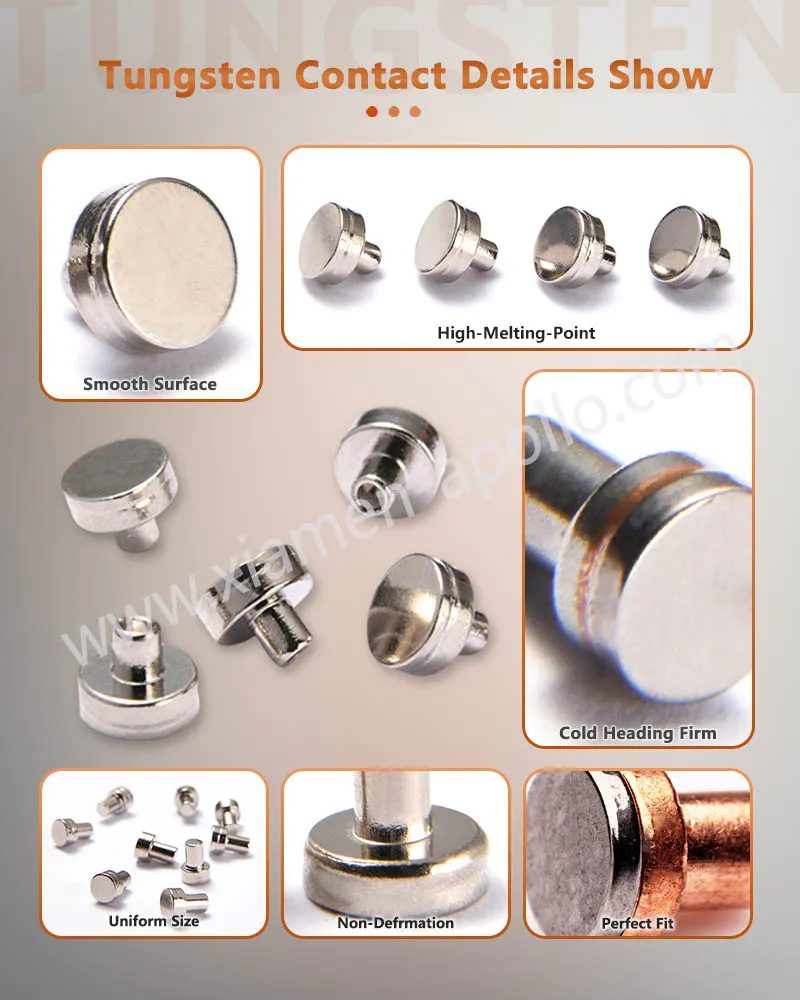
With the rapid development of new energy, power electronics, and smart grid industries, tungsten-copper composite materials have ushered in new development opportunities. High-performance tungsten-copper solid rivet contacts, with their excellent high-temperature resistance, anti-welding properties, and stable conductivity, have shown broad application prospects in new energy vehicles, high-voltage direct current transmission, and energy storage equipment. In the future, by optimizing the material's microstructure, improving manufacturing processes, and developing novel composite structures, tungsten-copper solid rivet contacts will play a crucial role in higher power densities and more demanding operating conditions, continuously driving the development and innovation of electrical connection technologies.
contact us
If you are looking for high-performance Iron Tungsten Contact Rivets solutions, please contact our technical team. We can provide professional selection advice and product support tailored to different application scenarios to jointly improve the reliability and lifespan of electrical equipment.
