In the field of mechanical manufacturing and assembly, the stability of threaded fastener connections is directly related to the safe operation of equipment. However, impacts and vibrations can easily cause traditional threaded connections to loosen, the root cause being insufficient fixing force generated by friction between threads and the tension and compression of bolts. Against this backdrop, lock nuts, with their special design providing additional vibration resistance, have become a key component for solving this problem and are widely used in various industrial scenarios. This guide will provide a detailed introduction to the working principle of lock nuts, common types, and how to select the appropriate lock nuts, so that you can better understand and use them in practical applications.
Lock nuts, also known as locking nuts or self-locking nuts, are special nuts used to secure bolts or other fasteners. They function by compressing the secured component, and their built-in locking function effectively prevents loosening due to vibration. Lock nuts come in various sizes and styles, suitable for numerous applications, such as securing electrical connections, splicing materials, and connecting mechanical parts to fixed objects.
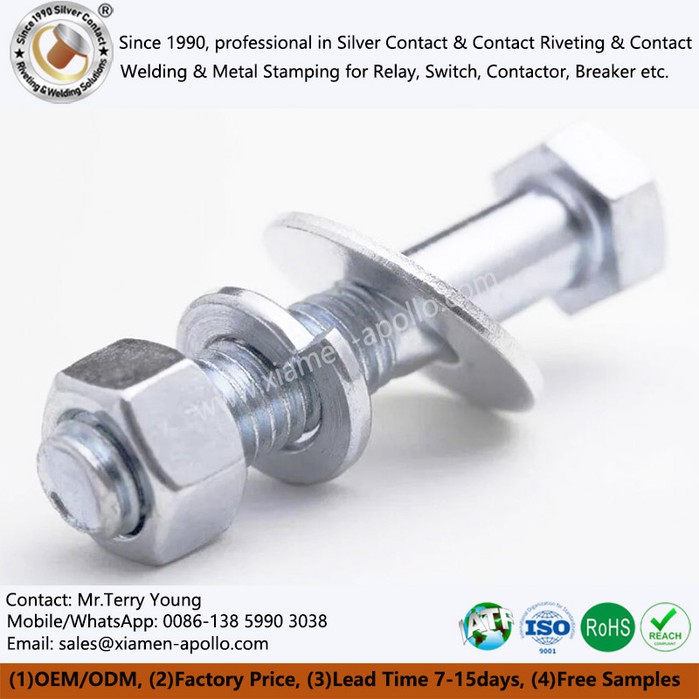
Effective torque lock nuts or straw lock nuts are designed to maintain a constant, uniform torque under vibration or dynamic loads, and their built-in locking function prevents loosening. During assembly and disassembly, rotational resistance will be felt, requiring the use of a wrench and the application of a greater torque than standard nuts. Nylon insert lock nuts have an internal nylon insert that locks by clamping the threads, commonly used for threaded rods and other items subjected to vibration and dynamic loads. Hexagonal lock nuts, a variation of standard hexagonal nuts, are thinner and primarily used to prevent hexagonal nuts from loosening, suitable for applications requiring two parts to be secured together.
Double-lock nuts or center lock nuts have a hexagonal face on each side, providing a stronger locking force than standard hexagonal nuts. Their helical thread design prevents loosening; the difference between Stover lock nuts and double-lock nuts lies in the position of the helical thread. Serrated flange lock nuts have a serrated flange that firmly clamps the threads, suitable for applications involving sheet metal or metal parts. Keps K-Lock nuts have a ribbed flange that grips the threads, generating a strong locking force. When tightening, be careful with the force applied to avoid overtightening and losing its locking function.
Castle lock nuts, or Castellated nuts, have a rounded, toothed top design that generates a locking force when tightened. They are commonly used in applications requiring low torque, such as wheel bearing mounting. Knurled nuts have knurled external threads that help secure them to bolts or other components. They are suitable for applications requiring frequent disassembly or where overtightening to avoid damaging the threads is not recommended. Wedge lock nuts have a wedge-shaped design that allows them to wedge into the threads, generating a strong locking force when tightened. They are suitable for harsh applications subject to heavy loads and vibration.

Regarding size specifications, lock nuts follow both metric and imperial systems. In the metric standard, standard thread sizes cover M3 to M20, while mainstream lock nut sizes are M25 to M50. Larger sizes, such as M60 and M8.5, can be sourced through specialized channels. Common widths range from 5.5mm to 13mm. The imperial system is divided into two categories: UNC (Unified Coarse Thread) and UNF (Unified Fine Thread). UNC diameters range from 0.0730" to 6", covering both numbered and fractional specifications; UNF diameters range from 0.0600" to 1.11/16", including numbered, fractional, and UNEF sub-specifications.
When using locknuts, the method of securing the nut to the bolt varies depending on the type of locknut. Generally, the initial threading and hand-tightening process is the same as for standard hexagonal nuts, followed by further tightening with a wrench or other tools until secure. Some locknuts are designed to lock correctly only in one direction; pay attention to the thread direction. For some specially designed and branded locknuts, locknut washers may also be needed to ensure complete secure fastening.
Besides locknuts, various alternative fastening solutions exist in the industry. Safety threads (also known as locking threads) achieve locking by drilling through a hole in the fastener and twisting it to secure it. 0.032-inch stainless steel products are widely used in high-frequency vibration environments such as aircraft and racing cars. Thread-locking fluid, as a specialized adhesive, is applied to the threads and cures to achieve locking. Since its introduction in the 1950s, it has become an important supplementary solution for fastener locking. In addition, oval nuts and other options can also be used, flexibly adapted according to specific working conditions.
Locking nuts play an important role in various mechanical connections due to their unique design and strong anti-loosening properties. Whether it's a traditional nylon insert locking nut or a specially designed wedge-shaped locking nut, different application requirements can be selected. When selecting a suitable locking nut, factors such as load type, operating environment, and required torque must be considered to ensure optimal connection stability and safety.
Contact Us