

In modern electrical and power control systems, the performance of electrical contact materials directly determines the reliability, lifespan, and safety of equipment. As a core conductive component, Silver electrical contacts have long dominated the mid-to-high-end switchgear market due to their superior overall performance. From household relays to industrial circuit breakers, from miniature signal switches to high-capacity power distribution devices, Solid Silver Contacts continuously meet increasingly stringent switching requirements through material innovation and structural optimization. This article systematically reviews the material system, performance advantages, and typical application scenarios of Silver Alloy Rivets, providing technical reference for industry selection.
The core value of Pure Silver Contacts stems from its unique physicochemical properties. First, silver has the lowest resistivity of all metals (only 1.59 μΩ·cm at 20℃), ensuring minimal energy loss when current flows. Second, even when silver oxide (Ag₂O) forms on the surface, it still maintains good conductivity and does not form an insulating barrier like copper oxides. More importantly, the arc temperature generated during switch opening and closing can reach over 2000℃, while silver and its alloys effectively resist thermal erosion and welding, ensuring stable operation for tens of thousands or even hundreds of thousands of cycles. For this reason, despite its higher cost, pure silver solid contact remains irreplaceable in low-current, high-reliability applications.
However, pure silver has low hardness and limited resistance to welding, making it unsuitable for medium- to high-load applications. Therefore, the industry has developed various silver-based composite and alloy systems to achieve an optimal balance between performance and cost. Currently, mainstream products are mainly divided into three categories:
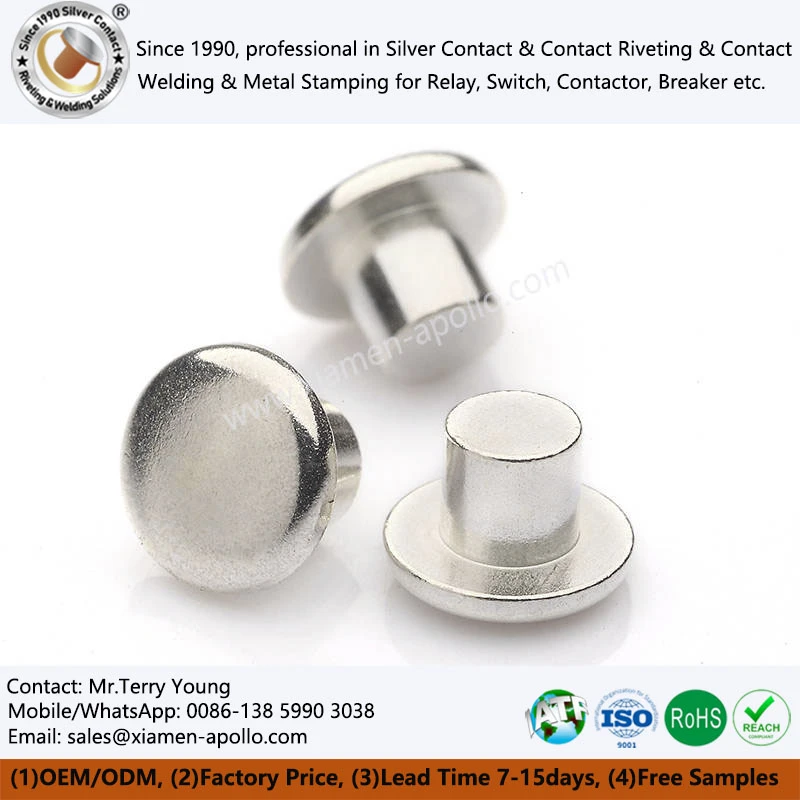
The first category is Silver alloys contact, typically represented by Silver nickel solid contact and Silver cadmium oxide solid contact. Silver-nickel materials (such as Ag-10Ni) are strengthened through nickel particle dispersion, significantly improving wear resistance and arc resistance, making them suitable for frequently used Silver contacts for relays. While silver cadmium oxide (Ag-CdO) was once widely used due to its excellent arc-quenching properties, it is gradually being replaced by more environmentally friendly alternatives due to the environmental toxicity of cadmium.
The second category is currently the most prevalent Silver tin oxide solid contact. Through an internal oxidation process, nano-sized SnO₂ particles are uniformly distributed within a silver matrix, forming a stable, dispersed, strengthened structure. A typical formulation, such as Ag-8SnO₂, has a resistivity controlled below 2.5 μΩ·cm, offering more than three times the anti-welding performance of pure silver, and is non-toxic and environmentally friendly. More advanced ternary systems (such as Ag-SnO₂-In₂O₃) further reduce contact resistance by introducing indium oxide, resulting in a 15–20°C reduction in operating temperature rise. This makes them particularly suitable for applications with stringent thermal management requirements, such as Silver contacts for MCCBs.
The third category comprises specialized materials for high-voltage, high-current applications-Silver tungsten. Although not listed in the keywords, its technical logic is worth considering. Within the existing keyword system, Silver zinc oxide solid contact, as an emerging environmentally friendly material, is also gradually entering the market. While its conductivity is slightly lower than that of silver tin oxide, it exhibits good arc resistance under specific AC loads and may gain a place in the future market for Silver contacts for breakers.
At the application level, different devices have varying performance requirements for Silver Alloy Contacts. For example, Silver contacts for switches typically operate at low currents below 10A and can be made of pure silver or low alloying, emphasizing conductivity and response speed; while Alloy Silver contacts for relays need to balance switching frequency and lifespan, making silver-nickel or silver-tin oxide more suitable; as for MCCBs (molded case circuit breakers) and air circuit breakers, solid Silver contacts are required to reliably interrupt under short-circuit current surges, making high SnO₂ content silver-tin oxide or composite multiphase materials the preferred choice.

It is worth noting that the geometry of silver electrical contacts is equally crucial. Typical solid contacts have diameters between 1 and 5 mm and thicknesses between 0.3 and 1.2 mm. Optimized contact pressure distribution through spherical, planar, or shouldered structures increases the effective conductive area, thereby reducing contact resistance and localized temperature rise. Combined with precision riveting or welding processes, components such as Silver Nickel contacts and Silver Tin Oxide contacts can be integrated into composite rivets, finding wide applications in industrial control, new energy charging piles, and smart grids.
Looking ahead, with the advancement of "dual-carbon" goals and accelerated electrification, restrictions on heavy metal-containing materials such as Silver Cadmium Oxide contacts will become more stringent, leading to continued deepening of the research and application of environmentally friendly silver oxide contacts. Simultaneously, new technologies such as nano-modification, gradient structures, and surface microtexturing will further enhance the service performance limits of silver electrical contacts.
Overall, electrical contacts have evolved from single-material solutions to multi-system, multi-functional engineering solutions. Through scientific material selection and precise matching with application scenarios, not only can equipment lifespan be extended and energy efficiency improved, but electrical safety can also be ensured. In the process of transforming high-end manufacturing towards high-quality development, high-performance silver-based electrical contact materials will continue to play an indispensable role.
If you would like to obtain advice on the applicability of different solid contact materials in specific electrical appliances or a comparison of technical parameters, please feel free to contact us.
Contact Us
