

As a fundamental component for enabling automatic and remote control within electrical control systems, relays are widely utilized across various fields, including home appliances, industrial automation, automotive systems, telecommunications, electric power, energy, security, and aerospace. Their core function lies in using a small current to control the switching (on/off) of a larger current, thereby protecting the contacts of the control switch and facilitating the safe switching of electrical circuits. In traditional automobiles, relays are primarily employed to control the opening and closing of circuits for electrical accessories such as windshield wipers, power windows, and lighting systems; operating typically within a voltage range of 12 to 48 volts, these devices are classified as low-voltage products. The performance and reliability of these relays depend significantly on the design of their electromagnetic systems, wherein the Relay Iron Core plays a pivotal role in guiding magnetic flux and enhancing electromagnetic attraction. Typically, the Relay Iron Core works in conjunction with the yoke, armature, and coil to form a closed magnetic circuit, enabling the electromagnet to generate sufficient and stable attraction when energized, thereby reliably actuating the relay contacts.
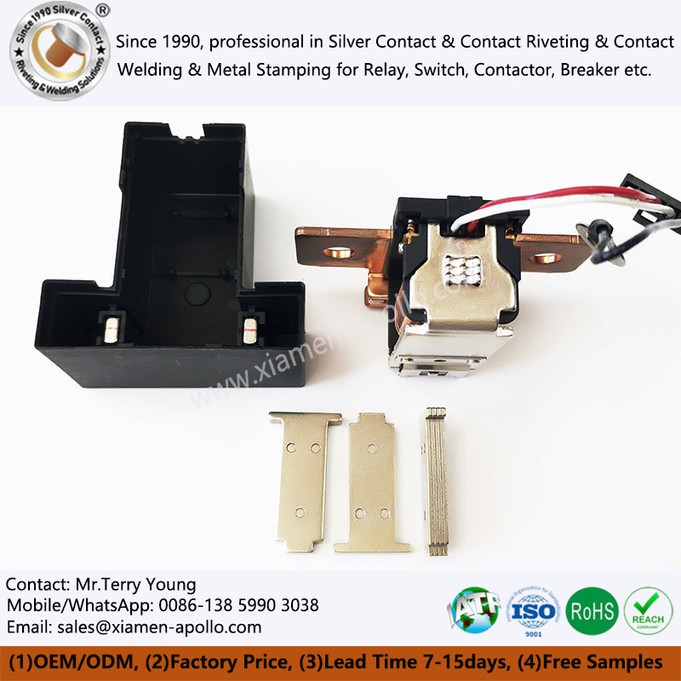
With the advent of the new energy vehicle (NEV) era, vehicle electrical systems have undergone a fundamental transformation. The main circuit voltage in NEVs typically exceeds 200V-far higher than the 12–48V range found in traditional vehicles. Consequently, in addition to retaining traditional low-voltage relays, NEVs must be equipped with specialized high-voltage DC relays to control the switching of the main circuit connecting the battery, motor, and electronic control systems. In this high-voltage DC environment, standard relays are incapable of meeting the stringent requirements for safe arc suppression and reliable circuit interruption. To address this, the industry has widely adopted vacuum-type or gas-filled high-voltage DC relays. Among the components utilized, the Flat Core for EV Relay is extensively employed in the electromagnetic system design of high-voltage DC relays due to its compact structure and high magnetic circuit efficiency. This flat core design effectively minimizes magnetic reluctance while accommodating limited spatial constraints, enabling the relay to generate greater electromagnetic force at equivalent coil power consumption; this, in turn, drives rapid contact actuation and reduces arc duration.
During the manufacturing process of high-voltage DC relays, the Stamping Iron Core Bending Part for EV Relay serves as a critical flux-guiding component, formed through precision stamping and bending processes. Given the extremely rigorous requirements for dimensional accuracy, surface quality, and magnetic property consistency in high-voltage DC relay cores, the stamping and bending process enables the mass production of core components featuring complex geometries and strict tolerances. These cores are typically fabricated from soft magnetic materials-such as electrolytic pure iron or DT4C-which undergo annealing treatment to achieve high magnetic permeability and low coercivity. Furthermore, the Stamping Core for New Energy Relay constitutes one of the core components within the electromagnetic system of high-voltage DC relays for NEVs. Compared to traditional relays, NEV relays must withstand significantly higher voltages and greater current surges; therefore, their iron cores require not only superior soft magnetic properties but also robust resistance to fatigue and mechanical shock. The stamping process ensures an optimal internal grain flow within the core, thereby minimizing hysteresis losses and ultimately extending the overall electrical service life of the relay.
In terms of material selection, the Pure Iron Core for EV Relay is considered the ideal choice for flux-guiding applications. Pure iron possesses high saturation magnetic induction and low coercivity, enabling it to rapidly establish a strong magnetic field when a coil is energized and to demagnetize quickly upon power disconnection, thereby ensuring the reliable release of the relay contacts. In the context of high-voltage DC relays, the relay coil core is directly coupled with the coil; consequently, the magnitude of its magnetic permeability dictates the efficiency of electromagnetic conversion. If the core's magnetic permeability is insufficient, the coil requires a higher current to generate adequate attraction force, leading to increased coil temperature rise and energy consumption, and potentially compromising the long-term reliability of the relay. Therefore, high-end high-voltage DC relays typically utilize high-purity electrical pure iron for the manufacture of their cores, complemented by precise heat treatment processes.
From the perspective of the overall electromagnetic system structure, the electromagnet core constitutes an integral component of the relay's electromagnet assembly; together with the coil, yoke, and armature, it forms the complete magnetic circuit. When the coil is energized, the electrical pure iron core undergoes rapid magnetization, generating a powerful electromagnetic attraction force that actuates the armature. The magnetic stability of the iron core directly influences the relay's pickup voltage and dropout voltage. To satisfy the stringent reliability requirements of high-voltage DC relays, many manufacturers have adopted the DT4C iron core as their standard material. DT4C represents a premium grade within the category of electrical pure iron, characterized by an exceptionally low carbon content and excellent magnetic stability, making it ideally suited for high-frequency applications involving frequent, long-duration switching operations.
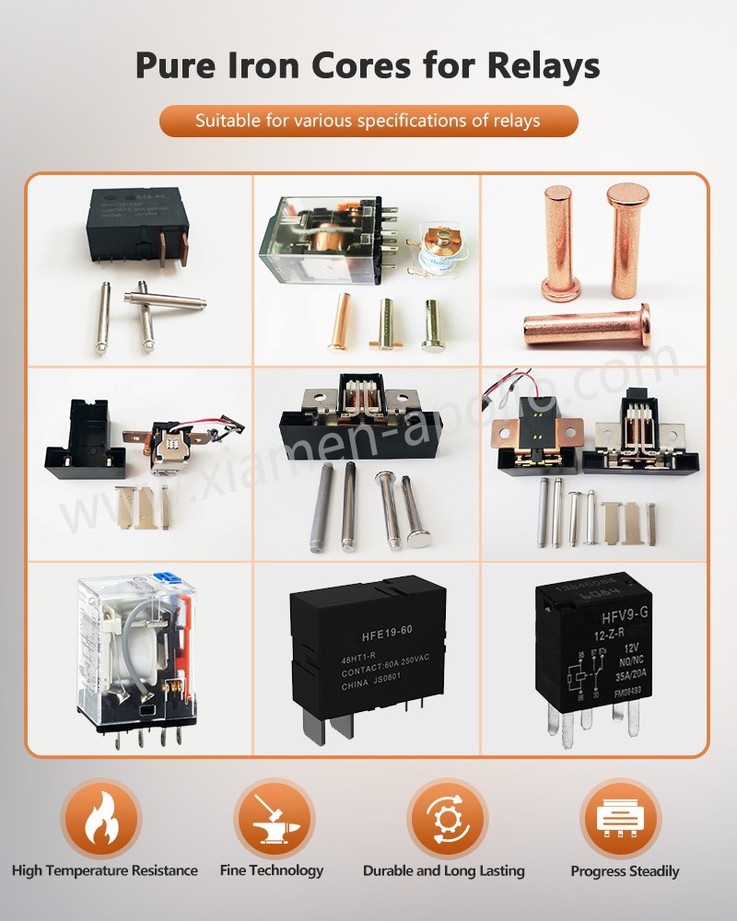
Delving deeper into the core components, the design of the electromagnetic relay core requires a careful balance between magnetic circuit efficiency and mechanical strength. In the manufacturing process for high-voltage DC relays, the cold forging of DT4C iron cores stands out as a high-precision forming method. This cold forging process results in a denser internal microstructure and superior dimensional accuracy within the iron core, while simultaneously minimizing the need for subsequent machining. It is particularly well-suited for the mass production of iron core components that feature symmetrical shapes and demand high performance standards. Following the cold forging stage, DT4C iron cores typically undergo an annealing heat treatment to relieve internal stresses and restore their optimal soft magnetic properties.
In summary, spanning the spectrum from traditional automotive low-voltage relays to the high-voltage DC relays found in new energy vehicles, the continuous advancements in iron core materials and manufacturing processes have established a solid technical foundation for achieving high reliability, extended service life, and miniaturization in relays. If you require further information regarding the manufacturing processes and technical specifications of EV relay cores, we invite you to contact us to receive expert selection advice and technical support.
Contact Us
