

In electromagnetic servo mechanisms and various types of relays, the relay yoke stands as one of the core components that determine the upper limit of the device's performance. Essentially, it acts as a stationary iron core; its primary function is to collaborate with the movable iron core (armature)-which is attracted by the electromagnet-to form a closed magnetic circuit. By efficiently confining the magnetic flux lines generated by the electromagnetic coil within its structure, the yoke maximizes the utilization of magnetic energy, thereby significantly enhancing the electromagnet's attraction force and operational efficiency. Depending on the specific application scenario, common mounting configurations for magnetic yokes generally fall into three categories: fully enclosed, semi-enclosed, and hollow. Among these, the fully enclosed type is predominantly used in large-scale relays and electromagnetic servo mechanisms; the semi-enclosed type is commonly found in small stepper motors or miniature relays; while the hollow type is primarily applied in specialized fields requiring unique connecting shaft structures or in devices such as electromagnetic guns.
From the perspective of manufacturing processes, components classified as relay coil yokes typically feature thin material gauges, compact dimensions, and extremely stringent precision requirements. Taking a typical electromagnetic relay yoke as an example, the raw material is frequently selected as DT4E pure iron sheet, typically with a thickness of approximately 2 mm. To ensure dimensional consistency and processing efficiency during mass production, the industry widely adopts a manufacturing scheme involving a compound die for punching and blanking, followed by a bending operation. This process not only features a streamlined die structure and controllable costs but also effectively meets the rigorous demands for component flatness and dimensional accuracy required in medium-volume production runs. Furthermore, through rational layout design (such as staggered nesting), material utilization efficiency can be effectively enhanced, thereby reducing production costs.
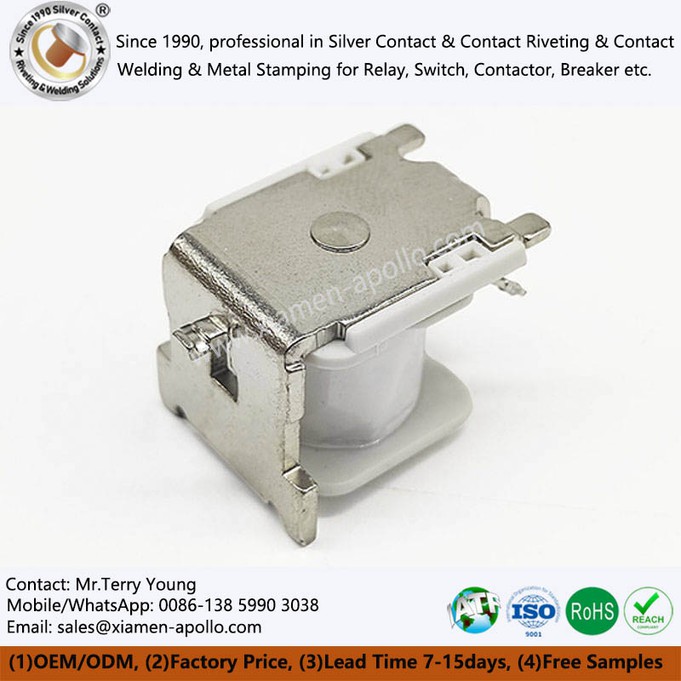
When conducting a manufacturability analysis for stamped electrician's pure iron strips, particular attention must be paid to the dimensional accuracy and structural features of the parts. For instance, bent components often require a high degree of dimensional precision; to ensure a bending angle of 90° ± 30′, it is typically necessary to incorporate an additional corrective bending operation following the standard bending process. Furthermore, since many components within a Relay Yoke Mount Kit feature asymmetrical shapes on either side of the bend line, they are highly susceptible to shifting during the bending process. To address this challenge, engineers often ingeniously leverage existing features on the part-such as circular holes on the longer side or shoulders on the shorter side-to design locating pins and ejector plates. This strategy effectively prevents the blank from sliding during the stamping process, thereby ensuring the high precision of the finished product.
As a critical component-specifically, an electrician's pure iron yoke-the soundness of its mold design directly determines the quality of the final product. When establishing the stamping process plan, the standard workflow typically follows the sequence: "piercing and blanking (compound operation) - bending - corrective bending." In the design calculations for compound dies, the precise positioning of the pressure center is paramount; it is essential to ensure that the pressure center of the die aligns perfectly with the centerline of the press slide to prevent abnormal wear on the equipment. Concurrently, for irregularly shaped blanked parts, it is advisable to employ Electrical Discharge Machining (EDM) wire cutting and the "single-match" processing method to determine the working dimensions of the punch and die. This approach ensures precise control over the double-sided clearance, thereby yielding a high-quality blanked cross-section.
Regarding the structural selection for V-bending dies, two mainstream options typically prevail: the first involves a bending die equipped with an ejector plate and locating pins, while the second is a V-bending die designed with inherent corrective capabilities. Given the stringent precision requirements for critical components-such as the Relay Yoke Neck-the industry generally favors the first option. A structure featuring an ejector plate and locating pins effectively suppresses blank displacement during bending, allowing edge-length tolerances to be maintained within ±0.1 mm-a standard of precision that is difficult to achieve with conventional bending dies. This sophisticated mold structural design serves as the cornerstone for ensuring the stable performance of the core magnetic circuit components within the relay.
During the production of stamped sheet metal components-such as yoke bending plates-the physical properties of the material itself constitute a factor that must not be overlooked. The mechanical properties of DT4E pure iron sheet are comparable to those of Q215 steel; typically, its bending radius exceeds the material's minimum allowable bending radius, thereby providing a solid foundation for forming operations. However, to prevent stress concentration or cracking caused by bend lines situated in close proximity to abrupt dimensional transitions, thorough simulation and validation must be conducted during the mold design phase. By optimizing the fillet radii and clearances of the punch and die, it is possible to effectively enhance the surface quality and structural integrity of the Relay Coil Yoke, thereby averting potential issues during subsequent assembly.
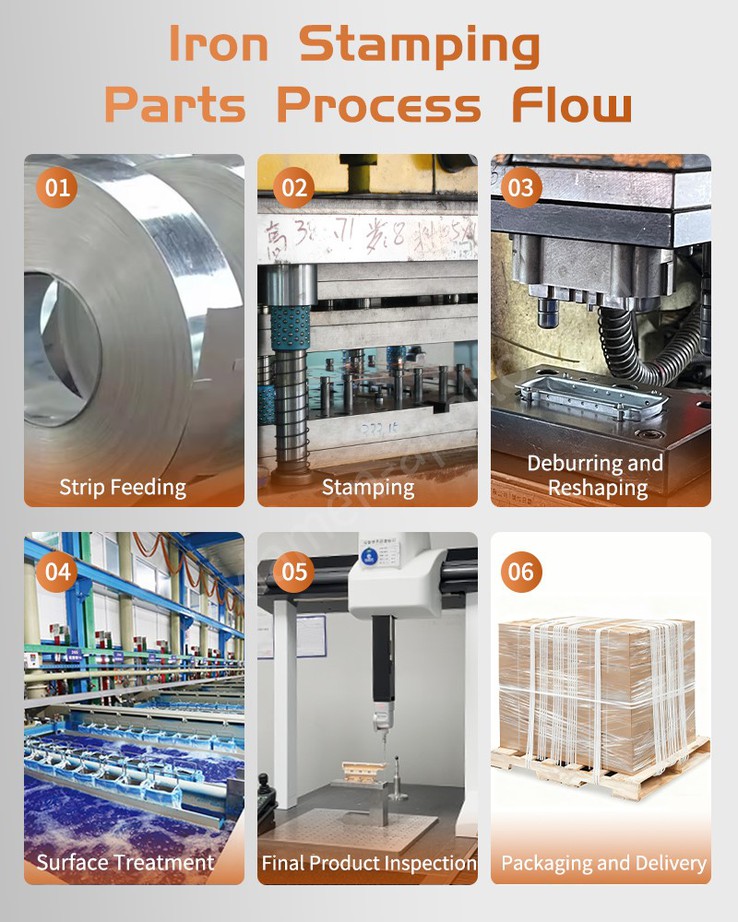
With the advancement of new energy vehicles and smart grids, the requirements for relays and their associated components are becoming increasingly rigorous. Whether serving as part of a Relay Yoke Mount Kit or functioning as an independent core magnetic component, the Electrician Pure Iron Yoke must exhibit superior magnetic permeability and extremely low coercivity. By incorporating high-precision progressive dies and multi-station stamping technologies, modern production lines have achieved fully automated manufacturing-spanning the entire process from raw material uncoiling and leveling to punching, forming, and cutting-thereby significantly enhancing both the production efficiency and product consistency of Relay Yoke Metal Parts.
If you are seeking professional and reliable solutions for precision Electromagnetic Relay Yokes and mold development, please feel free to contact us at any time for detailed technical support and a quotation!
Contact Us
