

Against the backdrop of the global manufacturing industry's accelerated transformation towards intelligent and low-carbon technologies, the electrician pure iron core (EPC) industry is undergoing a structural upgrade. With the rapid development of new energy vehicles, industrial automation equipment, and smart home appliances, the demand for high-performance EPC and soft magnetic iron cores for relays continues to rise, and technological innovation in the industry has entered a critical stage.

From Traditional Machining to High-Precision Cold Forging-DT4C Cores Become the Market Focus
In recent years, soft magnetic materials for relays have been continuously optimized. Among them, DT4C Iron Core, as a representative material, performs exceptionally well in Electromagnet Core manufacturing due to its high permeability, low coercivity, and excellent machinability.
Compared with traditional turning or stamping processes, the DT4C Relay Iron Core Cold Forging process has significant advantages in terms of precision and material utilization. Cold forging technology not only reduces hysteresis loss but also improves product consistency and mechanical strength, leading to its widespread application in industrial control systems and new energy electrical modules.
High-Purity Soft Magnetic Cores Drive Improved Relay Sensitivity
With increasing precision requirements in industrial control, the magnetic properties of Pure Iron Cores have become crucial for relay response speed. By optimizing smelting purity and annealing processes, modern Pure Iron Relay Core products achieve extremely low hysteresis loss and extremely high permeability.
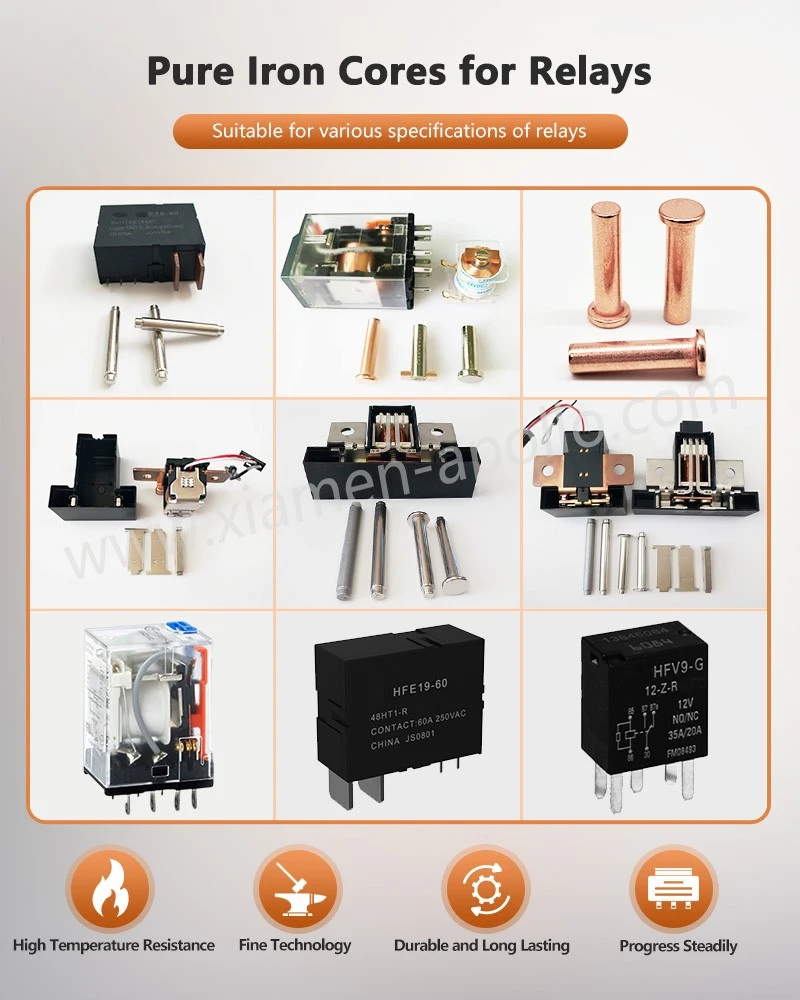
These Soft Magnetic Iron Cores for Relays are widely used in high-sensitivity Relay Coil Cores and Core for Electromagnetic Relay systems, ensuring stable and rapid engagement and disengagement of relays even in complex electromagnetic environments. This provides a more reliable electromagnetic control foundation for new energy vehicle drive systems, energy storage inverters, and charging piles.
The Combination of Cold Forging, Precision Processes, and Automated Assembly
On the manufacturing side, the widespread adoption of Cold Forging Relay Core technology signifies an industry shift from "experience-based manufacturing" to "precision manufacturing." By combining CNC cold forging with high-precision mold technology, relay cores can achieve dimensional tolerance control within ±0.005mm, further improving assembly consistency.
Simultaneously, the high-precision Relay Pin and Core Pin design effectively reduces magnetic circuit gaps and improves the magnetic efficiency of the entire relay system. The construction of such integrated production lines is becoming a key investment focus for major electromagnetic component manufacturing bases.

Continuously Expanding Application Areas – From Home Appliances to Energy Control Systems
With the popularization of energy electronics and smart terminal devices, Iron Core for Industrial Control Relays are not only used in traditional low-voltage electrical appliances, but also play a core role in new energy power conversion devices, industrial robot control modules, and smart grid protection systems.
Industry experts point out that in the next five years, the market for Relay steel cores and high-purity electrical iron cores will maintain an average annual growth rate of over 8%, with the combination of cold forging technology and high-permeability materials becoming the main driving force.
Sustainable Manufacturing Becomes a New Industry Consensus
Guided by green manufacturing policies, the production process of Electrician Pure Iron Core is gradually adopting energy-saving heat treatment and environmentally friendly cleaning technologies to reduce energy consumption and emissions during manufacturing. Simultaneously, industry standards are developing towards higher magnetic performance, lower losses, and easier recycling, driving the sustainable iteration of soft magnetic material systems.
Conclusion: As the "heart" of electromagnetic components, relay cores are at the forefront of the integration of intelligent manufacturing and new energy applications. With continuous innovation in materials and processes, such as Soft Magnetic Iron Cores for Relay, Pure Iron Relay Core, and DT4C Iron Core, their role in power control, automotive electronics, and energy storage systems will become increasingly prominent. In the future, whoever can achieve continuous breakthroughs in material purity, cold forging precision, and magnetic performance stability will gain technological dominance in the relay industry.
contact us
