

In modern low-voltage power distribution systems, circuit breakers serve not only the fundamental function of connecting and disconnecting circuits but also act as critical protective components that safeguard the secure operation of the power system. With the rapid advancements in industrial automation, power equipment, and new energy systems, low-voltage circuit breakers are now subject to increasingly stringent requirements regarding short-circuit protection, overload protection, and selective coordination. Concurrently, the conductivity and brazing quality of the internal contact assemblies within a circuit breaker directly impact the device's breaking capacity and operational reliability. In this context, conductive connection structures utilizing the Silver Contact Brazing on Copper Bars process have emerged as one of the key technologies in modern circuit breaker manufacturing.
Based on their protective capabilities, low-voltage circuit breakers are typically classified into two categories: selective circuit breakers and non-selective circuit breakers. Selective circuit breakers generally feature multi-stage protection characteristics-including long-time delay, short-time delay, and instantaneous protection-whereas non-selective circuit breakers predominantly employ an instantaneous-action mechanism and are primarily utilized for short-circuit protection. Within high-breaking-capacity circuit breakers, the contact system must withstand the impact of high-magnitude currents; consequently, the industry widely adopts Resistance Projection Welding for Silver Contacts to enhance both the connection strength and the electrical conductivity stability between the silver contacts and the conductors.
In the design of power distribution systems, selective coordination between upstream and downstream circuit breakers is of paramount importance. When a fault occurs in a downstream circuit, the circuit breaker closest to the fault point should ideally be the first to trip; this prevents the upstream breaker from inadvertently tripping and disrupting power supply to other circuits. To achieve this selective protection, the conductive components within the circuit breaker must possess stable and reliable current-carrying capabilities. By employing the Resistance Butt Welding Silver Contact process, the mechanical strength of the contact welding zone is effectively enhanced, thereby mitigating issues related to contact resistance during long-term operation.
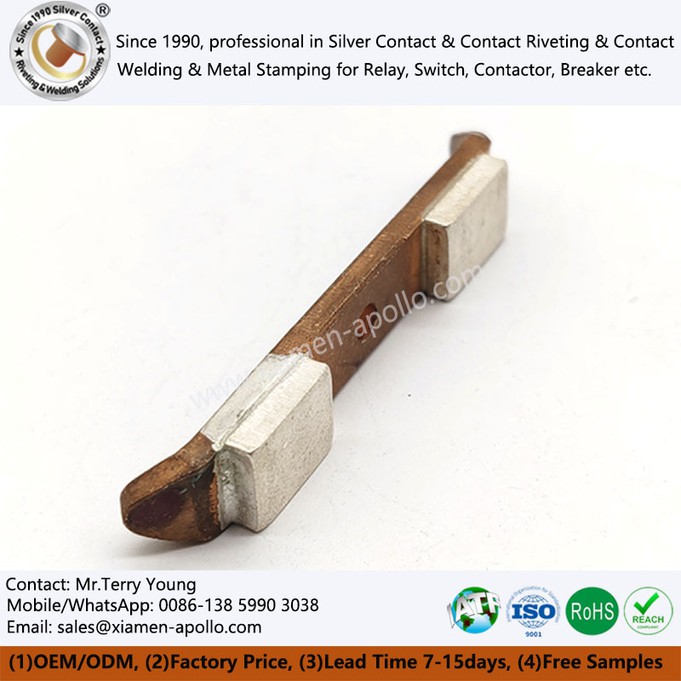
Under short-circuit fault conditions, a circuit breaker must interrupt extremely high currents within a very short timeframe; consequently, the method of connection between the internal conductors and the contacts is critical. Modern low-voltage circuit breakers typically utilize highly conductive copper busbars as their main conductors and employ Copper Spot Welding Silver Contact technology to establish a stable bond between the silver contacts and the copper substrate, thereby improving the system's overall conductivity and thermal stability.
As the load capacity of low-voltage power distribution systems continues to increase, the current-limiting performance of circuit breakers has increasingly become a key focus of industry attention. Cascading protection technology leverages the current-limiting capabilities of upstream circuit breakers to reduce the actual short-circuit current experienced by downstream breakers, thereby enhancing the overall efficiency of the system's protection scheme. In this operational environment, the adoption of highly reliable Resistive Welding Silver Contact processes effectively boosts the circuit breaker's resistance to contact welding (fusion) under the impact of high short-circuit currents.
Selective circuit breakers are typically equipped with short-delay overcurrent trip units, the response times of which are configured according to specific system protection requirements. To ensure effective operational coordination between upstream and downstream breakers, the internal contact assemblies must not only exhibit superior conductivity but also possess robust durability against thermal cycling. Consequently, the industry widely adopts AC Resistance Welding Silver Contact technology to enhance welding stability and ensure long-term operational reliability under AC operating conditions.
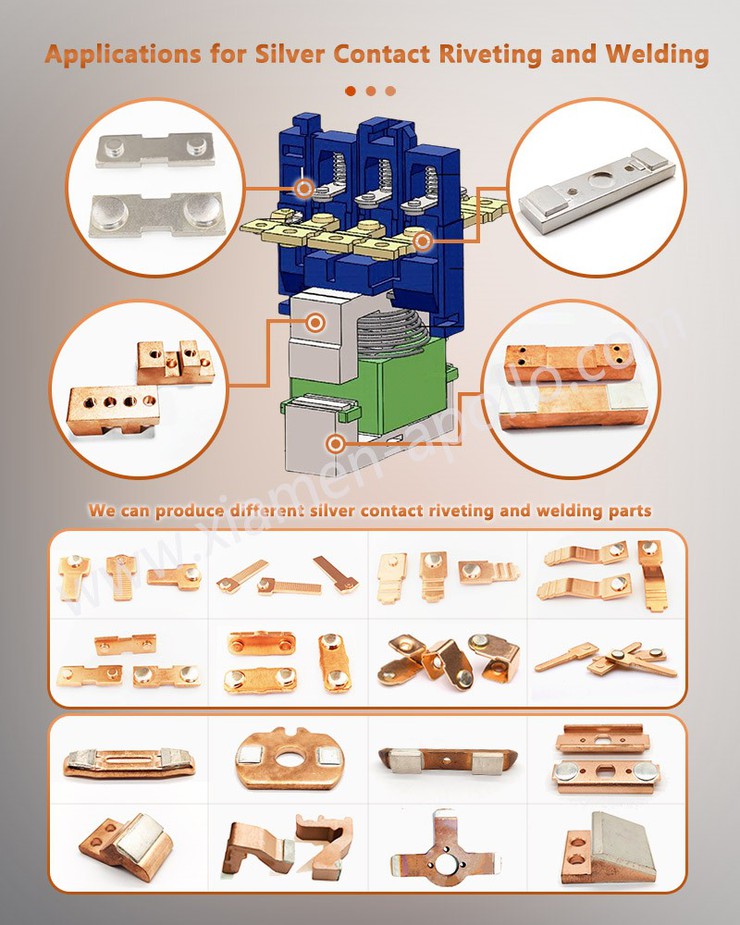
As low-voltage power distribution systems continue to evolve toward greater intelligence and higher reliability, circuit breakers require not only more precise protection capabilities but also advanced manufacturing processes for their conductive components. Moving forward, the technology of Silver Contact Brazing on Copper Bars will continue to advance, providing modern power systems with even more stable and secure protection solutions.
If you would like to learn more about Copper Spot Welding Silver Contacts, please feel free to contact us; we are ready to provide you with professional product and technical support.
Contact Us
