

In the complex architecture of modern industry and electronic equipment, relays are hailed as "industrial vitamins," serving as "automatic switches" that control larger currents with smaller ones. Relays possess independent control systems (input circuits) and controlled systems (output circuits). Their core function is to precisely connect or disconnect the output circuit when input quantities such as voltage and current reach preset values. This characteristic makes them widely used in power protection, industrial automation, and electronic equipment, playing a crucial role in automatic regulation, safety protection, and circuit switching. With the advancement of the "dual-carbon" strategy and the rise of the intelligent technology wave, the relay industry is experiencing a period of rapid demand growth.
Steady Market Expansion and Technological Iteration
In recent years, benefiting from the rapid development of emerging fields such as new energy, AI data centers, industrial automation, and smart grids, the relay industry market has shown a steady expansion trend. Data shows that from 2019 to 2024, the industry market size grew from RMB 22.76 billion to RMB 31.745 billion, with a compound annual growth rate of 6.88%. Looking ahead, it is projected that from 2025 to 2029, the market size will further increase from RMB 36.109 billion to RMB 60.61 billion, with a compound annual growth rate of 13.82%. This significant growth stems not only from the broadening of application areas but also from the increasing demands on relay performance, such as reliability, voltage resistance, and vibration resistance. Against this backdrop, the importance of Silver Contact and Stamping becomes increasingly prominent. Precision stamping technology combined with highly conductive silver contact materials can effectively reduce contact resistance and improve the stability and lifespan of relays under high-frequency switching operations.
The Rise of New Energy Vehicles and High-Voltage DC Relays
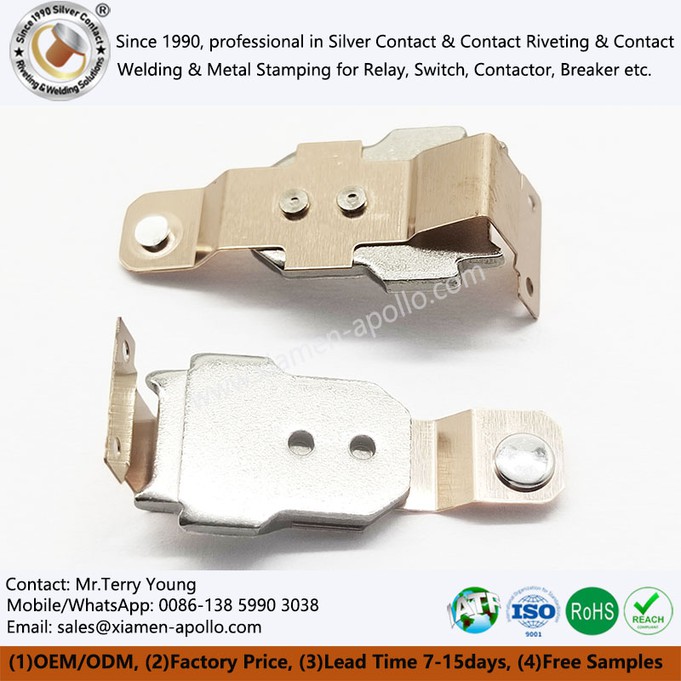
The explosive growth of new energy vehicles is one of the core driving forces behind the development of the relay industry. Since the main circuit voltage of new energy vehicles is typically higher than 200V, far exceeding the 12-48V of traditional fuel vehicles, special high-voltage DC relays are necessary in addition to traditional low-voltage relays. In 2025, my country's production and sales of new energy vehicles reached 16.626 million and 16.49 million units respectively, ranking first in the world for 11 consecutive years. In this massive market, Moving Spring Assembly for Automotive Relay plays a crucial role. This component needs to maintain stable elasticity and conductivity under high voltage and high current conditions; its design and manufacturing process directly determine the safety performance of the relay under critical operating conditions such as vehicle start-stop and charging/discharging switching.
The Evolution of AI Data Centers and Solid-State Relays
With the iteration of artificial intelligence and big data technologies, AI data centers, as the core infrastructure of the digital economy, are experiencing explosive growth. The 24/7 uninterrupted operation of data centers places extremely high demands on power distribution and redundancy. Relays in this scenario play a crucial role, acting as automatic transfer switches and controlling server power. To adapt to the high-load characteristics of AI data centers, traditional electromagnetic relays are gradually evolving into solid-state relays, while intelligent relays integrating sensors and edge computing functions are also beginning to emerge. In the manufacturing of these high-end relays, In-Die Electrical Riveting Contacts technology plays a key role. This technology can complete the precise riveting of contacts in an instant during stamping, ensuring absolute accuracy in contact position and high connection strength, meeting the data center's requirements for millisecond-level response and extremely high reliability.
The Future of Smart Grids and Relay Protection
The accelerated construction of smart grids provides stable and continuous demand support for the relay industry. As the core of the energy internet, smart grids are committed to achieving efficient power transmission and precise distribution. In the power transmission and distribution sector, relay protection applications account for more than 50% of the market share. To achieve safe protection for ultra-high voltage lines and substations, relays must possess extremely high sensitivity and reliability. In this process, In-Mold Riveting Components are widely used in the manufacture of relay frames and terminals with high insulation performance. This technology directly embeds metal conductive parts into plastic molds, which not only significantly improves the insulation performance of the components but also effectively prevents dust and corrosive gases from eroding the internal structure, providing a solid hardware foundation for the long-term stable operation of smart grids.

Industry Development Trend Summary
In summary, the relay industry is at a critical juncture, transitioning from traditional functions to intelligent and high-reliability technologies. From material upgrades in Silver Contact Riveting Assembly to process innovations in In-Die Rivet Electrical Contacts, every technological advancement is driving the overall development of the industry. The demands of emerging fields such as new energy, AI data centers, industrial automation, and smart grids are not only creating vast market opportunities for the relay industry but also posing higher challenges to product performance.
We specialize in providing Moving Spring Armature Riveting Assembly, dedicated to injecting core power into your products. If you have further customization needs for the above processes or components, please feel free to contact us for professional support.
Contact Us
