

Traditional cold-heading and cold-pressure welding processes have long been the primary bottleneck hindering quality improvements in tri-metal electrical contacts. Conventional cold-pressure welding relies on plastic deformation to achieve solid-state bonding, requiring a deformation rate of over 60% at the composite interface to ensure sufficient bond strength. Due to the constraints of the three-layer structure, the plastic deformation of the rivet shank often falls short of these requirements, frequently leading to defects such as delamination or separation. The new tri-metal round copper electrical contact rivet utilizes an innovative vacuum diffusion welding process that fundamentally resolves the industry-wide issue of insufficient bond strength associated with traditional methods, resulting in significantly enhanced product stability.

Compared to imported specialized cold-heading equipment, vacuum diffusion welding technology offers multiple advantages, including high material utilization, consistent product quality, and controllable costs. Processing with imported equipment requires shaving off 20% to 40% of the contact material, resulting in significant material loss, high recovery costs, and high equipment prices. In contrast, vacuum diffusion welding achieves metallurgical bonding through atomic diffusion, eliminating the need for extensive machining; electrical tri-metal rivets processed this way feature tight bonding at the interface, lower contact resistance, and superior parameter consistency.
Specialized integrated equipment is the core foundation for ensuring the quality of diffusion-welded tri-metal contacts; the equipment must precisely control three key parameters: temperature, vacuum level, and heating duration. Mature industry equipment utilizes high-frequency induction heating, characterized by rapid heating, uniform furnace temperature, and high controllability, with standard parameters meeting the production needs of various silver-copper composite contacts. Leveraging high-precision diffusion welding equipment, tri-metal silver contact rivets can be mass-produced to standardized specifications, eliminating performance deviations in individual products.
The design of the equipment's heating zone and the specialized graphite welding molds are critical components for achieving high-quality mass production. The equipment features a low-speed rotating tray and a sealed glass bell-jar structure to eliminate temperature gradients and ensure uniform heating of the workpieces from all angles; the high-density graphite positioning plate offers high-temperature resistance, anti-sticking properties, and high precision, allowing for the batch processing of hundreds of contacts in a single cycle. Utilizing precision positioning molds, tri-metal button silver electric contacts avoid defects such as welding misalignment and eccentricity, significantly boosting production efficiency and the product pass rate.
To reduce the complexity of multi-layer welding, the industry employs a hybrid production process combining cold-heading pre-forming with diffusion welding. First, a dual-composite contact blank is created via cold-heading, simplifying the original three-part welding process into a two-part one; this drastically reduces the number of welding interfaces and lowers the difficulty of quality control during mass production. Silver bimetal contact rivets for electrical contactors benefit from this simplified process, which effectively enhances assembly efficiency and ensures welding consistency across large production batches.
The raw material blanking and surface cleaning stages directly determine the bonding quality of the welding interface. The industry employs an automatic cold-heading blanking process that eliminates material waste and ensures high dimensional accuracy; a subsequent coining step guarantees clean, smooth cut surfaces on the silver discs, while immediate welding after blanking enables a cleaning-free production workflow. By utilizing pristine welding interfaces, Trimetal Silver Alloy Contacts facilitate superior atomic diffusion, effectively preventing weak or defective welds caused by impurities or oxide layers.
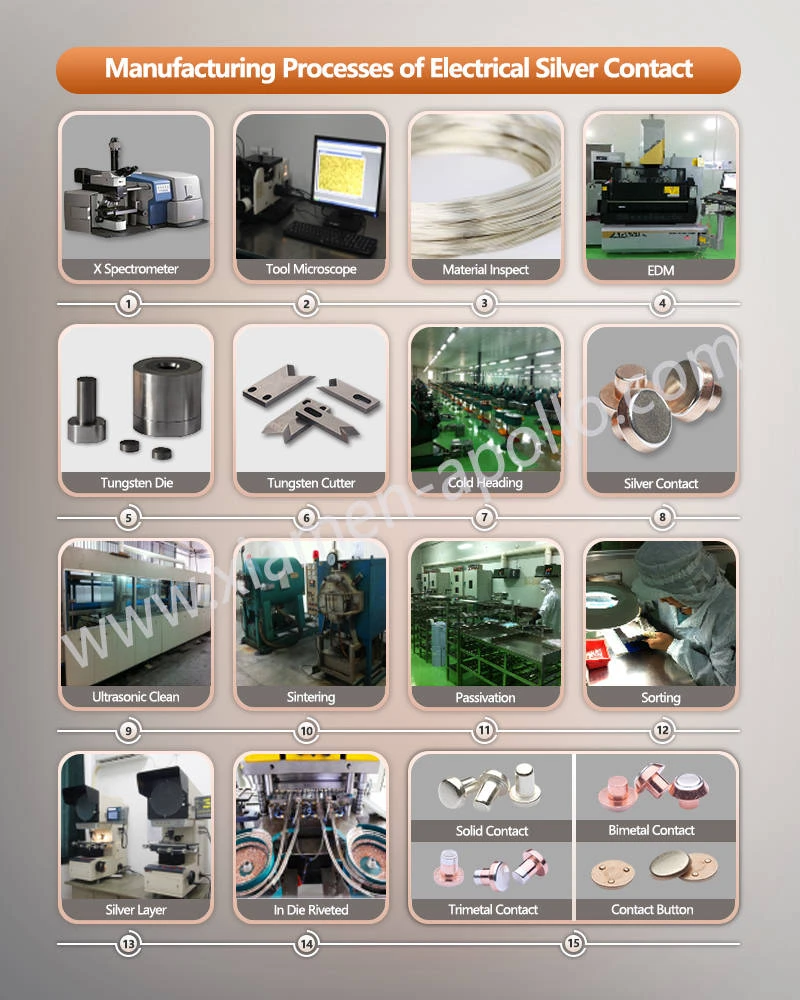
High-temperature rapid welding is the core stage of the entire process; the welding temperature directly determines the interfacial bonding strength and product stability. Maximizing the welding temperature-without causing over-melting defects-activates metal atoms, shortens welding time, and strengthens the metallurgical bond. Parameters must be tailored to specific contact materials; for instance, silver-tin oxide (AgSnO2) materials, which have poorer weldability, require an additional intermediate transition layer. Through precise optimization of temperature control parameters, the welding process for tri-metal silver rivet contacts meets the production requirements for various silver-based composite contacts.
The high-temperature welding stage is followed by a low-temperature diffusion homogenization treatment to compensate for the inherent limitations of rapid, high-temperature welding. Rapid welding can lead to incomplete atomic diffusion, leaving behind interfacial micropores or bonding gaps; a vacuum-based, low-temperature diffusion soak eliminates these interfacial defects, achieving a complete solid-state metallurgical bond. After undergoing this dual-stage thermal process, the internal microstructure of the pure tri-metal AgSnO2 electrical contact becomes dense and uniform, resulting in significantly enhanced electrical and mechanical properties.
The final riveting and forming step corrects dimensional deviations caused by high-temperature welding, ensuring the product meets precision standards. Adequate machining allowances are factored into the production stage, allowing precision molds to calibrate the contact's shape, dimensions, and surface condition to industry blueprint specifications. Following this precision forming process, the silver alloy tri-metal contacts exhibit a uniform appearance and consistent dimensions, making them perfectly suited for assembly into various electrical devices and for operation under demanding, high-frequency conditions.

Contact Us
Please feel free to contact us for professional technical support and customized solutions regarding process optimization, mass production plans, and contact selection for tri-metal silver contacts.
