

In March 2026, China's manufacturing industry continued to heat up, driven by both policy dividends and market demand. The Government Work Report for the first time proposed "creating a new form of intelligent economy" and explicitly promoted the "two-way development" of artificial intelligence and manufacturing, injecting strong momentum into high-end equipment, automation, and core component industries. However, while industry prosperity was rising, cost pressures caused by sharp fluctuations in upstream raw material prices were sweeping across the entire precision manufacturing sector-many companies were forced to announce price increases, and the industry entered a new stage of competition characterized by "high demand, high costs, and high technology."
Raw material prices have surged, with fasteners and contact materials bearing the brunt.
Recently, global prices for key metal raw materials have seen an unprecedented surge. As of March 11, 2026, the price of tungsten carbide powder reached 2,300 yuan/kg, an increase of nearly 380% compared to the 2025 average price; tungsten powder prices exceeded 2,360 yuan/kg, a similar increase. This round of price increases has not only impacted the cemented carbide cutting tool industry but has also affected the manufacturing sector of precision electrical contacts based on silver, copper, and nickel.
As core components of low-voltage electrical appliances, relays, and switching equipment, Bimetal Silver Contacts and Bimetal Rivet For Relays are highly dependent on a stable supply of precious and non-ferrous metals. While silver-based composite materials such as Bimetal Contacts Ag/Cu reduce the amount of precious metals used through structural design, cost pressures remain significant given the persistently high price of silver. Furthermore, slip ring contacts and sliding electrical contacts used in slip rings and motor commutators are also facing repricing due to rising copper and silver raw material prices.
Industry analysts point out that this round of raw material price fluctuations stems from multiple factors: a surge in demand for high-performance materials from emerging fields such as new energy and humanoid robots; geopolitical factors impacting key mineral supply chains; and global inflation expectations driving up futures prices through speculative capital. Against this backdrop, companies with vertical integration capabilities or those employing alternative material technologies have a greater advantage in terms of resilience.

Strong Demand for Smart Manufacturing Drives Order Booked Through Q3
In stark contrast to cost pressures, robust market demand is evident. Since the beginning of 2026, domestic high-end machine tool manufacturers have seen a significant increase in orders, with some manufacturers' orders booked until September. Processing demands from fields such as humanoid robot joint components, AI server liquid cooling housings, and new energy vehicle electric drive systems are accelerating the transformation of precision manufacturing towards "small batches, multiple varieties, and high precision."
This trend directly drives demand for highly reliable electrical connection components. For example, Switch Silver Contacts need to maintain low contact resistance during high-frequency switching; Fixed Silver Contacts require oxidation and weld resistance for long-term service. To meet these demanding conditions, more and more companies are turning to advanced processes such as Cold Headed Bimetal Contacts, using composite structures to balance conductivity, strength, and cost control.
High-end equipment is rapidly evolving, supporting the upgrading of the industrial chain.
Faced with challenges, leading companies in the industry are strengthening their competitiveness through technological innovation. Recently, the release of the fifth-generation vertical machining center marks a new breakthrough for domestically produced equipment in terms of high speed, high precision, and high rigidity. It can efficiently process aluminum alloy, stainless steel, and composite material shells, providing full-scenario solutions for emerging fields such as humanoid robots and energy storage equipment. Meanwhile, the localization of foreign brands in China has also entered a new stage-the cumulative delivery volume of a certain international machine tool manufacturer's factory in China has exceeded 20,000 units, and its jointly developed high-performance, cost-effective models are helping SMEs respond quickly to market changes.
Furthermore, the work hardening effect generated during the cold heading process of Composite Contacts and Noble Metals Contacts helps improve the surface hardness and wear resistance of the contacts; while the dense grain structure effectively inhibits material migration and welding tendency under the action of electric arc. Combined with subsequent surface strengthening treatments such as micro-arc oxidation or laser cladding, a nanoscale ceramic composite layer or gradient functional coating can be constructed on the working surface of the contacts to further delay oxidation and reduce contact resistance drift.
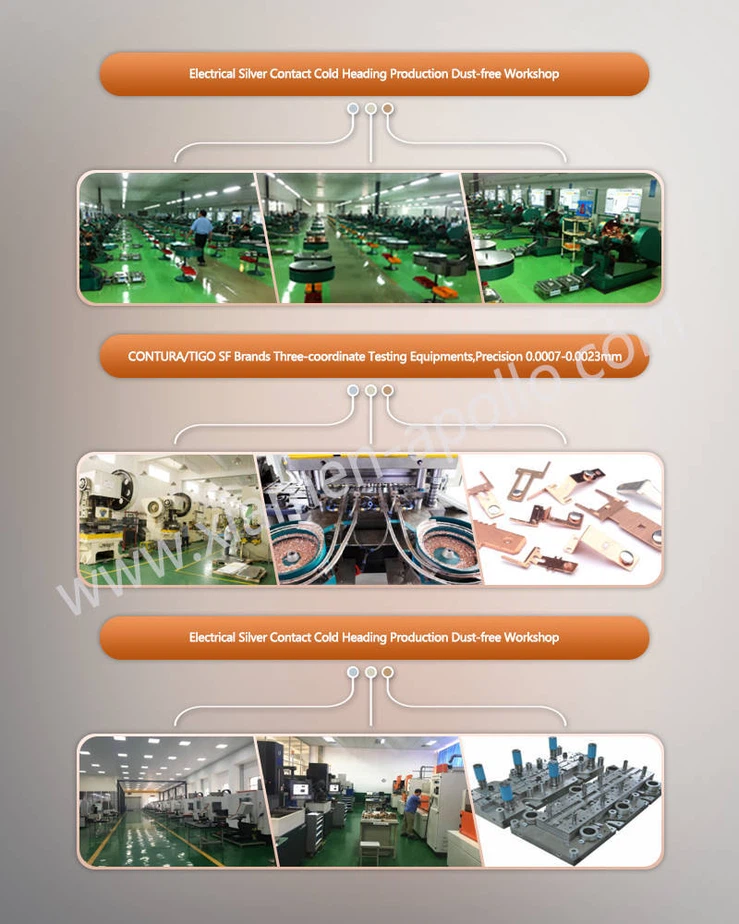
From a single Bimetallic Rivet Contact to a five-axis machining center, China's manufacturing industry is undergoing a profound transformation from "scale expansion" to "value creation." Despite short-term cost pressures, in the long run, technological upgrades and supply chain collaboration will build stronger competitive barriers. In the wave of deep integration between artificial intelligence and the real economy, only by adhering to innovation and lean operations can we create new opportunities amidst change.
If you would like to learn more about the arc resistance performance of Bimetallic Silver Contacts in high-frequency relays, please contact us-we will provide you with professional industry insights and technical interpretation.
Contact Us
