In recent years, China's electrical contact materials industry has maintained a dynamic trajectory of development. Electrical contact materials serve as critical foundational components for the manufacture of electronic devices such as switches, relays, and connectors; their performance directly determines the reliability and service life of electrical equipment. Within this sector, nickel-plated contacts are increasingly becoming the preferred solution for a growing number of manufacturing enterprises, owing to their exceptional oxidation resistance and conductive stability.
Product Classification and Technological Evolution
China's electrical contact materials industry primarily encompasses three major product categories: metallic, ceramic, and colloidal materials. Among these, metallic products command the largest market share. Within the realm of metallic contact materials, nickel-plating technology plays a pivotal role. While traditional pure copper contacts possess excellent electrical conductivity, they are prone to oxidation, which leads to increased contact resistance. In contrast, the adoption of Nickel-Coated Copper Contacts technology-which involves plating a layer of nickel onto a copper substrate-allows for the retention of copper's high conductivity while utilizing the density of the nickel layer to isolate the underlying material from the air, thereby significantly extending the lifespan of the contacts.
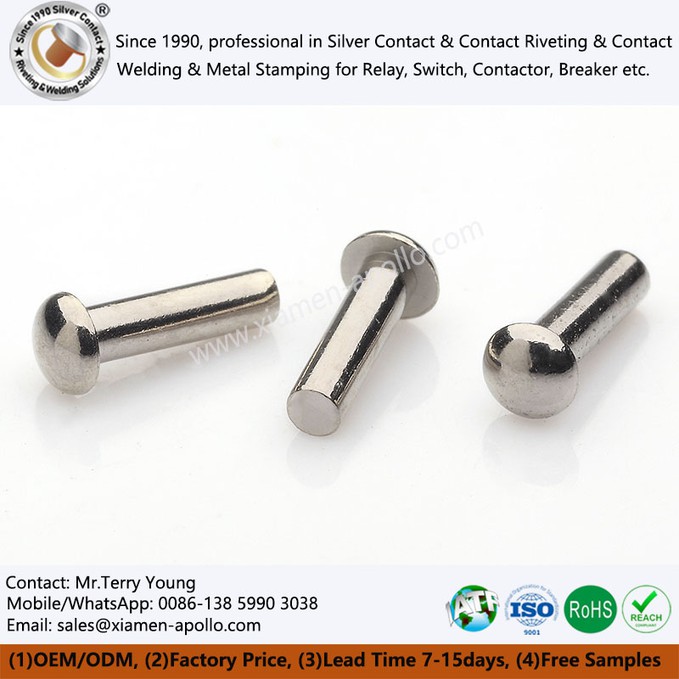
As technology continues to advance, manufacturing processes within the industry are also undergoing continuous improvement. Nickel-Plated Contact Rivets represent a classic product form within this sector; these components consist of pre-formed, nickel-plated contacts shaped into rivets, which are then fastened onto switch bases using automated riveting equipment. By effectively balancing both electrical contact reliability and assembly efficiency, these components have found widespread application in the fields of home appliance switches and automotive relays.
The Rise of Electroless Nickel Plating Technology
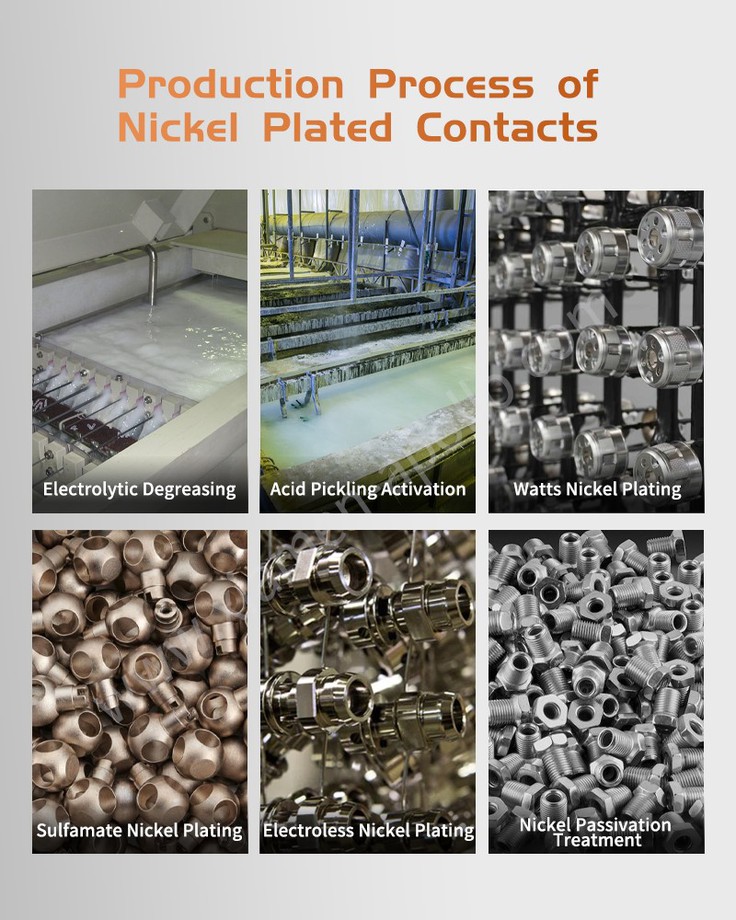
Within the realm of nickel plating processes, electroplating and electroless plating constitute the two primary approaches. Among these, electroless nickel plating has garnered increasing attention from enterprises due to the exceptional uniformity of its deposits. The technology-specifically applied to rivets-utilizes autocatalytic reactions to deposit a nickel layer onto contact surfaces; requiring no external electric current, it enables the formation of coatings with uniform thickness even on contacts of complex geometries, making it particularly well-suited for the production of miniaturized and irregularly shaped contacts.
The thin nickel layers formed through electroless plating are characterized by their non-porous, dense structure and high hardness, offering corrosion resistance that far surpasses that of electroplated nickel. For switching equipment required to operate in harsh environments-such as those characterized by high humidity or the presence of corrosive gases-this thin yet uniform nickel coating provides long-term, reliable protection.
The Core Role of Nickel Plating in the Field of Electrical Contacts
From an application perspective, the primary functions of nickel plating for electrical contacts include: preventing oxidation of the copper substrate, minimizing contact wear, inhibiting arc erosion, and reducing contact resistance. Whether in household wall switches or heavy-duty industrial contactors, the nickel layer on the contact surface silently withstands the electrical and mechanical stresses generated during every switching cycle.
Broadly speaking, any contact that has undergone nickel plating treatment can be classified as a Nickel Plated Electrical Contact. These products are widely utilized across numerous sectors, including consumer electronics, home appliances, automotive systems, and industrial control equipment.
Among these, Nickel Plated Copper Switch Contacts specifically refers to nickel-plated copper contacts designed for use in power switching devices; they serve as the core conductive components in products such as wall switches, microswitches, and push-button switches.
Industrial Application of the Electroplated Nickel Process
Electroplated Nickel Contacts represent the most widely adopted method of nickel plating currently utilized within the industry. By precisely controlling current density, plating bath temperature, and plating duration, a nickel layer of the desired thickness can be deposited onto the surface of copper contacts. The electroplated nickel process is a mature technology with relatively low costs, making it well-suited for mass production-particularly for standard products where requirements for plating uniformity are not exceptionally stringent.
During the electroplating process, the quality of the nickel plating for electrical contacts is contingent upon several factors: the cleanliness of the substrate surface, the composition of the plating bath, and the electrical current parameters, among others. A high-quality nickel plating layer should exhibit excellent adhesion; it must not peel or flake off following bending or stamping operations, and it should possess a requisite level of hardness and wear resistance.
Heavy-Duty and Stamping Processes
In industrial applications, switches and contactors are frequently subjected to severe current surges; standard plating finishes are often insufficient to meet these demands. Heavy Duty Nickel Plated Contacts feature a thickened nickel plating layer designed to effectively mitigate arc-induced surface erosion on the contacts, thereby delaying the rise in contact resistance and ensuring the long-term, reliable operation of equipment under harsh operating conditions.
From a manufacturing perspective, Stamped Nickel Plated Contacts represent the most efficient method currently available for contact production. Utilizing high-speed stamping presses and precision progressive dies, the entire stamping and forming process can be completed in a single pass directly from copper or nickel strip stock. Conversely, for irregularly shaped contacts requiring complex bends or multi-segment geometries, the Formed Nickel Plated Contacts process is employed, involving a series of sequential forming operations to achieve the final configuration.
Industry Competition and Future Outlook
The competitive landscape within China's electrical contact materials industry is currently intensifying. Competition among enterprises primarily manifests across three key dimensions: product pricing, technological proficiency, and quality control. As consumer demands for the safety and reliability of electrical products continue to rise, downstream equipment manufacturers are imposing increasingly stringent quality standards on electrical contacts. Against this backdrop, companies capable of reliably supplying Micro Nickel-Plated Contacts are poised to capture a larger share of the market.
Looking ahead, the electrical contact materials industry is set to evolve in two primary directions: first, toward high performance-achieved by optimizing plating composition and thickness design to further enhance the contacts' resistance to arcing and wear; and second, toward miniaturization-adapting to the trend of electronic device miniaturization by developing nickel-plated contact products of smaller dimensions and higher precision.
The selection of contact materials and the associated manufacturing processes directly determine the reliability and service life of electrical products. If you are currently developing a new project or seeking to optimize an existing solution involving Thin Nickel Layer Electrical Contacts, we invite you to contact us for expert advice.
contact us