

In electrical control systems, relays serve as core components for achieving the principle of "using a small signal to control a large load," and are broadly categorized into two main types: AC relays and DC relays. Although their fundamental function-controlling the opening and closing of circuits through electromagnetic effects-is shared, the inherent differences in their operating power sources (AC versus DC) result in significant distinctions regarding magnetic circuit design, core construction, and manufacturing processes. A thorough understanding of these differences is crucial for the proper selection and application of these devices.
First, from the perspective of fundamental electromagnetic principles, the operating states of the two types differ markedly. AC relays are energized by alternating current that varies sinusoidally; consequently, the magnetic flux within their magnetic circuits is also alternating. As a result, although the direction of the electromagnetic attraction remains constant, its magnitude pulsates between maximum and minimum values in tandem with the current-at a frequency that is twice that of the AC power supply. In contrast, DC relays are energized by direct current, which follows a linear pattern; this generates a constant, unchanging magnetic field, resulting in highly stable electromagnetic attraction. This inherent fluctuation in attraction force necessitates that, during the design of AC relay cores, specific measures be taken to eliminate vibration and noise.
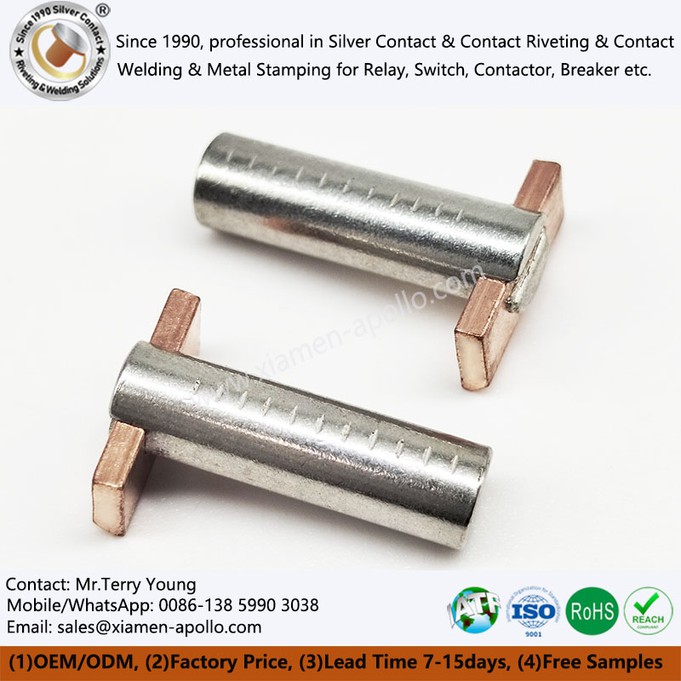
To address the issue of armature chatter caused by the periodic zero-crossing of AC electromagnetic attraction, the core face of an AC relay typically incorporates an embedded short-circuit ring (also known as a shading ring). This AC Relay Core and Copper Ring configuration generates a phase-lagging magnetic flux, ensuring that sufficient attractive force remains to keep the armature closed even at the precise moment the total magnetic flux crosses zero, thereby achieving a silent and stable engaged state. In contrast, the core of a DC relay-due to its constant magnetic field-does not encounter the zero-crossing problem; consequently, it requires no short-circuit ring and is typically constructed from a solid block of cast iron or soft steel.
Regarding material selection, to mitigate eddy current losses and hysteresis losses induced by alternating magnetic fields, AC relay cores typically forgo a solid structure in favor of a laminated design, comprising multiple mutually insulated silicon steel sheets. In certain high-performance or specialized applications, a Grooved Core for AC Relay design may also be employed. By machining specific grooves into the core surface, the circulation paths of eddy currents can be effectively interrupted, thereby reducing core heating under high-power alternating magnetic fields and enhancing the relay's overall energy efficiency.
Beyond the flat-laminated structure, certain types of AC contactors or high-power relays may instead utilize a cylindrical "AC Rod" design. Regardless of its specific form, the AC Core-serving as the central conduit for magnetic flux-must possess exceptionally high magnetic permeability. A high-quality AC core is capable of generating a powerful working magnetic field across the air gap using a relatively low number of ampere-turns-a critical attribute for modern electrical equipment striving for lightweight and compact designs.
Unlike DC relays, where coil current is primarily limited by resistance, AC relays generate a continuous back electromotive force (back EMF) during steady-state operation; consequently, their coil current is predominantly determined by inductive reactance. This implies that AC relay coils typically feature fewer turns and thicker wire gauges to minimize internal resistance and heat generation. Conversely, the coil current in DC relays is governed solely by resistance; to prevent conditions approximating a short circuit, their coils typically feature a high number of turns and finer wire gauges, resulting in higher internal resistance. This fundamental difference also dictates the significant divergence in the design of their respective drive circuits.
As a complete Coil-Core for Electromagnetic Relay system-whether applied to DC or AC circuits-its fundamental objective remains the efficient conversion of electrical energy into magnetic energy. When designing the core of an AC relay, engineers must comprehensively consider the distribution of magnetic reluctance, eddy current effects, and the stability of the mechanical structure. An optimal core design ensures that the magnetic circuit operates within its ideal linear region, thereby preventing a reduction in attractive force or a delay in release caused by localized magnetic saturation.
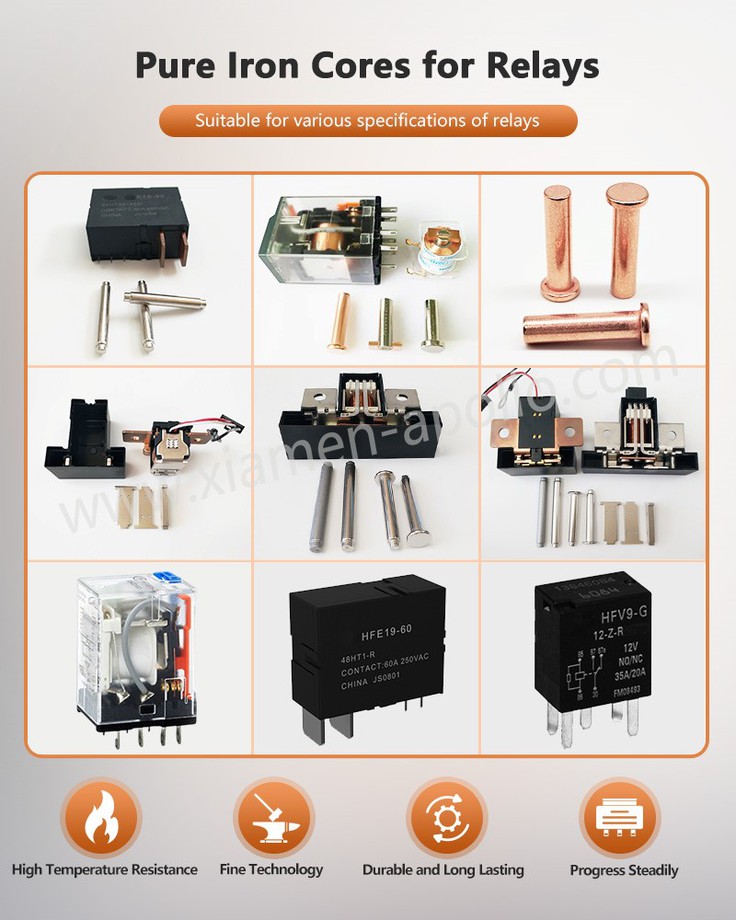
Ultimately, regardless of the specific configuration of an AC relay, its performance ceiling is determined by the material quality of the Pure Iron Core employed. High-purity iron core material translates to lower residual magnetism and higher magnetic induction-the fundamental physical basis for achieving a relay that pulls in firmly and releases rapidly. Selecting high-quality pure iron material is the key to preventing common faults-such as contact sticking and excessive noise-at the very source.
If you are seeking professional and reliable solutions for Grooved Cores for AC Relays, precision soft magnetic components, or related stamped parts, please feel free to contact us at any time for detailed technical support and customized services!
Contact Us
