

A relay is an electrical device that controls the flow of current in a circuit based on external electrical signals. Essentially, it acts as a "switch," controlling the current flow through the opening and closing of its Silver Electrical Contacts. The reliability and lifespan of a relay largely depend on the operating state of this core component; therefore, a thorough understanding is essential for proper equipment use.

The operation of the relay's core conductive component consists of four stages: disconnection, open state, closing process, and closed state. Its core requirement is the reliable ability to close and open circuits. The key to this performance lies in the contact resistance of the Precision Electrical Contacts. This resistance is inherent; no conductive component is completely contact-resistant.
Contact resistance has several adverse effects: When current flows through a closed conductive component, excessive resistance consumes power, causing the component's temperature to rise. This sustained temperature increase ultimately affects the Composite Contacts' operational stability, and in severe cases, can lead to welding failures, preventing the closed conductive component from opening.
Contact resistance has several adverse effects: When current flows through a closed conductive component, excessive resistance consumes power, causing the component's temperature to rise. This sustained temperature increase ultimately affects the Cold Headed Bimetal Contacts' operational stability, and in severe cases, can lead to welding failures, preventing the closed conductive component from opening.
Another form of contact resistance is "film resistance," which adheres to the surface of conductive components, leading to decreased conductivity and, in severe cases, complete loss of conductivity. This is a core reason for circuit breakage or intermittent continuity in practical applications. The root cause of this problem is the formation of a thin film on the Sliding Electrical Contact due to dust, moisture, and other contaminants.
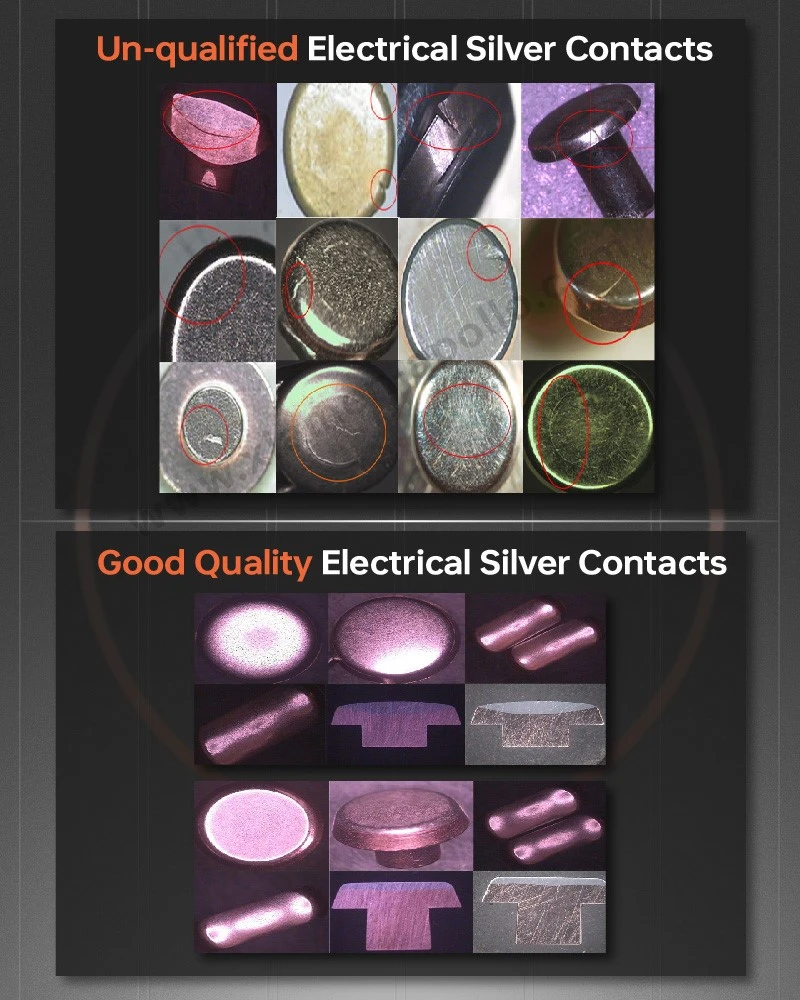
Factors affecting the contact resistance of relay conductive components include the magnitude of contact pressure, the selection and use of materials, and the structural form. To ensure stable contact resistance and improve equipment reliability, the key is to keep the Slip Ring Contacts away from moisture, dust, and harmful gases, reducing the possibility of component contamination.
Relay conductive components are classified into different types, and Spring Electrical Contacts are correspondingly divided into three categories: normally open (also called normally closed) contacts that are open when the coil is not energized; normally closed (also called normally closed) contacts that are closed when the coil is not energized; and a combination where one moving conductive component is normally closed with one stationary conductive component and normally open with another stationary conductive component is called a changeover type.
Beyond the design of basic conductive components, numerous relay conductive parts with varying structures have emerged on the market to meet diverse application needs. For relays used in high-altitude areas, in addition to considering equipment insulation, breaking capacity, and heat dissipation, the environmental adaptability of the Electrical Contacts is also a crucial factor.
Product Recommendation
To fundamentally solve problems such as contact resistance, oxidation contamination, and welding in the core components of relays, selecting the right material is key. Our Silver Electrical Contacts are designed specifically for this purpose. Leveraging the excellent conductivity, thermal conductivity, and oxidation resistance of silver, this product effectively reduces contact resistance, minimizes film resistance formation, and enhances the components' high-temperature resistance and anti-welding capabilities. It is suitable for various relay application scenarios, ensuring stable performance even in special environments such as high altitudes, thus laying a solid foundation for the reliability and lifespan of relays from a material perspective.
contact us
High-quality Precision Electrical Contacts contribute to stable relay operation. We welcome customers to inquire about selection, discuss orders, and provide professional product solutions suitable for various application scenarios!
