

In high-voltage direct current (HVDC) electrical systems, particularly in new energy vehicles, charging infrastructure, and energy storage, unprecedented demands are placed on the reliability and lifespan of core switching devices, such as HVDC contactors.
The performance bottleneck of these devices often stems not from the electromagnetic design itself, but from the critical interface within them that handles electrical connections, high-voltage insulation, and hermetically sealed enclosures: the permanent bonding area between the ceramic insulator and the metal conductor.
Simple mechanical assembly or bonding of organic materials using traditional processes is highly susceptible to failure under long-term electrothermal stress and harsh environmental conditions.
Therefore, the sophistication of ceramic-to-metal packaging technology directly determines the ultimate performance of power semiconductors and contactor modules.
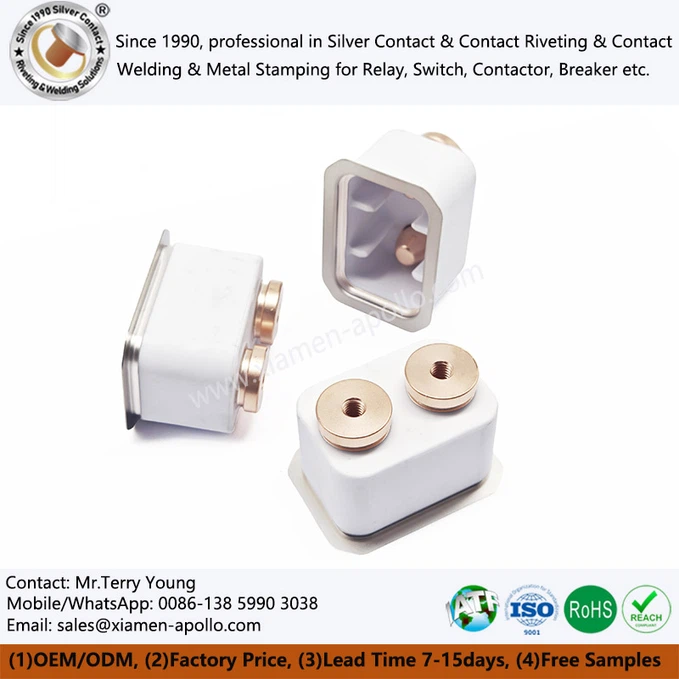
The starting point for achieving high-performance ceramic-to-metal packaging lies in a deep understanding and precise selection of material systems. At its core is a Precision Metallized Ceramics structure, typically composed of three parts:
High-purity alumina ceramic substrate (e.g., 95% alumina): As the main insulating and structural component, its value lies in its excellent dielectric strength, high thermal conductivity, superior thermal stability, and mechanical strength. It provides a stable physical and chemical platform for metallized ceramic components.
Precision metallization layer: This is the core achievement of the ceramic metallization process. By forming a thin metal film (often a molybdenum or tungsten-based alloy) tightly bonded to the substrate on the ceramic surface, this layer achieves a functional transformation from insulator to conductor, providing an ideal metallurgical bonding surface for subsequent soldering. High-quality metallized ceramics require the metallization layer to have excellent adhesion strength, solderability, and a coefficient of thermal expansion matching the ceramic.
Metal conductors (such as high-conductivity oxygen-free copper or Kovar alloy): As current carriers or structural connectors, they are brazed at high temperatures to form an airtight, high-strength metallurgical bond with the metallization layer, ultimately constituting a complete Alumina Metallized Ceramics assembly.
The core technology for reliably joining ceramics and metals is high-temperature active metal brazing. This process is far from ordinary welding; it's a precision metallurgical process performed in a vacuum or protective atmosphere using special brazing filler metals containing active elements such as titanium and zirconium.
At high temperatures, these active elements effectively wet the ceramic surface, reacting chemically to form a transition layer, thus achieving an atomic-level bond between the brazing filler metal, the metallized layer, and the ceramic.
This process is crucial for manufacturing High-Strength Metallized Ceramic Components, determining the final product's hermeticity, mechanical strength, and long-term thermal cycling reliability.
Precision Metallized Alumina Ceramic Components produced using this process achieve extremely high leakage rates, ensuring long-term stability of the internal medium.

Therefore, these advanced Metalized Ceramics for Electrical Components have become the preferred solution for fields with extremely stringent reliability requirements, such as fast-charging relays for 800V platforms in new energy vehicles, DC circuit breakers for energy storage systems, and high-end industrial frequency converters.
They are not only ideal choices for Metallized Ceramic Housing for Power Semiconductors, but also key foundational components driving high-voltage electrical systems towards higher power density and longer service life.
contact us
