

When constructing photovoltaic power stations in complex terrains-such as mountainous regions, hilly areas, barren slopes, and undulating ravines-traditional fixed-mount PV racking systems often suffer from poor adaptability. These systems not only necessitate extensive earthworks for site leveling but also present numerous challenges, including difficult foundation construction, high costs, and significant disruption to the original natural landscape. Against this backdrop, cable-structure PV racking systems have emerged as the preferred solution for photovoltaic projects in complex terrains; leveraging advantages such as large spans, minimal land footprint, and exceptional terrain adaptability, these systems-when paired with standardized aluminum mounting brackets-can further enhance overall installation stability and structural compatibility.
Distinguishing itself from traditional all-steel support frameworks, the cable-structure racking system operates on a core principle: utilizing high-strength prestressed steel cables to replace large volumes of solid structural steel. Drawing inspiration from the structural design concepts of suspension bridges, this system suspends and tensions the photovoltaic modules in mid-air. The entire structure relies solely on vertical columns anchored at both ends and at key intermediate points, thereby drastically reducing the number of required intermediate support foundations. This design endows the structure with a unique combination of lightweight characteristics and high structural strength; furthermore, when integrated with aluminum alloy solar panel mounting brackets, it precisely meets the specific fastening requirements of the cable-structure assembly, ensuring seamless adaptability across a wide spectrum of undulating and complex terrain installation scenarios.
The installation of photovoltaic brackets in complex terrain follows a standardized construction process, the primary phase of which involves on-site terrain surveying and customized solution design. During the preliminary construction stage, a field survey is conducted to assess site slope, surface undulation, and geological conditions. For slopes ranging between 10 and 20 degrees, conventional fixed brackets may be employed; however, in areas where slopes exceed 20 degrees-or where the terrain is characterized by pits and intersecting ravines-the inherent advantages of cable-structure systems become fully apparent. Based on the actual topography, technical personnel plan the precise locations for support columns and determine the configuration for cable tensioning. Adhering to the principles of "minimal excavation" and "no backfilling," the system is adapted directly to the existing terrain; furthermore, by utilizing specialized Aluminum Photovoltaic Bracket Accessories, installation nodes can be flexibly adjusted to accommodate the layout requirements of varying slopes.
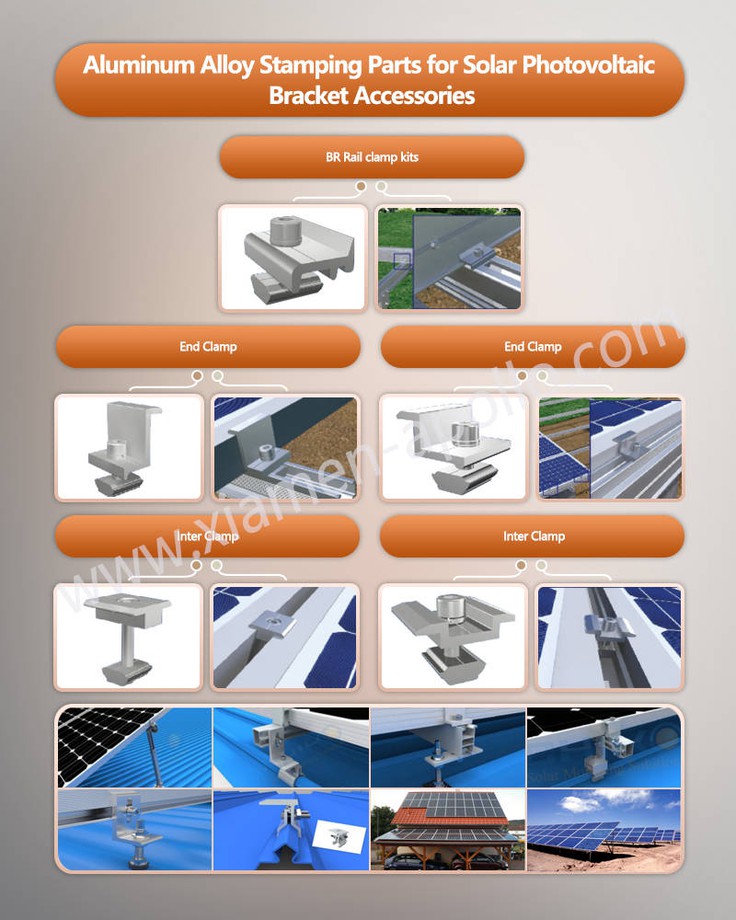
The second phase involves the pouring of foundations and the erection of support columns-a critical stage in the installation process for complex terrain. Concrete foundations are poured and steel columns erected at the pre-planned locations. Compared to traditional photovoltaic bracket systems, the cable-structure system eliminates the need to drive piles or construct foundations beneath every individual PV module; instead, columns are strategically positioned only at the two ends of the slope and at key intermediate load-bearing points, thereby reducing the total volume of foundation work by over 70%. The height of the support columns can be flexibly adjusted to compensate for ground elevation differences, thereby adapting seamlessly to the undulating contours of mountainous terrain; when paired with Aluminum Solar Panel End Clamps for PV Mounting Systems, this configuration ensures the precise connection and secure fastening of the columns to the structural cables.
Once the column layout is complete, the process moves to the cable tensioning phase. High-strength, pre-stressed steel cables are anchored to the columns at both ends, and professional equipment is utilized to precisely control the tensioning force. Much like tuning a musical string, the tension is balanced to ensure uniform load distribution, thereby establishing the cables as a stable, load-bearing track. In mountainous regions frequently subject to strong winds, additional wind-resistant cables and auxiliary stabilizing cables are installed to reinforce the overall structure and minimize structural oscillation; Aluminum Solar Middle Clamps are employed to securely fasten the PV modules to the cables at intermediate points, further enhancing the wind resistance and overall stability of the entire system.
The final stage involves the mounting of the photovoltaic modules. Construction personnel install specialized clamps along the cables to sequentially secure the PV panels, making minor adjustments to ensure the overall flatness and alignment of the array. This method facilitates the easy installation of large-span arrays-ranging from 10 to 60 meters-without occupying ground-level space; consequently, the land beneath the bracket structure remains available for other uses, such as agricultural cultivation or livestock grazing. The entire construction process requires no heavy machinery on-site; the primary installation procedures can be completed entirely by manual labor. By utilizing standardized components-such as Aluminum Clamp Hooks for roof-mounted photovoltaic supports-the system can also effectively accommodate the auxiliary installation requirements of specific, unique site locations.
Cable-structure photovoltaic mounting systems offer multiple practical advantages in complex terrain scenarios. Economically, they reduce steel consumption by over 10% compared to traditional mounting systems, potentially lowering overall steel costs by 30% to 50%. Furthermore, construction procedures are streamlined, and project timelines can be shortened by nearly 40%. In terms of terrain adaptability, these systems are compatible with diverse and challenging topographies-including rocky ground, slopes, ditches, and depressions. Their large-span design allows them to bridge ground protrusions and ravines, thereby significantly enhancing land utilization efficiency. Additionally, the use of Aluminum Alloy Waterproof Solar Rails ensures adaptability to humid outdoor environments, thereby enhancing the corrosion resistance and weather durability of the mounting components.
Furthermore, this model is notably eco-friendly; it requires fewer foundation points, causes minimal disruption to surface vegetation, and features ample ground clearance beneath the support structures, thereby facilitating the integrated development of "Agri-PV" (agriculture-photovoltaics) and "Pasture-PV" (pastoral-photovoltaics) systems. In terms of structural safety, the prestressed steel cables exhibit excellent flexibility as well as superior wind and seismic resistance; the standard design is capable of withstanding winds up to Force 12. When combined with the lightweight characteristics of the Aluminum Clamp Hook for Roof Photovoltaic Support, the overall structural load is further reduced. During actual construction, it is essential to select a professional construction team, strictly control the prestressing tensioning process, ensure proper anti-corrosion treatment for the steel cables and Aluminum Alloy Solar Panel Mounting Brackets, designate access routes for future maintenance, and prioritize anti-slip and anti-overturning designs for foundations situated on mountainous terrain, thereby guaranteeing the long-term, stable operation of the power station.
Photovoltaic construction in complex terrain has gradually evolved toward solutions characterized by lightweight design, minimal environmental disturbance, and high adaptability. Cable-supported structures-integrated with Aluminum Solar Middle Clamps-have emerged as the mainstream model for developing PV projects on barren slopes and mountainous terrain, and their range of future application scenarios is expected to continue expanding.
If you require assistance with selecting specific specifications for Aluminum Alloy Waterproof Solar Rails or need comprehensive engineering support solutions, please feel free to contact us at any time. We offer customized solutions tailored to your specific needs, as well as on-site technical adaptation services for your projects.
Frequently Asked Questions
1. What photovoltaic projects are suitable for Aluminum Mounting Brackets?
Suitable for photovoltaic power station projects in mountainous, hilly, barren slope, rooftop, and complex terrain environments, offering excellent terrain adaptability.
2. What is the main function of Aluminum Solar Middle Clamps?
Used to fix the photovoltaic modules in the middle, ensuring secure installation and improving overall structural stability.
3. What module specifications are suitable for Aluminum Solar Panel End Clamps?
Customizable to different photovoltaic module thicknesses, widely applicable to mainstream photovoltaic module installation systems.
contact us
