

In our daily lives, power switches are ubiquitous, yet most people know very little about the industrial trivia behind them. A prime example involves the "I" and "O" symbols commonly found on switch panels. Many people habitually assume that "I" stands for "Input" and "O" stands for "Output," or simply interpret "O" as "Off." In reality, neither of these explanations is accurate. The origins of these two symbols can be traced back to World War II; at that time, to ensure the stable operation of electrical equipment for various national militaries, engineers introduced the universally recognized concept of binary code: in binary, "1" represents "on," and "0" represents "off." Consequently, "I" symbolizes a closed circuit (on), while "O" symbolizes an open circuit (off). In 1973, the International Electrotechnical Commission (IEC) officially incorporated this standard into its technical specifications, and it has remained in use ever since, becoming the universal language for power switches worldwide.
The core value of a power switch lies in the reliability and safety of its switching mechanism-factors that depend directly on the performance of its internal contact materials. Among various types of metal contacts, nickel-plating technology has emerged as the preferred process for medium-to-high voltage and high-current switches, thanks to its exceptional resistance to oxidation and wear. By employing advanced electroplating techniques to coat a copper substrate with a dense layer of nickel, the mechanical lifespan of the contacts can be significantly enhanced. Specialized "Nickel Plated Contacts" effectively prevent the base metal from oxidizing or rusting during prolonged use, ensuring that the switch maintains extremely low contact resistance even after tens of thousands of operations, thereby eliminating potential hazards such as overheating or arcing caused by poor contact.
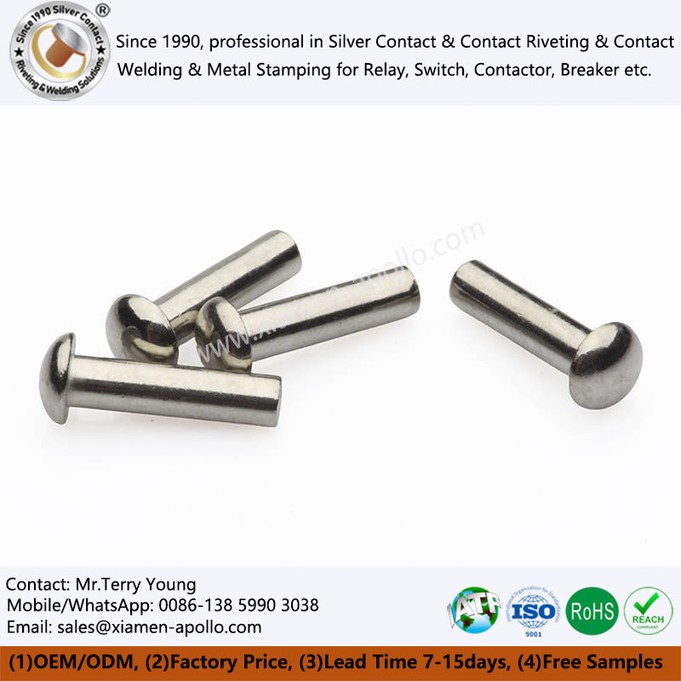
To achieve an optimal balance of performance, modern switch contacts typically employ a composite metal structure. Nickel-coated copper contacts perfectly combine the high electrical conductivity of copper with the high hardness of nickel. While pure copper offers excellent conductivity, it is relatively soft and prone to oxidation; conversely, the nickel layer not only provides high hardness and wear resistance but also forms a stable passivation film on the surface. This "copper-core, nickel-shell" structure ensures highly efficient, low-loss current transmission while endowing the contacts with exceptional resistance to arc erosion-a critical factor in guaranteeing the safe operation of both residential and industrial power switches.
In the realm of precision manufacturing, switch contacts take on various forms; among these, rivet-type contacts are widely utilized due to their structural robustness. Nickel-plated contact rivets are typically formed using cold heading or hot forging processes, followed by a comprehensive nickel plating treatment. This integral, one-piece structure ensures the secure mounting of the contact onto the switch's internal support bracket; even under conditions involving frequent physical actuation or vibration, the contact remains firmly in place without loosening or shifting, thereby providing a solid physical foundation for the long-term mechanical stability of the power switch.
Beyond traditional electroplating techniques, electroless nickel plating represents a significant technological breakthrough for switch contacts. Electroless nickel plating for rivets utilizes chemical reactions to deposit a nickel-phosphorus alloy layer onto the metal surface. Compared to electroplating, the thickness of the electroless nickel layer is remarkably uniform, achieving complete coverage even within the intricate recesses or along the edges of complex rivet shapes. This process not only enhances the contact's corrosion resistance but also imparts superior solderability, making it ideally suited for precision power switch components that demand the highest standards of dimensional accuracy and corrosion protection.
From the perspective of materials science, nickel plating for electrical contacts serves a purpose far beyond mere aesthetics or simple rust prevention. As a transition metal, nickel possesses an exceptionally high melting point and excellent chemical stability. During the momentary opening and closing of a switch, high-temperature electrical arcs can easily form between the contacts; a high-quality nickel plating is capable of withstanding this instantaneous thermal shock, thereby preventing the contact surfaces from fusing together (welding). This capability is paramount to ensuring the safety of power switches in high-power appliances-such as air conditioners and water heaters-as it effectively eliminates the risk of failure-to-disconnect accidents caused by contact adhesion.
In the fields of industrial control and automation, the requirements for the reliability of electrical connections are even more rigorous. Consequently, nickel-plated electrical contacts have become the standard configuration for relays, contactors, and various types of industrial switches. These contacts are required to operate reliably over extended periods within harsh electromagnetic environments and under fluctuating temperature and humidity conditions. The stable contact interface provided by the nickel plating ensures the precise transmission of control signals, preventing signal attenuation or control failures caused by the thickening of oxide films; thus, it serves as the microscopic safeguard for the stable operation of industrial automation systems.
For residential and commercial wall switches, the design of nickel-plated copper switch contacts places greater emphasis on balancing tactile feedback during switching with electrical service life. High-quality electroless nickel-plated rivets, paired with precision spring mechanisms, endow the switches with a crisp, distinct switching sound and eliminate any sensation of sluggishness during operation. Furthermore, the abrasion resistance of the nickel layer ensures that-even after tens of thousands of actuations-the internal contacts remain as responsive as when new, thereby significantly enhancing both the user experience and the product's durability.
As environmental awareness continues to rise, the manufacturing processes for electroplated nickel contacts are evolving toward greener and more efficient methodologies. Modern, advanced electroplating production lines utilize precise control over current density and plating bath formulations to not only boost the efficiency of nickel deposition but also substantially reduce the discharge of heavy-metal-laden wastewater. This eco-friendly and highly efficient manufacturing approach enables nickel-plated contact rivets to maintain high performance while simultaneously meeting increasingly stringent global environmental regulations, thereby driving sustainable development within the electrical manufacturing industry.
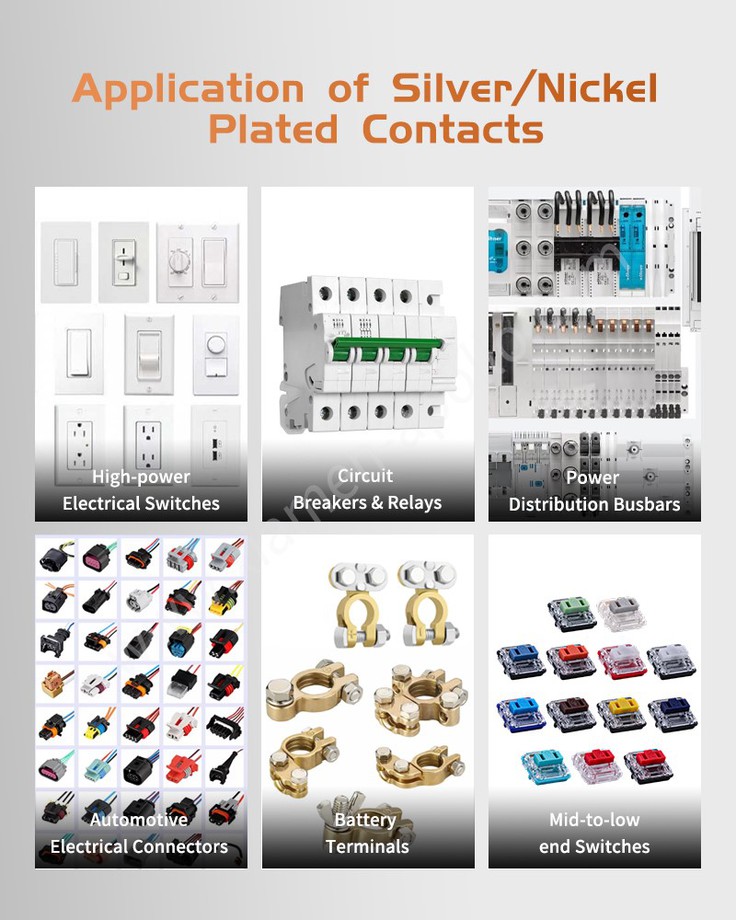
As electronic devices continue to trend toward miniaturization, the demand for micro nickel-plated contacts is growing steadily. In the power management systems of smartphones, wearable devices, and miniature relays, contact dimensions often measure merely a few millimeters-or even less. Executing high-quality nickel plating at such minute scales poses extreme challenges regarding both mold precision and the electroplating process itself. Nickel plating for electrical contacts demands not only exceptional dimensional consistency but also the ability to maintain stable conductivity under extremely low contact pressures.
Although power switches may be small in size, they embody a profound synthesis of expertise in materials science, mechanical design, and precision manufacturing. From the standardization of binary symbols to the precision machining of nickel-plated electrical contacts, every single stage is critical to ensuring electrical safety and stability. When selecting power switches, beyond considering aesthetics and brand reputation, understanding the internal contact technology serves as a vital criterion for assessing product quality.
If you are seeking high-quality nickel-plated copper switch contacts, customized conductive components for power switches, or professional metal electroplating services, we invite you to contact us at any time. Our expert team is ready to provide you with comprehensive solutions-ranging from material selection and process design to mass production-helping your electrical products achieve superior safety performance and enhanced market competitiveness.
contact us
