What are Electrical Copper Contacts?
Electrical copper contacts are core components used in electrical devices to achieve conductive connections and transmit current. They are typically made of copper and its alloys, which feature high conductivity, high wear resistance, and good corrosion resistance. They play an irreplaceable role in electrical devices such as switches, motors, relays, circuit breakers, and charging ports.
The basic function of a Solid Copper Contact is to form a stable interface with another contact, enabling current transmission with low contact resistance and maintaining a reliable electrical connection under conditions such as mechanical switching and vibration.

Why Copper is the Material of Choice for Electrical Contacts
Copper has a long history of use in Electrical Copper Rivets, and its material advantages are proven industrially, primarily in the following aspects:
1. Extremely High Electrical Conductivity
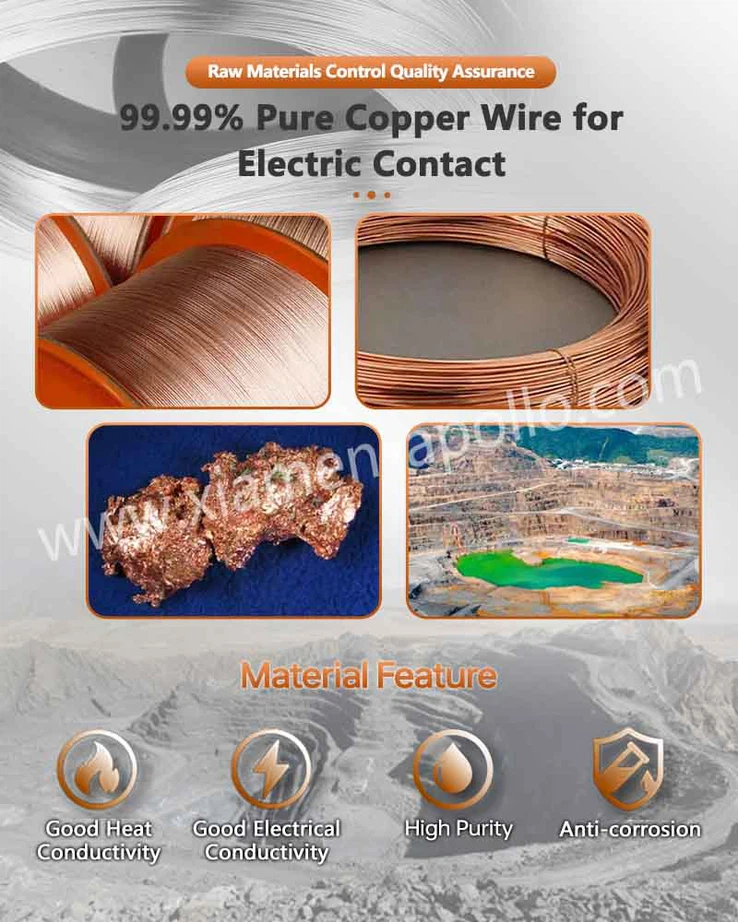
Pure copper has an electrical conductivity of up to 58 MS/m (100% of the International Annealed Copper Standard (IACS), significantly superior to most metals and second only to silver. High conductivity means Electrical Solid Copper Contacts have lower resistance, less heat generation, and lower energy loss for the same size.
2. Excellent Thermal Conductivity
Copper's thermal conductivity can reach 400 W/(m·K), which helps dissipate heat quickly and reduces the risk of oxidation, deformation, and performance degradation caused by heated Copper Rivet surfaces.
3. Excellent Mechanical Properties and Wear Resistance
Copper and its alloys, while maintaining ductility, can achieve high hardness and wear resistance through work hardening or alloying, extending Electrical Copper Contacts life.
4. Strong Corrosion Resistance
A dense copper oxide film forms on the copper surface, protecting humid and hot environments. It is particularly suitable for applications such as outdoor power distribution, rail transit, and new energy charging.
5. Excellent Machinability
Copper is suitable for a variety of processing methods, including turning, stamping, riveting, welding, and plating, to meet diverse structural and performance requirements.
Main Types of Electrical Copper Contacts
Depending on their structure and application, Electrical Copper Rivet Contacts can be divided into the following categories:
1. Flat Contacts
Commonly found in devices such as circuit breakers and knife switches, they feature a large contact surface and high current-carrying capacity.
2. Round or Rivet Contacts
Often combined with silver or silver alloys to form composite contacts, used in relays, contactors, etc.
3. Spring Contacts
Ensure Solid Copper Rivet pressure through a springy structure, making them suitable for low-current applications such as signal transmission and plug-in connectors.
4. Composite Contacts
Uses a copper base, composited with materials such as silver and silver-tin oxide, to enhance arc resistance and weld resistance.
Manufacturing Process for Electrical Copper Contacts
High-quality copper contacts require a precision manufacturing process, the main steps of which include:
1. Material Selection and Proportioning
Choose pure copper (such as T2 copper) or copper alloys (such as brass C2680, beryllium copper C17200, chromium-zirconium copper (CuCrZr), etc.), depending on the application.
Pure copper is suitable for high-conductivity applications, while alloyed copper is suitable for wear resistance and high-temperature resistance.
2. Forming
Stamping: Used for mass production of regular flat or shaped Copper Electrical Contacts.
Turning: Used for high-precision round contacts.
3. Surface Treatment
Common methods include silver plating, nickel plating, and tin plating to reduce contact resistance and prevent oxidation.
The thickness of the silver plating layer is typically 3–10 μm and can be adjusted according to the current level.
4. Heat Treatment and Hardening
Solution treatment and age hardening of copper alloy contacts enhance strength and wear resistance.
5. Quality Inspection
Inspections include dimensional accuracy, surface roughness, coating thickness, contact resistance, and current-carrying capacity to ensure batch consistency.

Typical Applications of Electrical Copper Contacts
Red Copper Contacts are found in virtually all equipment that requires current transmission. Key applications include:
1. Low-voltage power distribution systems
These include circuit breakers, disconnectors, and busbar connectors, which must withstand high operating currents.
2. Medium- and high-voltage power equipment
Copper contacts with silver plating maintain stable performance under arcing conditions and are used in high-voltage contactors and vacuum switches.
3. Automotive and New Energy Vehicles
On-board DC contactors, charging connectors, and high-current relays all utilize copper contacts.
4. Rail Transit
Wear-resistant Electric Copper Contacts are used in pantographs, signal relays, and control system connectors to ensure long-term reliability.
5. Industrial Automation and Robotics
High-speed switching contactors and relays rely on Solid Contact for Switch Part with low contact resistance to reduce energy loss.
Performance Testing and Standard Reference
High-performance Electric Copper Contacts must meet international and industry standards. Key testing indicators include:
| Contact resistance | Typically required to be less than 1 mΩ. |
| Current carrying capacity | Calculated based on the Copper Electrical Contacts' size and material conductivity, and verified in actual testing. |
| Temperature rise test | After a period of power application, the contact temperature rise should generally not exceed 65°C. |
| Mechanical life | Mechanical switching cycles can reach tens of thousands to millions. |
| Electrical life | The number of switching cycles at rated current and voltage, typically 10%–50% of the mechanical life. |
Future Development Trends
With the rapid development of industries such as new energy, smart grids, and high-speed rail, the demand for Solid Copper Rivet is evolving towards higher performance and more environmentally friendly solutions:
1. High-Conductivity Alloying
Develop copper alloys that combine high conductivity and high strength, reducing the use of precious metals such as silver.
2. Green and Environmentally Friendly Materials
Promote lead-free plating and recyclable copper alloys, complying with environmental regulations such as RoHS and REACH.
3. Precision Machining and Automated Production
Apply CNC machine tools, automated plating lines, and in-line testing equipment to improve consistency and yield.
4. Improved Extreme Environment Resistance
Develop Electrical Copper Contacts materials and structures that are more corrosion-resistant and fatigue-resistant for extreme operating conditions such as high temperature, high humidity, and high vibration.

Procurement and Selection Recommendations
For professional buyers, selecting Electrical Solid Copper Contacts requires comprehensive consideration of the following factors:
Current rating and contact resistance requirements
Operational environment (temperature, humidity, corrosive atmosphere)
Mechanical and electrical life requirements
Material and plating type
Processing accuracy and consistency
Batch stability and delivery capability
Conclusion
As one of the most critical conductive components in electrical equipment, the performance of Electrical Copper Rivets directly determines the safety and reliability of the equipment. With technological advancements and industry upgrades, the materials, processes, and applications of Solid Copper Contacts are continuously being optimized and expanded. For professional buyers and engineering designers, a thorough understanding of their material properties, manufacturing processes, and performance indicators not only helps optimize product design but also reduces procurement costs and improves overall system efficiency.
contact us