

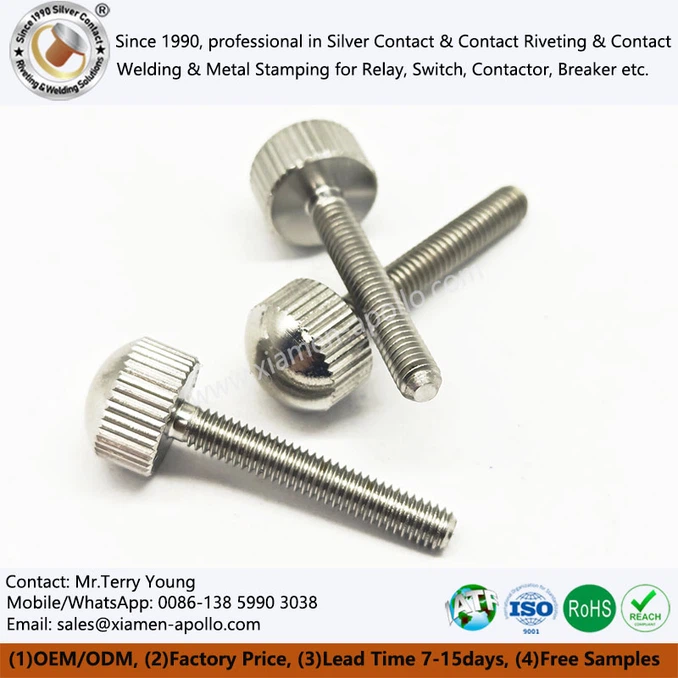
Screws are fundamental fasteners in industrial manufacturing, equipment assembly, and precision instrument assembly. Their precision, mechanical strength, and surface quality directly determine the overall assembly stability and service life. This is especially true for various knurled manual fasteners, such as knurled thumb screws, which require extremely high precision in their manufacturing processes. Standardized screw production employs a mature and rigorous process flow. From raw material selection to finished product electroplating, each step directly affects the screw's dimensional accuracy, hardness, wear resistance, and oxidation resistance.
The wire rod process is the starting point of screw production. Its core function is to select and verify the basic parameters of the raw material wire rod, laying a solid foundation for subsequent processing. Industrial carbon steel wire rod is the mainstream raw material for screw production. Before production, core parameters such as brand, specifications, material, furnace number, and weight must be strictly verified. Its chemical composition includes elements such as carbon, manganese, phosphorus, sulfur, silicon, copper, and aluminum. The content of copper and aluminum impurities must be strictly controlled; lower content ensures the purity of the screw material, making it suitable for the production standards of high-precision knurled head screws.
The wire drawing process is a crucial step in raw material pretreatment. Its main function is to stretch and polish the raw wire rod using specialized equipment, correcting the wire diameter to precisely match the specifications required for screw production. The raw wire rod has slight dimensional deviations and contains an oxide layer and impurities. After wire drawing, the wire becomes uniform in size and has a smooth surface, meeting the forming requirements of precision hand screws such as hand twist screws and avoiding subsequent forming defects.
The cold heading process is the core step in screw forming, determining the overall shape and structure of the screw. During processing, the equipment automatically cuts standard wire and extrudes it using high-precision molds, completing the shaping of the screw shank length, diameter, head structure, under-head radius, and groove shape in one step. The industry can process various head shapes and groove shapes according to customized needs to adapt to different assembly scenarios. The basic knurled structure of various knurled head bolts is initially formed through a refined cold heading process.
Cold heading is highly adaptable, compatible with the prefabrication of various irregular screw structures. Whether it's a standard Phillips head or slotted head, or a precision Torx or hexagonal head, it can all be integrally formed using custom molds. This process boasts high forming efficiency and excellent workpiece consistency, maximizing the preservation of the metal's structural toughness, laying the foundation for subsequent processing and performance enhancement of high-strength screws such as knurled cap screws.
Thread rolling is a crucial process for shaping screw threads, directly determining thread engagement accuracy and locking stability. This process relies on the relative pressing motion of a fixed and a movable die to extrude standard thread patterns onto the surface of the cold-headed screw blank. Threads formed by thread rolling have full textures, precise dimensions, uniform pitch, and are free of burrs and deformation, fully meeting the assembly and use standards for knurled machine screws.
Heat treatment is the core process for improving the screw's mechanical properties, primarily addressing the issues of insufficient hardness and toughness imbalance in the metal after cold working. By controlling the temperature and duration using professional heat treatment equipment, the tensile, torsional, and wear resistance of screws can be significantly improved, enhancing their self-tapping and locking capabilities. This makes the Knurled Panel Screw less prone to stripping and breakage during long-term equipment assembly, suitable for various equipment panel fastening scenarios.
The final core process is electroplating, a surface protection and aesthetic enhancement process for the screws. While the mechanical properties of the screw body meet standards after heat treatment, the metal surface is prone to oxidation and rust, making it unsuitable for long-term use under complex working conditions. Through a professional electroplating process, a dense protective coating can be formed on the screw surface. This not only achieves diverse appearance and color effects but also isolates it from air and moisture corrosion, significantly extending the service life of the Thumb Screw with Knurled Head and improving both product practicality and aesthetics.
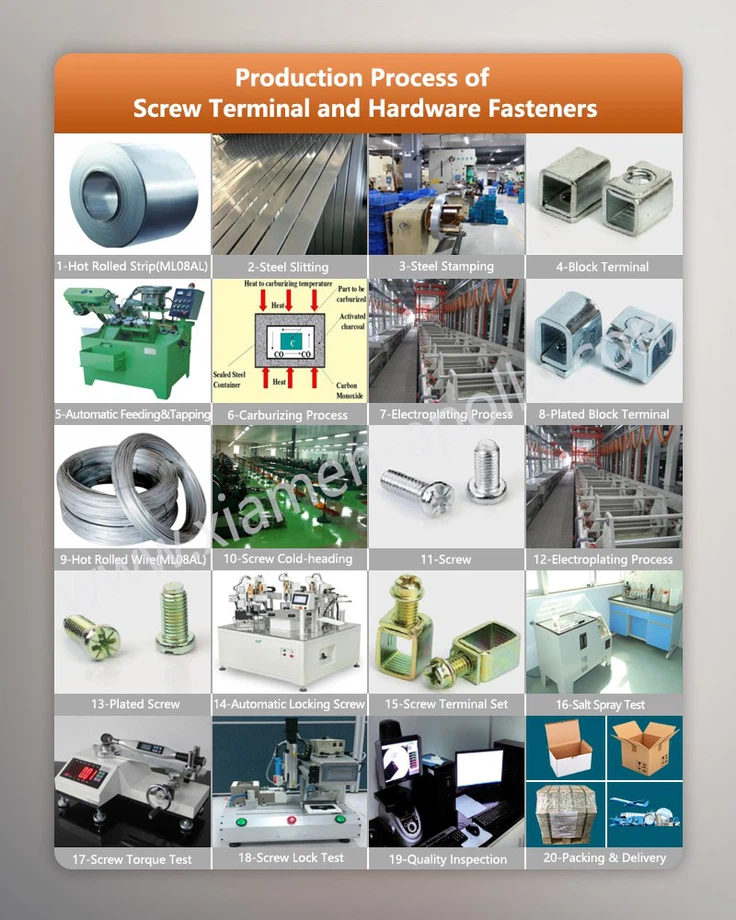
The entire screw manufacturing process is interconnected, with each step-from raw material pretreatment and forming to performance enhancement and surface protection-having strict process standards. Precise process control allows for the custom production of various irregularly shaped screws, including Knurled Round Head Thumb Screws and Knurled Flat Head Thumb Screws, ensuring product precision and quality meet standards.
For custom production and process adaptation solutions for various specifications of Knurled Flat Head Thumb Screws, you can contact our professional team at any time. Leveraging our mature production processes, we can create high-precision, high-stability industrial fasteners to your specific needs.
contact us
