

Brass is a widely used copper-zinc alloy. Its excellent strength, corrosion resistance, and machinability, combined with its unique golden luster, make it a preferred material in many industries, including electronics, construction, and electrical engineering. Its high-temperature resistance and oxidation resistance make it crucial in the manufacture of stamped parts where precision and durability are paramount. Therefore, precision brass sheet stamping technology is widely used in industrial production.
What is Brass Sheet Stamping? It is a core manufacturing process that applies high pressure to brass sheets using dies to shape or cut the sheet into parts of specific shapes and specifications. This process, with its precision forming advantages, can efficiently produce complex and delicate parts, making it particularly suitable for mass production and an indispensable processing method in modern manufacturing.

The inherent properties of brass determine its unique advantages in stamping processes. As a highly durable and versatile alloy, its combination of properties is highly regarded in the industry. Corrosion resistance is one of brass's core advantages; it possesses excellent resistance to rust and corrosion, especially excelling in marine and industrial environments, making it particularly suitable for stamping applications in outdoor, high-humidity environments. In terms of strength, it boasts outstanding tensile strength, capable of withstanding various stresses and pressures during production and use, and is not prone to deformation, ensuring the structural stability of Brass Sheet Metal Parts Terminals.
Dulleriness and machinability are key characteristics that make brass suitable for stamping processes. Brass is relatively easy to form, enabling the realization of complex designs, and is easy to turn, drill, and cut, allowing for the precise production of various precision stamped parts, reducing processing difficulty and production costs. In addition, it has good electrical and thermal conductivity, which makes it highly advantageous in the manufacture of electrical stamping parts. It is often used to produce stamping parts related to electrical switches and sockets. Its unique golden luster brings good aesthetic appeal and can be used in decorative relay pin brass terminals. Its low friction properties make it suitable for stamping parts such as gears and bearings that require reduced wear, while its ductility allows it to be drawn into wires or sheets without breaking, further expanding the application scenarios of stamping.
Custom brass sheet metal stamping parts encompass several core operations, each catering to different processing needs, collectively forming a complete stamping production process. Blanking is the fundamental step in stamping, primarily involving cutting flat blanks from a single sheet of brass stamped parts. These blanks serve as the base material for subsequent stamping processes. The shape of the blanks is entirely determined by the design of the stamping die; precise blanking is a prerequisite for ensuring the accuracy of subsequent processing.
Bending is a common forming operation in brass sheet metal stamping parts. A bending machine applies uniform pressure to the brass sheet, causing it to deform along a straight line to form the desired angle or curve. This is commonly used for processing complex-shaped stamped parts such as brackets, panels, and housings. The precision of the bending process directly affects the assembly adaptability of the stamped parts. Forming is a more complex three-dimensional processing operation, encompassing various processing methods such as stretching and compression. It can process sheet metal brass stamping into deep-drawn cups, trays, and other three-dimensional structural components to meet the needs of various complex products.
Perforation is primarily used to machine holes, slots, and other structures on relay pin brass terminal sheet metal. A punch press drives a punch head to press the sheet metal into the corresponding die, creating clean and regular holes. This is widely used in customized brass stamping contact parts for wall socket plugs that require hollowing out or connection. Embossing is a high-precision surface finishing operation that uses high-pressure stamping to press fine patterns, text, or textures onto the surface of brass sheet metal parts. It can be used to create logos, decorative patterns, etc., enhancing the appearance and recognizability of stamped parts.
Surface treatment of a rotary switch brass terminal is a crucial step in improving product quality, not only optimizing appearance but also extending service life. Common surface treatments include polishing, brushing, antique finish, nickel plating, and clear coating. Polishing gives the stamped part a shiny, reflective texture, enhancing its aesthetics; brushing provides a fine texture while reducing fingerprints; antique finishes create a vintage feel, suitable for decorative products; nickel plating enhances the corrosion resistance of the stamped part while presenting a smooth, silver appearance, such as the surface treatment of some electrical terminals; clear coatings are mainly used to prevent brass from oxidizing and losing its shine, ensuring that brass sheet metal stamping parts maintain a good appearance for a long time. Appropriate surface treatments can specifically improve certain performance aspects of the stamped part, adapting to the needs of different application scenarios.
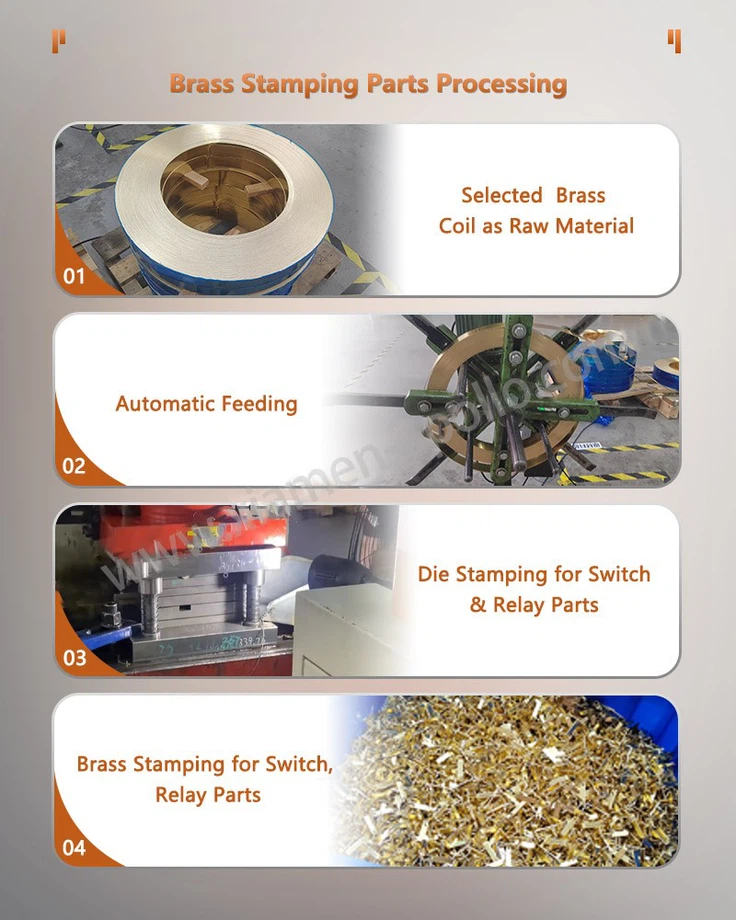
The production of high-quality Electrical Brass Stamping Parts for Switch Sockets relies on systematic management, encompassing material inspection, mold design and manufacturing, process parameter optimization, and end-to-end quality monitoring. As the industry progresses, brass stamping technology is evolving towards higher precision, more complex composite processes, faster production cycles, and deeper integration with automated and intelligent production lines. Simultaneously, the demands for environmental protection and sustainable production are increasing.
contact us
If you are looking for a reliable Sheet Metal Brass Stamping solution, please contact us. We will provide professional technical support and manufacturing advice for your project.
