

A latching relay is a specialized type of relay that relies on a permanent magnet to maintain its contact state. Compared to traditional electromagnetic relays, its most significant feature is that-once the contact switching is complete-it does not require continuous coil energization to maintain either a conductive or a disconnected state; consequently, it can significantly reduce system power consumption. In recent years, driven by the rapid advancements in smart metering, smart home systems, industrial automation, and new energy control systems, latching relays have been widely adopted across various low-power control applications-thanks to their advantages in low energy consumption, high stability, and long operational lifespan. Within this context, a high-performance Latching Relay Iron Core has emerged as a critical core component that fundamentally determines the overall performance of the relay.
The operating principle of a latching relay differs markedly from that of a traditional relay. Conventional relays typically rely on continuous coil energization to generate a magnetic field, thereby maintaining the contacts in a closed (actuated) state; conversely, latching relays utilize a permanent magnet to provide the sustaining magnetic force. Contact actuation is achieved solely by applying a brief current pulse to momentarily alter the direction of the magnetic field. This structural design not only reduces energy consumption but also mitigates the issues associated with coil overheating during prolonged operation. In the design of the magnetic circuit system, a high-performance Core for Latching Relays effectively enhances magnetic permeability and operational sensitivity, thereby ensuring rapid and stable switching performance for the relay.
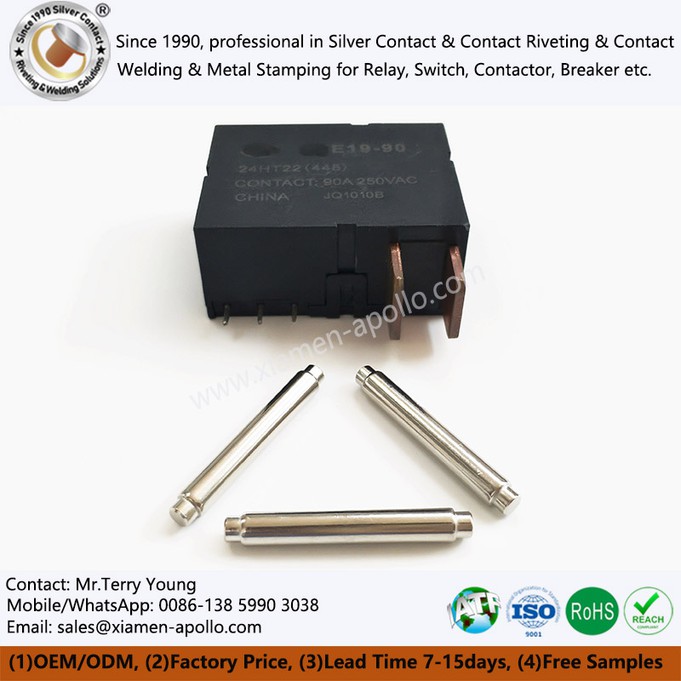
Since latching relays do not require continuous power supply, their primary advantage lies in energy conservation. Particularly in battery-powered devices or equipment designed for long-term continuous operation, they can significantly reduce overall system power consumption. For instance, in smart meters-where relays often need to maintain a specific operational state for extended periods-the use of standard relays would result in substantial energy loss due to the continuous power draw of their coils. By contrast, latching relays require only a momentary pulse to execute a switching action; consequently, they are widely adopted in smart metering equipment. To meet the stringent requirements of smart meters regarding high stability and low residual magnetism, the industry commonly utilizes Pure Iron Cores for Electric Meter Relays as the core magnetic material.
Within a latching relay, the properties of the magnetic core material directly influence the pull-in force, switching speed, and long-term stability. A high-quality magnetic core not only enhances magnetic flux efficiency but also minimizes hysteresis loss and the effects of residual magnetism, thereby improving the precision and repeatability of the relay's switching operations. Currently, high-purity DT4C material is widely employed in high-end relay products due to its excellent soft magnetic properties and low coercivity. Particularly in critical control applications requiring high reliability, the DT4C Iron Core for Latching Relays has emerged as a pivotal material choice for enhancing the relay's magnetic response performance.
In a latching relay, the coil and the magnetic core collectively form a complete magnetic circuit system. When a momentary current pulse is applied to the coil, it generates a transient magnetic field that interacts with the permanent magnet, thereby actuating the contact mechanism to switch its state. Consequently, the magnetic permeability of the core is paramount to the operational stability of the relay. A high-quality Electromagnet Core enhances magnetic field concentration efficiency and minimizes magnetic flux leakage, enabling the relay to maintain reliable switching performance even under low-power operating conditions.
As the demand for energy efficiency in smart devices continues to rise, the scope of applications for latching relays-spanning industrial control, smart home systems, and new energy sectors-continues to expand. For example, in remote meter reading systems, devices typically remain in a standby mode for extended periods, executing a switching action only upon receiving a specific control command; this necessitates a relay with extremely low static power consumption. In such operating environments, a high-performance Electrician Pure Iron Core effectively mitigates magnetic losses while simultaneously enhancing both magnetic field stability and mechanical durability.
Beyond their magnetic characteristics, latching relays must also demonstrate exceptional mechanical reliability. Since relays undergo a vast number of operational cycles during their long-term service life, the core material must strike a balance between mechanical strength and manufacturing precision. Currently, the use of DT4C iron cores-manufactured through cold forging and precision stamping processes-effectively enhances dimensional consistency, minimizes assembly errors, and further improves the long-term operational stability of relay products.
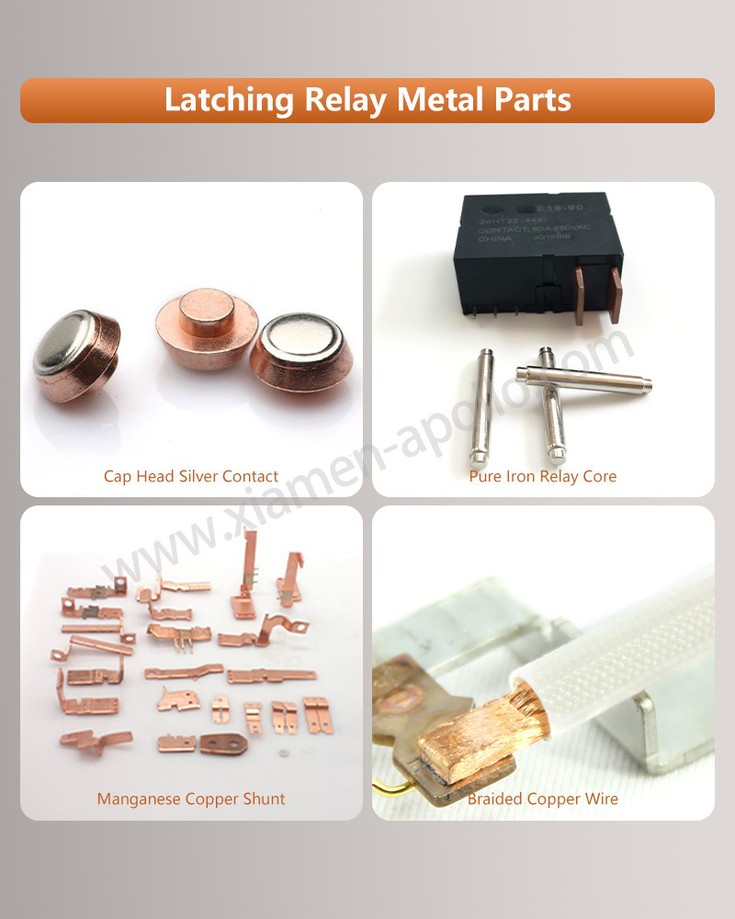
When selecting latching relays for practical applications, particular attention must be paid to several key parameters. First is the coil rated voltage; common specifications include 3.3V, 5V, 12V, and 24V, requiring the selection of a corresponding drive voltage based on the design of the control circuit. Second is the coil rated current; it is essential to ensure that the driving circuit can supply sufficient pulse current to successfully execute the latching (pull-in) operation. Additionally, a certain safety margin should be maintained regarding the contact rated current to guarantee stable, long-term operation. To further enhance magnetic circuit efficiency, a growing number of relay products are now incorporating Soft Magnetic Iron Cores for Relays materials to optimize low-power control performance.
If you are seeking solutions for latching relay cores, soft magnetic materials, or precision stamped components, we invite you to contact us for further technical information and product support. We offer specialized, customized services tailored to smart energy meters, industrial relays, and low-power control systems.
contact us
