

One of the core control units within a new energy vehicle's high-voltage system is the Power Distribution Unit (PDU). In certain vehicle models, the On-Board Charger (OBC) module is integrated directly into the PDU to facilitate critical functions such as power output, energy distribution, and charge control. Within this entire high-voltage architecture, the high-voltage relay serves as the electrical switch, with its internal contacts responsible for connecting and disconnecting high-voltage circuits operating at 300V or higher. As the trend toward higher operating voltages in new energy vehicles continues to accelerate, the reliability of the relay's internal structural components and magnetic circuit systems has become paramount; in particular, the stability of the EV Relay Core is directly linked to the long-term operational safety of the entire high-voltage system.
The operating principle of a high-voltage relay is fundamentally based on mechanical physical conduction. When the contacts are subjected to prolonged exposure to high-current surges, they become susceptible to issues such as oxidation, ablation, and arc erosion. Once an oxide layer forms on the contact surface, the contact resistance increases rapidly, subsequently triggering localized abnormal heating. Since the high-voltage circuits in new energy vehicles typically operate under conditions involving tens or even hundreds of amperes, even a minute change in resistance can generate an immense amount of heat. To enhance magnetic circuit response and conduction stability, an increasing number of high-voltage relays are now adopting a Flat Core for EV Relay structure to optimize electromagnetic attraction efficiency and minimize magnetic losses during long-term operation.
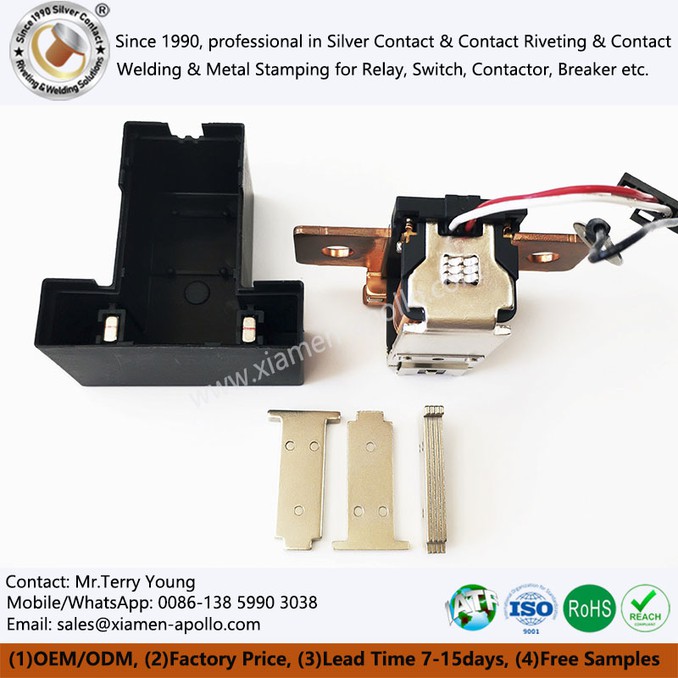
According to Joule's Law, the heat generated as electrical resistance increases grows exponentially. When relay contacts are subjected to sustained high temperatures, the oxidation of metal and material fatigue accelerate further, creating a vicious cycle where the hotter it gets, the worse it performs; and the worse it performs, the hotter it gets. As contacts undergo ablation, their originally smooth contact surfaces gradually become pitted and uneven; this drastically reduces the actual conductive area, ultimately leading to contact instability or even permanent welding (sticking). In the manufacturing of relays for new energy vehicles, stamping and bending processes demand extremely high precision regarding the dimensional consistency of the magnetic core. Consequently, the machining precision of the Stamping Iron Core Bending Part for EV Relay directly impacts both the relay's pull-in operation and its long-term durability.
When a relay's contact resistance continues to rise, the most immediate consequence is localized overheating. High-voltage distribution boxes typically integrate high-voltage wiring harnesses, capacitors, fuses, and numerous insulating structural components; the temperature resistance range of most of these materials lies merely between 120°C and 150°C. Should the contact temperature exceed 200°C, surrounding plastic supports may deform or even melt; in severe cases, this can ignite the insulation layers, creating a risk of internal short circuits within the distribution box. Therefore, the application of high-performance Stamping Cores for New Energy Relays within the high-voltage relay systems of new energy vehicles has emerged as a critical strategy for enhancing both thermal stability and magnetic permeability.
The high-voltage system in new energy vehicles typically employs a series-connection power supply architecture, wherein the battery, high-voltage distribution box, motor controller, and drive motor are all intricately linked. Should a relay suffer from poor contact, it can trigger severe fluctuations in the supply voltage. For instance, the input voltage to the motor controller might suddenly drop from a stable 350V to 280V, only to instantly recover moments later. Such fluctuations not only trigger the vehicle's limp-home mode but may also cause the controller to misdiagnose faults, thereby compromising safety during high-speed driving. To accelerate the magnetic response speed of high-voltage relays under complex operating conditions, certain products utilize a Pure Iron Core for EV Relay structure to enhance magnetic field conduction capabilities and minimize operational hysteresis.
Anomalies in relay contacts can also have a significant impact on the charging systems of new energy vehicles. During fast-charging sessions, the high-voltage relay is responsible for establishing the main electrical circuit between the battery pack and the charging station. If the relay contacts become oxidized, it can lead to fluctuations in charging current, interruptions in the charging process, or even a complete failure to initiate charging. More critically, unstable contact can generate instantaneous, high-magnitude current surges; over time, this may lead to cell overheating, swelling, and capacity degradation. To meet the demands for high-frequency operation and extended service life, high-voltage relays typically incorporate internal cores made of high-permeability relay iron to ensure rapid and stable armature pull-in following coil actuation.
One of the most hazardous issues within the high-voltage systems of new energy vehicles is high-voltage leakage resulting from insulation failure. Should relay ablation compromise the insulation of the wiring harness, high-voltage electricity may leak into the vehicle's metal chassis structure, thereby creating a potential risk of electric shock. This risk is particularly acute in wet environments-such as during rain or snow-where human contact with the vehicle's doors or charging ports could complete a conductive circuit. Consequently, the pure electrical iron cores utilized in high-voltage relays must not only exhibit superior magnetic properties but also strictly adhere to the new energy vehicle industry's rigorous standards regarding insulation safety and thermal stability.
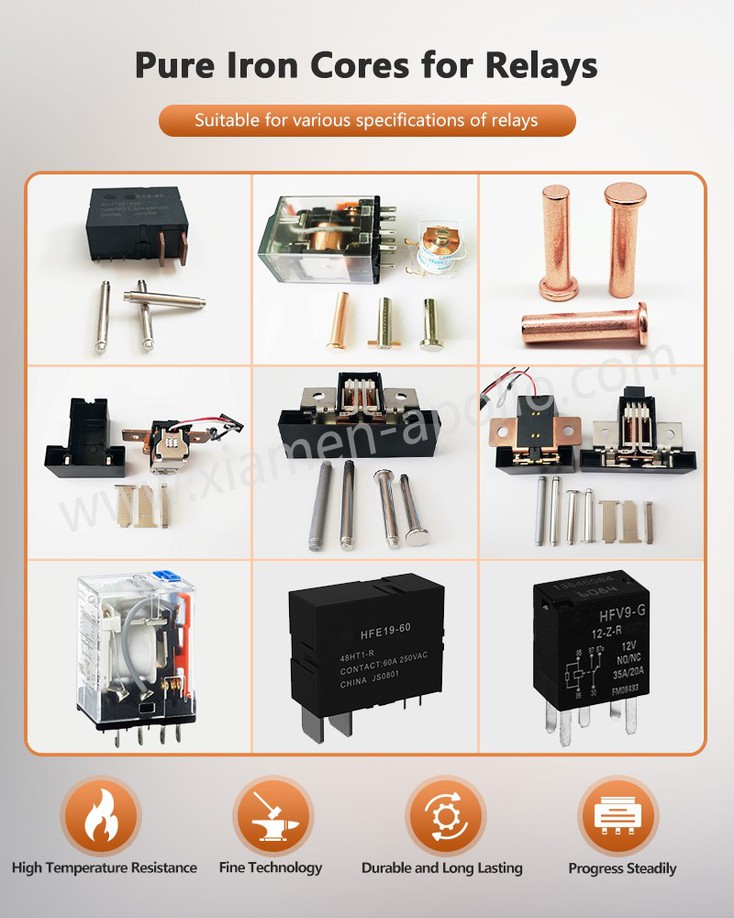
The long-term reliable operation of high-voltage relays in new energy vehicles depends not only on the contact materials themselves but is also closely tied to the processing techniques for the pure iron relay cores, the design of the magnetic circuit structure, and the overall thermal management capabilities. Particularly against the backdrop of continuously upgrading high-voltage platforms, the application of high-performance relay steel cores and soft magnetic materials is emerging as a pivotal direction in the technological advancement of new energy vehicle relays.
If you are seeking solutions involving relay steel cores, soft magnetic materials, or precision stamped components, we invite you to contact us for further product information and technical support. We offer specialized, customized services tailored to new energy relays, high-voltage power distribution systems, and electromagnetic control assemblies.
contact us
