

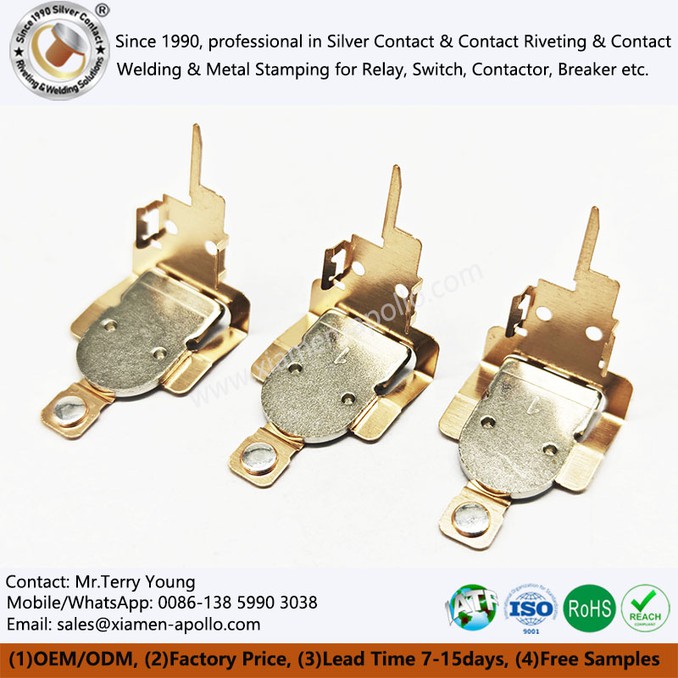
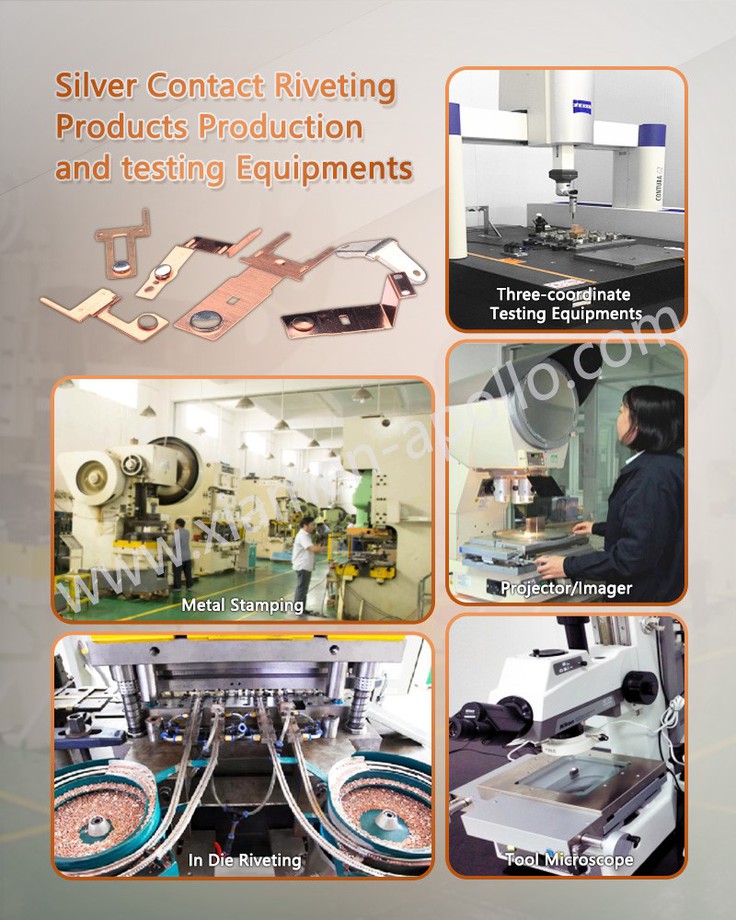
In the field of stamping manufacturing, the production efficiency of multi-component assemblies is often constrained by secondary assembly operations. When production volumes are substantial, the traditional process-involving separate single-machine stamping followed by subsequent rivet pressing-presents significant efficiency bottlenecks and safety hazards. A case in point is the pressure seat for roving frames; each assembly set comprises four joining components, and the annual demand is immense. Adopting an "in-die riveting" process-which integrates the stamping, forming, and riveting of multiple parts within a single die-represents an effective technical strategy for boosting production efficiency and ensuring consistent quality. This process is equally applicable to the production of products such as "In-Mold Riveting Electrical Contacts," wherein the riveting of silver contacts to copper terminals is seamlessly integrated into the stamping workflow.
Mold Structural Design
The mold employs a Z-axis dual-guidance structure featuring a ball-bearing mold base and a three-plate design with internal guide pillars and bushings, thereby ensuring precise alignment between the upper and lower mold halves. The X-axis progression of the material strip and the Y-axis feeding of the spacer blocks are each equipped with dedicated positioning sensors, photoelectric sensors, and contact switches; these components are seamlessly integrated with the press control system to facilitate fully automated production throughout the entire process.
To facilitate mold manufacturing, as well as rapid changeovers and repairs, all die cavities are designed as modular inserts or bushings. Key components include: the upper mold base, upper bolster plate, upper retainer plate, stripper bolster, stripper plate, lower die plate, lower bolster plate, lower mold base, lifter pins, punches and die inserts for each specific station, and the riveting mechanism assembly.
The In-Die Electrical Riveting Contacts process imposes extremely stringent requirements on the mold's positioning accuracy. Within a progressive die setup, the relative positional error between the electrical contact and the terminal must be maintained within a tolerance of ±0.05 mm; failure to meet this standard would result in skewed rivets or insufficient contact surface area. Consequently, the clearance fit between the mold's guide pillars and bushings-as well as the guiding precision of the stripper plate-constitute critical control parameters.
Riveting Mechanism and Pre-Riveting Depth Control
When the push rod advances the spacer block to the pre-riveting station (Station 6), the upper and lower dies close. Simultaneously, the push rod depresses a pressure lever; this action transmits a reaction force to an ejector pin via a linkage mechanism, causing the ejector pin to pre-rivet the spacer block into the spring locating block. Subsequently, the strip material carries the pre-riveted assembly to Station 7 for final riveting and flattening.
Precise control of the pre-riveting depth is critical. Insufficient pre-riveting depth may cause the spacer block to dislodge during subsequent feeding operations, whereas excessive depth could result in part deformation. The pre-riveting depth can be adjusted at any time by manipulating an adjustment screw that controls a wedge mechanism. When designing this adjustment assembly, it is essential to ensure that sufficient adjustment travel is provided.
In the In-Mold Riveting Components process, the functional division between pre-riveting and final riveting is the key to ensuring high-quality riveting. Pre-riveting serves only to achieve the initial fixation of the component, thereby allowing the strip material to carry the component forward in a step-by-step manner. Final riveting, conversely, applies sufficient force to induce plastic flow in the material and establish a permanent mechanical joint. Separating these two operations prevents potential part cracking-which can result from a single, massive deformation-and mitigates the adverse impact that high-force riveting shocks might otherwise have on the service life of the stamping die.
Key Design Considerations for Cam Profiles
An abrupt change in the velocity of the cylinder piston at the instant of intake generates significant inertial forces in the pushrod, subjecting the mechanism to rigid impact and rendering the pushrod susceptible to fracture. However, when employing a roller-follower cam mechanism, designing of Copper Blade Brazed (Rivet) the cam profile to follow a sinusoidal acceleration curve eliminates abrupt changes in acceleration during both the forward and return strokes; this ensures that the pushrod experiences no flexible impact during its motion, making the design highly suitable for high-speed applications.
In modern CAD software, a dedicated toolset can be utilized to automate the entire process-from component selection to profile generation-and to export the resulting DXF data for wire-cut machining. If the specific CAD software lacks this menu function, one may instead use Excel to input the cam curve formula: s = h[δ/δ0 - 1/(2π) sin(2π δ/δ0)]. After calculating the lift values for the corresponding equidistant points, these data can be copied and pasted into the CAD environment to generate the required spline curve.
Process Effectiveness and Scope of Application
Following its commissioning, the die operates smoothly, exhibiting flexible and reliable mechanical action. It yields products of high quality and excellent consistency, while significantly boosting production efficiency. Taking the spring locator seat as an example: under the original single-station process, two operators working an 8-hour shift could produce between 18,000 and 20,000 units per day. By adopting the in-die riveting technique within a progressive die, production output increased to 32,000–36,000 units in just 10 hours. This method eliminates the need for dedicated riveting time and obviates the separate blackening treatment previously required for the spacer blocks, resulting in an overall efficiency improvement of over 250%.
This process methodology is not limited to spring locator seats; it also serves as a valuable reference for process improvements involving various assembly components within the rocker arm series-specifically locking tabs, mounting brackets, and pressure plates. In the realm of electrical switches and relays, the technical approach to in-die riveting for electrical stamping contact components and metal parts with silver contacts aligns closely with this method. By performing the riveting of silver contacts to stamped copper components directly within a progressive die, assembly costs are significantly reduced, while simultaneously ensuring the positional consistency of the contacts and the stability of the riveting strength.
For multi-layer metal assemblies-such as silver-on-copper components used in switches and relays-the in-die riveting process offers distinct advantages over spot welding or manual riveting. These advantages include the absence of a heat-affected zone, the elimination of weld spatter, precise control over riveting force, and suitability for high-volume mass production. Consequently, electrical in-die riveting is rapidly becoming the standard manufacturing process across industries involving switches, relays, connectors, and similar devices.
If you would like to learn more about the specific applications of in-die riveting within progressive dies for silver contact and stamping operations, we invite you to contact our engineering team. We provide comprehensive technical support-ranging from strip layout design and die structure optimization to the fine-tuning of riveting process parameters-to help you enhance both the production efficiency and quality consistency of your stamped assemblies.
contact us
