Material integrity in electrical component sourcing depends on three verifiable controls: chemical composition confirmed by a Material Test Report (MTR), restricted-substance screening under RoHS and REACH, and batch-level traceability linking raw materials to finished components. For silver electrical contacts (AgSnO2, AgNi), copper stamping parts (C11000, C17200), and relay magnetic cores (DT4C), procurement teams must verify alloy grade, conductivity (%IACS), mechanical properties, and applicable SVHC concentrations against approved technical specifications. A qualified RoHS REACH electrical contact supplier should provide traceable MTR records, valid compliance declarations, and production-lot inspection data to reduce material substitution risks, customs delays, and non-compliant product shipments.

Raw Material Non-Compliance: The Hidden Cost of Electrical Component Sourcing
Material non-compliance in electrical components can trigger production-line rejection, customs detention, product recalls, and costly qualification failures. For silver contacts, copper terminals, relay cores, and precision stamped components, procurement teams must verify three independent aspects: chemical composition, physical and mechanical properties, and restricted-substance compliance. A valid Material Test Report (MTR), supported by RoHS and REACH documentation and lot-level traceability, provides the evidence needed to control these risks.
How Unverified Raw Materials Affect Electrical Component Performance
Substituting an unapproved alloy or using material outside the specified composition range can change electrical, mechanical, and thermal characteristics.
Typical sourcing risks include:
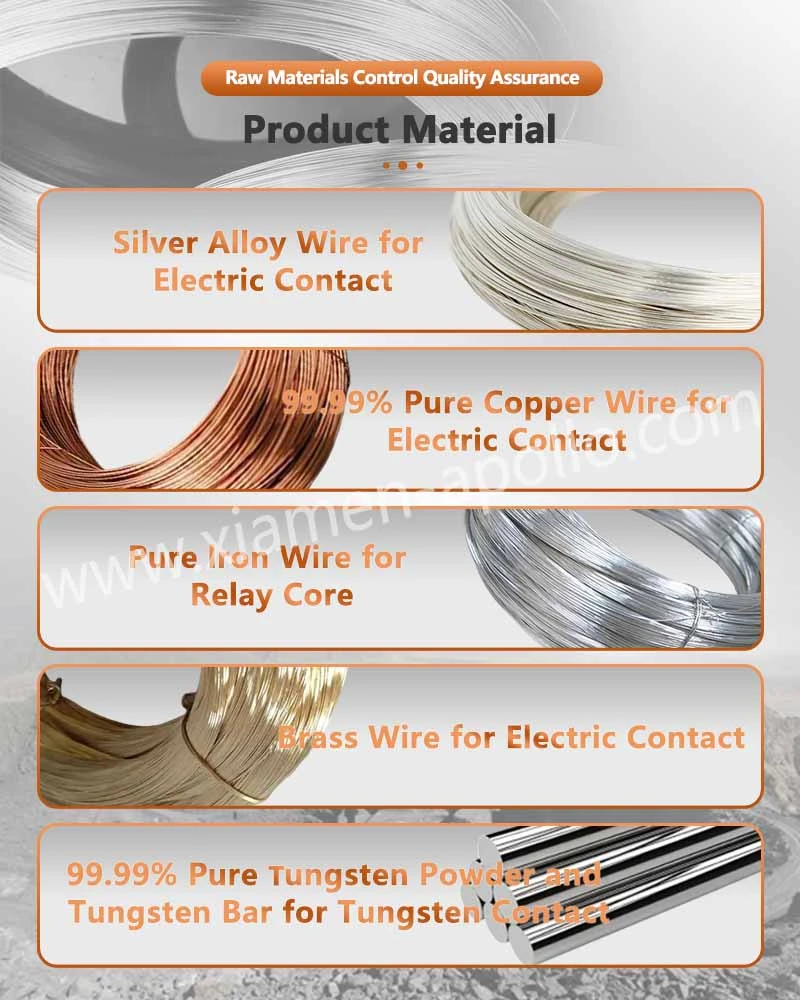
- Silver contact material substitution: An incorrect AgSnO2 composition can change contact resistance, arc erosion behavior, and welding tendency during switching operations.
- Copper alloy grade deviation: Unverified copper strip may exhibit conductivity below the specified value, increasing temperature rise at terminals under rated current.
- Relay core material inconsistency: Variations in iron purity and magnetic properties can affect saturation induction, coercivity, and relay operating characteristics.
- Mechanical property deviation: Incorrect temper or heat treatment can reduce spring force, fatigue life, and dimensional stability in stamped moving contacts.
- Restricted substance contamination: Uncontrolled plating chemicals, surface treatments, or alloying elements may introduce substances exceeding applicable regulatory limits.
For example, a copper terminal specified at 85% IACS cannot be accepted solely because its supplier identifies it as a copper alloy. Its actual grade, conductivity, temper, and dimensional characteristics must be verified against the approved drawing and material specification.
Procurement Risks: Customs Detention, Recalls, and Supplier Liability
The consequences of inadequate material verification extend beyond the incoming inspection stage.
| Risk category | Typical technical cause | Potential procurement consequence |
|---|---|---|
| Electrical failure | Incorrect AgSnO2 or AgNi composition | Contact overheating, welding, or shortened switching life |
| Mechanical failure | Incorrect copper alloy temper | Spring deformation and premature fatigue |
| Regulatory non‑compliance | Restricted substance above applicable limits | Market‑access restrictions and corrective action |
| Documentation failure | Missing or inconsistent MTR | Supplier rejection and delayed customs clearance |
A supplier declaration alone does not establish that every delivered production lot conforms to the customer's technical requirements. Procurement specifications should define the required material grade, testing method, acceptance limits, document format, and batch identification before purchase orders are released.
Establishing Material Acceptance Criteria Before Mass Production
A practical incoming-material control plan should contain the following checkpoints:
- Confirm alloy designation and applicable material standard, such as ASTM B152/B152M for copper sheet, strip, plate, and rolled bar.
- Verify chemical composition using an appropriate analytical method, such as ICP-OES or laboratory-based optical emission spectroscopy.
- Check electrical conductivity against the specified %IACS requirement.
- Verify tensile strength, hardness, elongation, and temper where required by the drawing.
- Confirm RoHS and REACH documentation against the applicable product configuration and regulatory revision.
- Match the incoming coil, bar, or batch number to the corresponding MTR and inspection record.
The acceptance criteria must be product-specific. A silver contact alloy, a copper terminal, and a DT4C relay core require different chemical and physical property limits.
Material Test Reports (MTR): Chemical Composition and Physical Property Verification
An MTR is a material-specific inspection document used to establish the identity and measured properties of a supplied metal batch. For copper stamping parts, silver electrical contacts, and relay magnetic cores, it should connect the material designation, heat or coil number, chemical analysis, mechanical test results, and inspection status.
An MTR is not simply a supplier declaration stating that a material meets a standard. Its reliability depends on the actual test results, traceable sample identification, applicable test methods, and the relationship between the tested material and the delivered production lot.
Chemical Composition Analysis: ICP-OES, OES, and XRF
Different analytical methods have different detection capabilities. Procurement engineers should specify the method according to the alloy system and the elements being controlled.
| Analytical method | Primary application | Engineering limitation |
|---|---|---|
| ICP-OES | Quantitative analysis of copper, silver, and alloying elements | Requires sample preparation and laboratory analysis |
| Optical Emission Spectroscopy (OES) | Rapid elemental analysis of metallic materials | Calibration must match the alloy matrix |
| X-Ray Fluorescence (XRF) | Incoming material screening and alloy identification | Light-element detection and quantitative accuracy depend on equipment and calibration |
For example, copper alloys containing Be, Ni, Sn, or Zn require element-specific verification. Portable XRF can be useful for incoming screening, but it should not automatically replace a validated laboratory method when low concentrations or light elements are acceptance-critical.
For silver contact materials, the analysis should distinguish the specified alloy composition rather than simply confirm the presence of silver.
Typical material designations include:
- AgSnO2 88/12: Silver-tin oxide contact material, with nominal composition specified by the applicable material standard or purchase specification.
- AgNi: Silver-nickel contact material, requiring verification of nickel content and material grade.
- C11000: Electrolytic tough-pitch copper, subject to the applicable ASTM or equivalent material specification.
- C17200: Beryllium copper alloy, requiring controlled verification of beryllium content and temper.
- DT4C: A commercially designated pure-iron grade used for magnetic components, requiring verification against the agreed chemical and magnetic property specification.
The nominal composition alone is insufficient. The material must also satisfy the specified electrical, mechanical, and functional requirements.
Mechanical and Electrical Properties: Beyond Chemical Composition
A chemical analysis cannot establish whether a copper strip has the required spring characteristics or whether a relay core has the required magnetic response.
For precision metal stamping, the MTR or supplementary inspection report should include the relevant mechanical and electrical measurements.
| Property | Test or measurement | Relevance to electrical components |
|---|---|---|
| Electrical conductivity | %IACS or resistivity measurement | Controls conductor losses and temperature rise |
| Tensile strength | ASTM E8/E8M or equivalent | Evaluates resistance to tensile loading |
| Elongation | ASTM E8/E8M or equivalent | Indicates forming capacity and ductility |
| Hardness | ASTM E18 or ASTM E384 | Evaluates material condition and surface hardness |
| Thickness | Micrometer or calibrated thickness gauge | Controls stamping geometry and dimensional consistency |
| Magnetic properties | Agreed magnetic test method | Evaluates relay-core induction and coercivity |
For copper alloy moving springs, tensile strength and hardness must be considered together with elongation and temper. A material with high tensile strength may still be unsuitable if its forming characteristics cause cracking during bending or progressive die stamping.
For relay cores, chemical composition is only the first verification stage. Magnetic induction, coercivity, and magnetic annealing conditions should be evaluated where these characteristics are specified by the customer.
How to Evaluate an MTR Before Approving a Material Batch
A technically acceptable MTR should provide sufficient information for independent verification.
The procurement and QA review should cover:
- Material identification: Alloy designation, material standard, grade, temper, and thickness.
- Batch identification: Heat number, coil number, or manufacturer batch number.
- Chemical analysis: Actual measured values, units, and applicable specification limits.
- Physical properties: Conductivity, tensile strength, elongation, hardness, or magnetic parameters where applicable.
- Test identification: Test method, inspection date, and laboratory or inspection organization.
- Acceptance status: Clear comparison between measured results and specified limits.
- Document authentication: Issuing organization, report number, and authorized approval.
For material supplied under EN 10204 inspection-document requirements, the purchaser should specify the required document type. A Type 3.1 inspection certificate, for example, includes specific inspection results validated by the manufacturer's authorized inspection representative independent of the production department. It should not be treated as interchangeable with every supplier-issued certificate of analysis.
RoHS and REACH SVHC Screening: Controlling Restricted Substances
RoHS and REACH address different regulatory requirements. RoHS restricts specified hazardous substances in electrical and electronic equipment (EEE), with maximum concentration limits generally assessed at the homogeneous-material level. REACH controls chemical substances and establishes additional obligations for articles containing substances of very high concern (SVHCs).
For electrical component sourcing, a generic statement such as "RoHS and REACH compliant" is not sufficient without identifying the tested material, applicable substance list, report date, and product configuration.
RoHS 10 Restricted Substances and Maximum Concentration Limits
Under EU RoHS Directive 2011/65/EU, as amended by Directive (EU) 2015/863, Annex II specifies ten restricted substances.
| Restricted substance | Maximum concentration in homogeneous material |
|---|---|
| Lead (Pb) | 0.1% |
| Mercury (Hg) | 0.1% |
| Cadmium (Cd) | 0.01% |
| Hexavalent chromium (Cr6+) | 0.1% |
| Polybrominated biphenyls (PBB) | 0.1% |
| Polybrominated diphenyl ethers (PBDE) | 0.1% |
| DEHP | 0.1% |
| BBP | 0.1% |
| DBP | 0.1% |
| DIBP | 0.1% |
These concentration limits apply to homogeneous materials, not simply to the total mass of a finished electrical component. For example, a copper terminal with a tin-plated surface involves at least two material layers that may require separate assessment.
The presence of lead in an alloy also requires careful interpretation. A restricted-substance result above the general limit does not automatically establish a violation if a valid, applicable RoHS exemption covers the specific use. Exemption scope and validity must be checked for the target product and market.
3RoHS Testing for Silver Contacts, Copper Terminals, and Plated Parts
Testing plans should reflect the actual construction of the component.
Typical assessment points include:
- Silver contacts: Verify the composition of AgSnO2, AgNi, or other specified contact alloys, including relevant restricted elements.
- Copper terminals: Assess the copper substrate and any surface treatment or plating separately.
- Tin-plated components: Check the plating layer and base material as distinct homogeneous materials.
- Steel relay cores: Evaluate the steel substrate and relevant coatings, including surface treatments.
- Stamped assemblies: Identify different material layers and purchased subcomponents rather than relying on a single whole-part screening result.
XRF is commonly used for rapid screening of elements such as Pb, Cd, Hg, and total chromium. However, XRF does not independently establish chromium oxidation state. A result for total chromium cannot automatically be interpreted as the concentration of hexavalent chromium. Appropriate chemical analysis is required where Cr6+ determination is necessary.
REACH SVHC Screening and the 0.1% Threshold
REACH Regulation (EC) No 1907/2006 establishes obligations relating to substances of very high concern (SVHCs). The ECHA Candidate List is updated periodically, so an assessment conducted against an outdated list may not reflect the current regulatory position.
Under Article 33, suppliers of articles containing a Candidate List SVHC above 0.1% weight by weight must communicate sufficient information to allow safe use, including at least the substance name. Under Article 7(2), notification to ECHA may also be required when the relevant SVHC exceeds 0.1% w/w and totals more than one tonne per producer or importer per year, subject to the applicable conditions and exemptions.
The 0.1% threshold should not be confused with a general REACH prohibition. It triggers specific communication and potentially notification obligations; other REACH restrictions and authorisation requirements must be assessed separately.
For manufacturers exporting to Great Britain, UK REACH must also be considered. Its Candidate List and regulatory requirements should be checked independently rather than assuming that an EU REACH screening result automatically covers the UK market.
Building a Practical RoHS and REACH Testing Matrix
A material-based compliance matrix reduces the risk of overlooking plating, coatings, or purchased subcomponents.
| Component or material | Main screening focus | Supporting documentation |
|---|---|---|
| AgSnO2 / AgNi contacts | Restricted elements and alloy composition | Material analysis and RoHS report |
| Copper stamping strip | Pb, Cd, Hg, and applicable alloying elements | MTR and RoHS screening |
| Tin-plated copper terminal | Base metal and plating layer | Layer-specific material declaration |
| Steel relay core | Substrate, coating, and surface treatment | MTR and restricted-substance assessment |
| Purchased plating chemicals | Relevant SVHCs and chemical restrictions | Supplier declaration and applicable SDS |
A complete compliance assessment should also record the applicable Candidate List revision, the tested sample configuration, laboratory identification, and any declared exemptions.
Download Contact Material Spec Sheet
Frequently Asked Questions: MTR, RoHS, REACH, and Material Traceability
Q1. What information should a material test report for copper stamping parts contain?
An MTR should identify the copper alloy grade, material standard, temper, thickness, heat or coil number, chemical composition, and applicable mechanical properties. Conductivity, tensile strength, elongation, and hardness should be included when specified by the purchase drawing.
Q2. Does a RoHS report for copper terminals cover the tin-plated surface?
Not automatically. The copper substrate and tin-plated layer are separate homogeneous materials and may require separate assessment. The testing plan should identify each material layer and evaluate the applicable restricted substances against the current RoHS requirements.
Q3. How can buyers verify the REACH SVHC status of electrical contacts?
Request a dated supplier declaration identifying the applicable ECHA Candidate List revision and the assessed material configuration. Where necessary, obtain supporting laboratory reports and verify the status of relevant alloying elements, coatings, and plating materials.
Q4. Can an electrical component manufacturer provide batch-level material traceability?
Yes, provided the manufacturer maintains a documented system linking incoming material identification, MTR records, production orders, inspection results, and finished-goods shipment numbers. Buyers should confirm this capability through sample records or a supplier quality audit.
Q5. What is the typical MOQ for custom copper stamping and silver contact components?
MOQ depends on material availability, component geometry, tooling requirements, production volume, and inspection arrangements. Buyers should provide the drawing, material grade, annual demand, and sample quantity to obtain a technically appropriate quotation.
contact us
Send your RFQ and material requirements now to arrange an engineering review, MTR verification, and a production traceability assessment before your next qualification or mass-production order.