

Threads are commonly used structures in mechanical engineering and are widely used in connection, transmission, and fastening. The following is the basic knowledge about threads, including definitions, classifications, elements, standards, and applications.
1. Definition of threads
Threads refer to continuous protrusions and grooves with the same cross-section formed along the spiral line on the surface of a cylinder or cone. The protrusion is called the thread tooth, and the groove is called the thread groove. The main function of threads is to connect, transform, and fasten.
2. Classification of threads
Classification by use
Connection threads: used to connect and fasten parts, such as ordinary threads (Mand ), and pipe threads (G, R, NPT, etc.).
Transmission threads: used to transmit power and motion, such as trapezoidal threads (Tr), serrated threads, rectangular threads, etc.
Fixed threads: used to fix the position of parts, such as set screws.
Classification by thread shape
Triangular threads: The tooth angle is 60°, mainly used for connection, such as ordinary threads (M).
Trapezoidal threads: The tooth angle is 30°, used for transmission, such as Tr threads.
Rectangular thread: The tooth angle is 0°, the transmission efficiency is high, but the processing is complicated.
Sawtooth thread: The tooth angle is 33°, used for one-way transmission.
Classification by the direction of thread rotation
Right-hand thread: Screw in when rotating clockwise, it is the most commonly used thread.
Left-hand thread: Screw in when rotating counterclockwise, used on special occasions (such as preventing loosening).
Classification by the number of threads
Single-line thread: The thread has only one spiral line.
Multi-line thread: There are two or more spiral lines, used for fast transmission.

3. Basic elements of the thread
Thread outer diameter (D)
The maximum diameter of the thread, that is the top diameter of the external thread or the bottom diameter of the internal thread.
Thread inner diameter (d)
The minimum diameter of the thread, that is the bottom diameter of the external thread or the top diameter of the internal thread.
Thread median diameter (d₂)
The middle diameter of the ideal thread is used to calculate the fitting accuracy of the thread.
Pitch (P)
The axial distance between the two points corresponds to the median diameter of two adjacent thread teeth.
Lead (L)
The axial distance between two points corresponds to the mid-diameter line of two adjacent teeth on the same helix. For single-line threads, the lead is equal to the pitch; for multi-line threads, the lead is equal to the number of lines multiplied by the pitch.
Engagement length (Lₙ)
The effective engagement length of the thread in the axial direction is used to determine the connection strength of the stainless steel screw thread.
4. Thread marking
The thread marking usually includes the thread code, tolerance zone code, and engagement length code.
For example, M6×1.0-6H/6g-LH Indicates a right-hand ordinary thread with a nominal diameter of 6 mm and a pitch of 1.0 mm, with an internal thread tolerance of 6H, an external thread tolerance of 6g, and a left-hand thread.
5. Thread standards
International standards (ISO)
ISO thread standards are internationally used thread standards and are widely used worldwide.
National Standards
China National Standards (GB): GB/T 192-2003 specifies the basic dimensions of common threads.
American National Standards (ANSI): ANSI B1.1 specifies unified thread standards.
German National Standards (DIN): DIN 13 specifies the basic dimensions of metric threads.
Japanese National Standards (JIS): JIS B0207 specifies the basic dimensions of common threads.
British National Standards (BS): BS 84 specifies the basic dimensions of Whitworth threads.
6. Thread Processing Methods
Turning
Thread processing using a lathe is suitable for single-piece or small-batch production.
Rolling
Cold processing of the workpiece by rolling the thread hob improves the strength and surface quality of the thread.
Milling
Thread processing using a thread milling cutter is suitable for complex threads or mass production.
Tapping
Used for processing internal threads, suitable for small-diameter threads.
Thread Grinding
Used for processing high-precision threads, such as precision lead screws.
7. Application of threads
Connecting threads
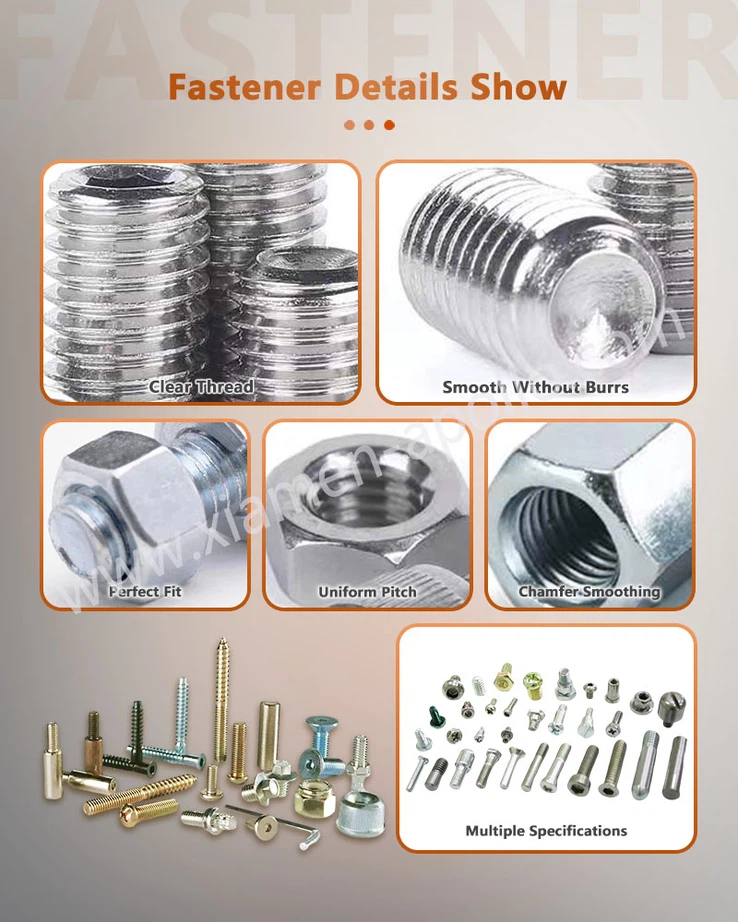
Used to connect and fasten parts, such as Hex Bolt Nuts, nuts, and screws.
Transmission threads
Used to transmit power and motion, such as worm gears and trapezoidal thread screws.
Fixing threads
Used to fix the position of parts, such as set screws.
8. Development history of threads
Machine Screw→Self Tapping Screw→Self Drilling Tapping Screw
●Machine thread: Drill and tap the assembly first during assembly, and the tapped internal thread is consistent with the external thread specification of the screw, and a smaller torque is used for assembly.
●Self-tapping thread: Drill holes on the assembly first during assembly, no need to tap the internal thread, and a larger torque is used for assembly.
●Self-drilling thread: Used directly on the assembly, the screw is drilled and tapped in one step.
Threads are an indispensable structure in mechanical engineering, and their design and processing accuracy directly affect the performance and reliability of mechanical systems. Understanding the basic knowledge, classification, elements, and standards of threads is of great significance for mechanical design and manufacturing.
