

In the fields of sheet metal fabrication and precision component manufacturing, stainless steel stamping is a highly efficient forming technique used to transform flat sheet material into designed parts. Compared to the stamping of ordinary carbon steel, stainless steel stamping presents unique challenges, such as high material strength, significant work hardening, and accelerated die wear. This article systematically elucidates the key technical aspects and engineering value of stainless steel stamping, examining it through the dimensions of operating principles, process workflows, and technical characteristics.
Basic Principles of Stainless Steel Stamping
Stainless steel stamping is a specialized branch of sheet metal fabrication, specifically tailored for processing stainless steel sheets typically ranging in thickness from 0.5 to 3 millimeters. Its core principle lies in the synergistic interaction between a die and a press machine, which induces plastic deformation in the sheet metal. The stamping die consists of a punch and a die cavity; the press drives the punch downward, forcing the sheet into the cavity to execute one or more operations-such as cutting, bending, deep drawing, flanging, or punching. Given stainless steel's high yield strength and pronounced tendency toward work hardening, the stamping process requires precise control over deformation rates and lubrication conditions to prevent material cracking or excessive die wear. The production of OEM stainless steel stamping parts is typically based on 3D models provided by the client; this process begins with a formability analysis, followed by the targeted design of the die contours and blank-holding force distribution to ensure uniform material flow during deformation, thereby minimizing localized thinning and springback.
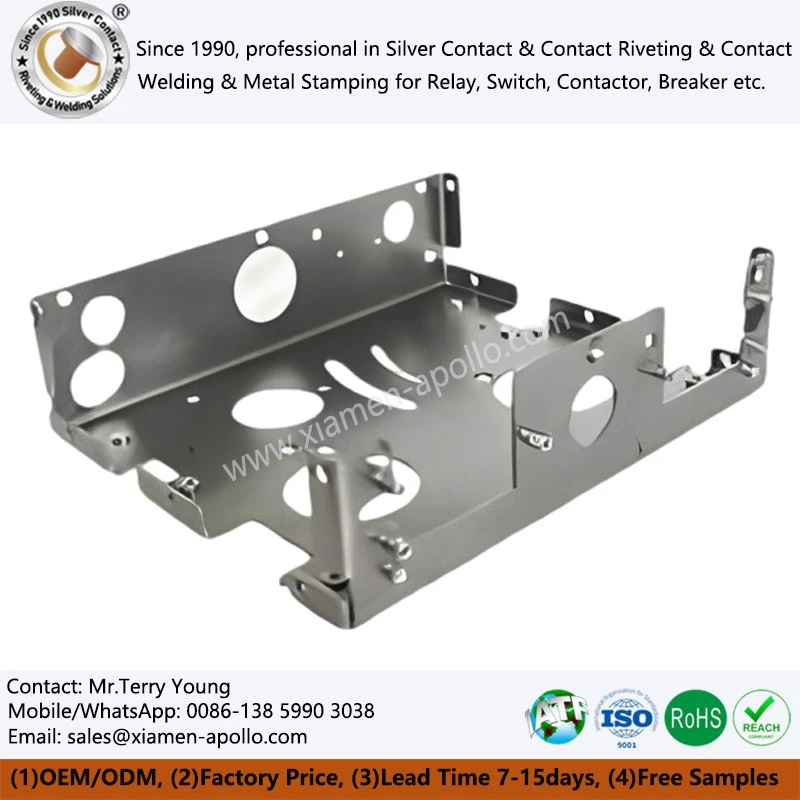
Mold Design and Manufacturing Requirements
The design and manufacturing of stainless steel stamping molds constitute the critical phase that determines the quality of the final stamped 304 stainless steel parts. Stamping molds must possess high strength and exceptional wear resistance; they are typically fabricated from cemented carbide or high-speed steel to withstand the intense contact stresses generated during the deformation of the stainless steel material. During the design phase, the clearance between the punch and the die cavity, the fillet radii, and the geometry of the blank-holding surface must be precisely determined based on the geometric features of the intended stainless steel stamping. For stainless steel sheet metal stamping operations involving bending or deep drawing features, Finite Element Analysis (FEA) is employed to predict springback-the elastic recovery of the material after forming-and to incorporate pre-compensated angles into the mold design. The metal stamping blanks are obtained from stainless steel sheets via shearing or laser cutting; laser cutting offers contour precision of ±0.005 mm, making it highly suitable for the high-volume preparation of blanks. The dimensions and geometry of the blanks must be precisely matched to the mold's positioning system to ensure consistent material placement within the die cavity during every stamping cycle. In the context of progressive die design, pilot holes must also be incorporated into the strip material to ensure precise positional alignment between consecutive stamping stages.
Detailed Overview of the Stamping Process Steps
The complete process flow for stainless steel stamping encompasses several distinct stages: mold fabrication, sheet blanking, process setup, material loading, pressure application, and part ejection. During the mold fabrication stage, the die cavity and punch are designed based on the final dimensional specifications, and high-strength mold materials are selected to ensure durability. Sheet blanking involves cutting the stainless steel sheet into the required blanks; this can be achieved through shearing or fiber laser cutting-with the latter offering superior precision and being particularly well-suited for blanks with complex geometries. A primary distinction in process setup between carbon steel stamped parts and stainless steel stamped parts lies in the requirement for higher press tonnage and more rigorous lubrication control for stainless steel. During the setup stage, the mold is mounted onto the stamping press, the punch is aligned with the die cavity, and parameters such as tonnage, stroke length, and stamping speed are entered into the control panel.
Material loading can be executed manually or via automated feeding systems; advanced equipment is typically outfitted with sensors to detect the position of the sheet material, thereby ensuring precise and accurate positioning prior to stamping. When pressure is applied-typically via hydraulic or mechanical presses-a controlled force is exerted to execute multiple operations-such as cutting, bending, stretching, and punching-within a single cycle. This ability to complete diverse operations in a single pass is the core characteristic that distinguishes the stamping process from single-stage forming methods. Following the Custom Stainless Steel Stamping process, post-processing steps such as deburring and polishing are required; additionally, surface treatments-such as electroplating, powder coating, or painting-may be selected to enhance both corrosion resistance and aesthetic quality.

Advantages and Application Industries of Stainless Steel Stamping
Stainless steel stamping offers numerous technical advantages. First, it allows for the completion of multiple forming stages within a single press cycle, resulting in production efficiency far superior to traditional processing methods where individual operations are dispersed across different pieces of equipment. Second, it boasts high material utilization rates; through intelligent nesting and layout optimization, scrap generation can be significantly minimized. Third, it offers low unit costs for mass production, making it particularly well-suited for manufacturing parts with annual production volumes exceeding several hundred thousand units. Galvanized Steel Stamping is similar to stainless steel stamping, though it presents a specific challenge: the zinc coating must be protected from peeling or flaking during the stamping process, thereby necessitating more rigorous requirements for die lubrication. Due to their high strength and corrosion-resistant properties, stainless steel stamped parts are widely utilized across various sectors, including automotive manufacturing, medical devices, industrial hardware, electronic equipment, and aerospace. Examples of components frequently mass-produced via stainless steel stamping include automotive exhaust system brackets, handles for medical surgical instruments, electronic device enclosures, and aerospace connectors.
Comparison of Stainless Steel Stamping with Other Metal Forming Processes
The primary distinction between stainless steel stamping and other metal forming processes lies in its ability to integrate multiple forming operations into a single production cycle. While a typical bending process can only alter bending angles, and a stretching process merely manages material flow in the depth dimension, stamping can simultaneously execute a variety of actions-such as blanking, bending, stretching, flanging, and embossing-all within a single cycle. The application of Electrical Panel Galvanized Steel Stamping in the manufacturing of electrical distribution cabinets serves as a prime example; a single panel may feature a combination of mounting holes, ventilation slots, reinforcing ribs, and bent edges-all of which are sequentially formed using a single set of progressive dies, eliminating the need to transfer semi-finished parts between different machines. However, adjusting the stamping process entails high costs; once the die has been manufactured, any design modification to the Steel Base for Capacitor necessitates either modifying or completely remaking the die. Consequently, stamping is best suited for products with mature designs and stable production volumes.
Quality Control and Common Issues in Stainless Steel Stamping
In stainless steel stamping production, common quality issues include excessive burrs from blanking, excessive springback during bending, cracking in drawn sections, and surface scratches. Blanking burrs are typically caused by excessive clearance between the punch and the die cavity, or by wear on the cutting edges; this requires regular inspection of the die's condition and timely regrinding. Bending springback occurs because stainless steel possesses a high yield strength; upon unloading, the material's elastic recovery causes the bending angle to deviate from the design specification. This issue can be mitigated by compensating the die angle or by incorporating local stiffening ribs to suppress springback. For GI Stamping Parts (galvanized iron), particular attention must be paid to the issue of coating peeling; the zinc coating may flake off during severe deformation. Therefore, it is essential to control the degree of deformation and select a coating process that offers superior adhesion. Regarding Carbon Steel Stampings involving deep drawing, the material is subjected to biaxial tensile stress at the punch radius; if this stress exceeds the material's tensile limit, cracking will occur. This issue can be alleviated by increasing the drawing radius, improving lubrication, or employing a multi-stage drawing process. Surface scratches typically stem from a rough die surface or insufficient lubrication; polishing the working surfaces of the die and applying an appropriate amount of stamping oil can effectively resolve this problem.

VII. Future Development Trends in Stainless Steel Stamping
As automation and digitalization technologies continue to integrate into stamping workshops, stainless steel stamping is evolving toward greater efficiency, more consistent quality, and shorter lead times. In-line monitoring systems can capture pressure curves, displacement data, and vibration signals in real time; by analyzing anomalous waveforms, these systems enable the timely detection of issues such as punch wear or material positioning errors. The rapid prototyping capabilities for stainless steel stamped parts are also improving; the adoption of additive manufacturing or rapid electroforming techniques helps shorten mold fabrication cycles, thereby meeting market demands for high-mix, low-volume production. Driven by the rapid growth of the new energy vehicle and energy storage sectors, the demand for high-strength stainless steel stampings is expected to continue rising, propelling stamping processes toward higher precision and more complex forming capabilities.
Conclusion
As an efficient and cost-effective sheet metal forming technology, stainless steel stamping utilizes the synergistic interaction between molds and presses to complete multiple forming operations within a single cycle, finding widespread application in fields such as automotive, medical, electronics, and industrial hardware. While the process principles for zinc-coated steel stamping are similar to those for stainless steel stamping, differences in material properties necessitate specific adjustments to mold clearances and lubrication strategies. From mold design and manufacturing, blank preparation, and process setup, to the post-processing of stamped 304 stainless steel parts, every stage exerts a significant influence on the final product quality. As the level of automation in stamping equipment increases and the performance of mold materials improves, the dimensional accuracy and surface quality of stainless steel stampings will be further enhanced, thereby meeting the requirements of even the most demanding engineering applications.
For further professional information regarding the customized manufacturing of cold-rolled carbon steel stampings and the optimization of mold designs, please feel free to contact our technical team; we would be pleased to provide you with detailed consultation and support.
contact us
