

As an indispensable core protective component within low-voltage power distribution systems-also known as a molded-case circuit breaker-this device features a structural design and performance characteristics that directly impact the safe and stable operation of the distribution network. Furthermore, screw clamp terminals serve as complementary connection components, providing a reliable guarantee for the integrity of the electrical circuitry. A defining feature of the molded-case circuit breaker is that all internal parts are hermetically sealed within a plastic housing; core sub-assemblies-such as auxiliary contacts, undervoltage releases, and shunt releases-typically employ a modular design, resulting in a highly compact overall structure. This design characteristic effectively precludes the possibility of internal maintenance or repair; consequently, in practical applications, these devices are primarily utilized as disposable protective components.
In terms of operational modes, molded-case circuit breakers are predominantly operated manually; however, for high-capacity models, electric-motorized opening and closing mechanisms are available as an option to accommodate the diverse requirements of various application scenarios. The judicious selection and integration of screw terminal blocks can further enhance both operational stability and the reliability of electrical connections. Driven by advancements in power electronics technology, electronic overcurrent releases have become widely adopted in molded-case circuit breakers, leading to their classification into two distinct categories: Type A and Type B. Among these, Type B products offer superior three-stage protection characteristics and more comprehensive protective functionality; conversely, Type A products-which utilize thermal-magnetic releases-command a larger market share due to their cost-effectiveness, establishing them as the preferred choice for the majority of application scenarios.
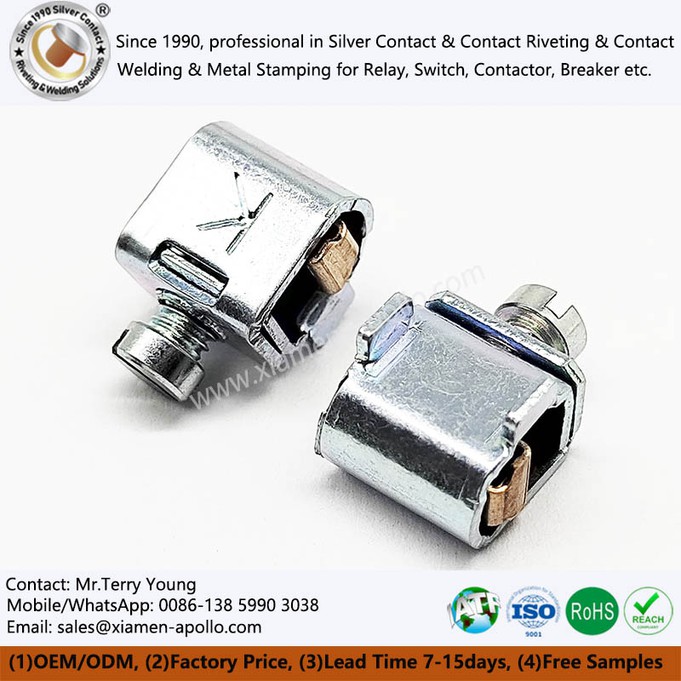
Structurally, a molded-case circuit breaker (MCCB) integrates core components-such as contacts, arc-extinguishing chambers, trip units, and operating mechanisms-within a single plastic housing, thereby simplifying maintenance requirements. The use of screw clamps for fuse terminals optimizes the interconnection between the MCCB and fuses, enhancing the overall coordination of the protection system. Primarily utilized as a branch-circuit protection switch, the MCCB's core protective functions are executed by its trip unit. These trip units fall into two main categories-thermal-magnetic and electronic-which exhibit distinct differences in their protective capabilities and are tailored to meet diverse power distribution protection requirements.
Thermal-magnetic MCCBs are classified as non-selective breakers; they offer only two modes of protection: long-delay overload protection and instantaneous short-circuit protection. Characterized by their simple structure and lower cost, they are suitable for general applications where high precision in protection is not a critical requirement. In this context, screw clamps for fuse holder terminals serve to bolster the connection stability between the breaker and the fuse holder, thereby preventing faults caused by poor contact. In contrast, electronic MCCBs offer a more comprehensive suite of protective functions, encompassing long-delay overload, short-delay short-circuit, instantaneous short-circuit, and ground fault protection. This enables them to respond precisely to a wide range of circuit anomalies, thereby safeguarding the integrity of the power distribution system.
Driven by continuous technological advancements, some newer models of electronic MCCBs now incorporate a "zone-selective interlocking" feature. This functionality facilitates coordinated protection between upstream and downstream breakers, preventing nuisance tripping (unwanted tripping of upstream breakers) and enhancing the operational stability of the power distribution system; the standardized design of screw terminals facilitates such functional expansions. Regarding operating mechanisms, most MCCBs employ manual operation, offering ease of use and cost-effectiveness. However, certain larger models are equipped with motorized operating mechanisms, making them suitable for high-capacity and high-frequency switching applications that meet rigorous industrial-grade power distribution demands.
A thorough understanding of the MCCB's operating principles is paramount for proper product selection and application. Screw terminal wire connectors play a vital role in optimizing the conductivity and stability of the circuit connections, thereby ensuring the effective and reliable execution of these operating principles. Fundamentally, the MCCB is a type of low-voltage circuit breaker in which the main contacts are closed either manually or via a motorized mechanism. Once closed, a free-trip mechanism latches the main contacts in the closed position, ensuring the continuous flow of current through the circuit; the specific design and layout of the core tripping components directly determine the breaker's protective performance capabilities.

Specifically, the coil of the overcurrent trip unit and the thermal element of the thermal trip unit are connected in series with the main circuit, while the coil of the undervoltage trip unit is connected in parallel with the power supply, thereby forming a complete protection loop. The proper installation of Screw Type Terminal Blocks ensures reliable connections between each tripping component and the circuit, preventing protection failures. In response to various circuit anomalies, the trip units trigger corresponding actions to safeguard the circuit; the stability of this process is directly critical to the safety of the power distribution system.
When the circuit experiences an overload condition, the thermal element within the thermal trip unit heats up due to excessive current flow, causing a bimetallic strip to bend. This bending action actuates the free-trip mechanism, causing the main contacts to disconnect the main circuit. The precise fastening provided by M4 Screw Terminals guarantees the installation accuracy of the thermal trip unit, thereby ensuring the sensitivity of the overload protection. This time-delay protection design effectively prevents false tripping caused by momentary overloads while ensuring that the circuit is promptly disconnected during sustained overload conditions.
When the circuit encounters an undervoltage anomaly, the armature of the undervoltage trip unit releases, similarly triggering the free-trip mechanism to disconnect the main circuit. Electrical Screw Terminal Blocks enhance the connection reliability between the undervoltage trip unit and the power supply, thereby preventing undervoltage protection failures. Furthermore, when the shunt trip button is pressed, the armature of the shunt trip unit energizes and engages, actuating the free-trip mechanism to manually disconnect the main circuit, thereby fulfilling the requirements for emergency shutdown.
If you wish to delve deeper into the intricacies of molded case circuit breaker selection techniques, installation essentials, and fuse terminal block compatibility, please contact us. We will provide professional industry solutions to assist you in resolving the various challenges encountered in your molded case circuit breaker applications.
contact us
