

In the manufacturing sector for electromagnetic equipment, transformers, and relays, the Coil Soft Iron Core serves as a fundamental component-essential for facilitating magnetic induction conversion and ensuring the stability of a device's electromagnetic performance. Industry standards predominantly favor cores fabricated from high-permeability silicon steel or pure iron; leveraging their superior magnetic permeability to reduce overall device dimensions and enhance electromagnetic conversion efficiency, these soft iron cores are widely utilized across various electromagnetic coil assemblies and constitute a core material for industrial electromagnetic components. Cold heading-a precision plastic forming technique characterized by minimal or zero material removal-has, by virtue of its efficiency, high precision, and ability to produce high-strength parts, emerged as the dominant process for mass production.
Cold heading relies on the principles of metal plastic deformation, utilizing external compressive forces applied via dies to induce a volumetric redistribution of the metal material. This process enables the rapid forming of various Cold Heading Pure Iron Core blanks and precision components, thereby facilitating the large-scale production of both standard parts and custom-shaped products. However, traditional cold heading processes exhibit significant limitations when fabricating components featuring internal holes or apertures; the intense compressive forces involved frequently induce deformation of the internal bore and cause deviations in hole diameter. This significantly compromises the precision of the finished product, rendering it incapable of meeting the stringent precision machining standards required for high-end Cold Heading Pure Iron Cores, and thereby hindering the mass production of such high-precision components.
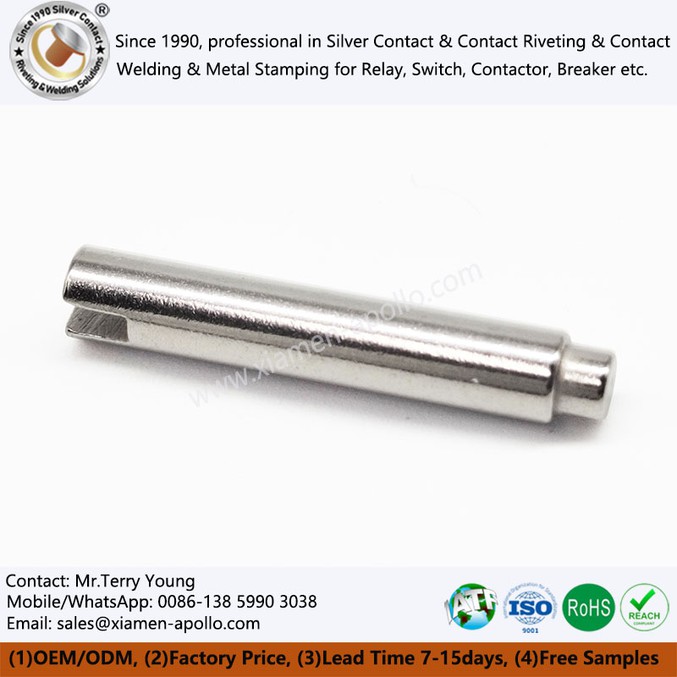
To address precision defects encountered during the cold heading of perforated Straight Coil Cores, a specialized rapid cold heading die has been developed featuring an optimized structural design that completely resolves issues related to hole deformation. The complete die assembly consists of two primary structural components: a male die assembly and a female die assembly. The male die assembly houses a pre-punch core and a buffer pad, enabling the stable feeding of workpieces; this configuration is ideally suited for the rapid forming of Straight Coil Cores with regular geometries, ensuring stability throughout the feeding and stamping processes.
The female die assembly is equipped with a locking sleeve, a die cavity, and an ejector pin mechanism. The locking sleeve ensures a secure, rigid connection between the die and the cold heading machine, thereby preventing processing misalignment. The die cavity is precisely dimensioned to match the required forming specifications of the Relay Core, while the ejector pin mechanism automatically ejects the finished workpiece upon completion of the process. This streamlines the unloading procedure, significantly boosts processing efficiency, and meets the demands for the mass, standardized production of various types of Relay Cores.
The core innovation of this die lies in the incorporation of an adjustable limiting device, specifically designed to resolve the complex challenge of deformation caused by upsetting and extrusion during the forming of perforated Coil Cores for electromagnetic relays. At the heart of this limiting device is a removable limiting rod; during processing, this rod is inserted and secured within the internal bore of the workpiece, providing internal structural support to the hole geometry. By counteracting the deformation stresses generated by extrusion forces, the device effectively maintains the precise diameter of the hole, thereby guaranteeing the forming accuracy of the Coil Core for electromagnetic relays and eliminating product scrap caused by hole dimension deviations.
To accommodate diverse processing requirements, the limiting rod features a modular, removable mounting structure. Through a coordinated design involving interlocking blocks, springs, and multiple sets of mounting holes, the extension length of the limiting rod can be freely adjusted to suit Pure Iron Core workpieces of varying hole diameters and thicknesses. This flexible structural adjustability allows the die to process not only solid (non-perforated) products but also complex-shaped Pure Iron Cores with perforations, thereby significantly expanding the range of applications for the equipment.
Furthermore, to facilitate the processing of complex, non-standard products, the die supports a dual-limiting-device configuration. These devices can be independently installed at both the pre-punch core and the female die ejector pin ends, enabling the specialized processing of composite structures featuring holes with different diameter specifications at each end. This design is perfectly tailored to meet the customized processing requirements of various non-standard iron core relay components, effectively resolving industry pain points associated with traditional molds-specifically, their limited versatility and poor adaptability.
In terms of material compatibility and precision machining, this mold is ideally suited for processing soft magnetic materials-such as pure iron and silicon steel-and is fully compatible with the materials utilized in high-end electromagnetic devices. Whether for standard industrial products or high-precision DT4C AC relay iron cores, this mold enables cold heading to produce finished parts characterized by precise dimensions and dense structural integrity, thereby effectively preserving the products' inherent soft magnetic properties and electromagnetic stability.
Compared to conventional processing molds, this novel cold heading die offers superior process compatibility, accommodating a wide range of subsequent processing requirements. Following the cold heading process, the relay cores-intended for nickel plating with a copper undercoat-exhibit a uniform structure devoid of any significant deformation. This allows them to proceed directly to subsequent surface treatments, such as electroplating and coating, making the mold particularly well-suited for the pre-treatment phase of nickel-plated relay cores with copper undercoats; it eliminates the need for secondary grinding, thereby significantly streamlining production workflows and reducing processing costs.

Overall, this novel rapid cold-heading die-by incorporating an innovative deformation-resistant limiting structure-has successfully resolved the long-standing challenge of insufficient precision in the cold heading of perforated pure iron cores for electrical applications. Characterized by broad adaptability, stable precision, and high mass-production efficiency, this die is compatible with the processing of various pure iron and silicon steel relay cores. It represents a premium solution for upgrading current relay core cold-heading processes, thereby driving the high-efficiency and high-precision advancement of the precision manufacturing industry.
Frequently Asked Questions
1. What are the typical application scenarios for cold-headed relay iron cores?
They are primarily used in various types of electromagnetic relays, transformers, and small-scale electromagnetic devices, making them ideally suited for the mass production of precision electromagnetic components and soft magnetic core parts.
2. What are the core advantages of the cold-heading molds used for relay iron cores?
Equipped with a deformation-preventing limit structure, these molds effectively eliminate the risk of hole-diameter distortion in parts featuring internal apertures, thereby ensuring superior precision. Furthermore, they are compatible with the processing of both perforated and solid parts, offering broad adaptability and high efficiency for mass production.
3. Which types of relay iron cores are compatible with this mold for processing?
It is capable of processing standard iron cores-including those made from pure iron or silicon steel-as well as perforated cores and cores featuring uniquely shaped apertures at both ends. This makes it widely applicable to the manufacturing of various devices and products, such as relays and electromagnetic coils.
contact us
For customized Relay steel Core, process optimization, or precision forming solutions, please consult our professional team. We offer tailored solutions designed to meet the specific requirements of diverse processing scenarios, ensuring both forming precision and mass-production efficiency.
