

As a fundamental component in automatic control systems, electromagnetic relays are widely utilized across various fields, including smart meters, industrial control, home appliances, and railway signaling. Their core function lies in using a low-power signal to control a high-power circuit, thereby enabling the switching-specifically, the opening and closing-of the circuit. The reliable operation of an electromagnetic relay hinges critically on the design of its internal electromagnetic system and the performance of the soft magnetic materials employed therein. Due to its high magnetic permeability and low coercivity, the Soft Magnetic Iron Rod RFe80 has become one of the most widely adopted flux-conducting materials within relay electromagnetic systems. When the coil is energized, the magnetic field is concentrated and the magnetic flux intensified through this iron core; this generates sufficient electromagnetic force to attract the armature, thereby actuating the contact assembly and completing the circuit switching process. Fundamentally, this process represents a conversion of energy-from electrical to magnetic, and ultimately to mechanical energy-and the quality of the soft magnetic materials directly determines key parameters of the relay, such as its sensitivity, pick-up voltage, and drop-out voltage.
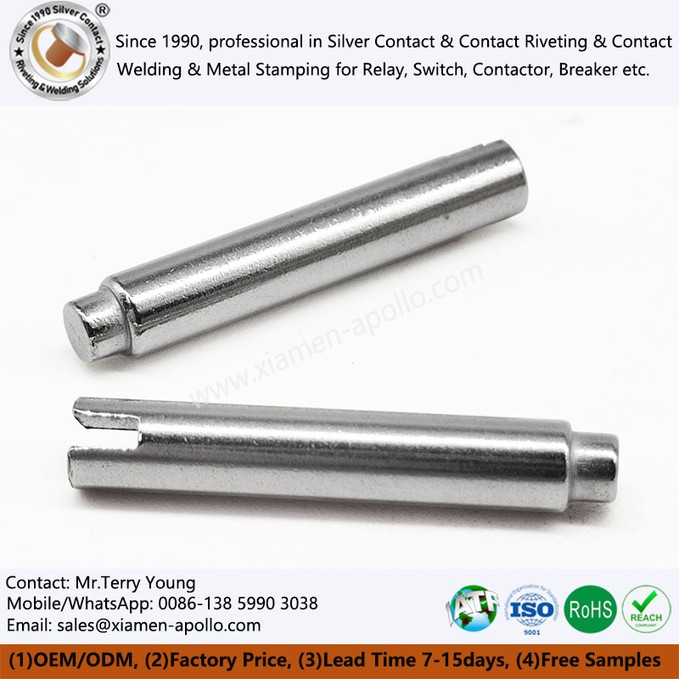
Within the structural composition of an electromagnetic relay, various components-typically including the relay rod, armature, contact system, and reset spring-work in concert. Specifically, when a rated voltage is applied across the coil terminals, current flowing through the coil generates a magnetic field. This magnetic field magnetizes the coil soft iron core (which is crafted from high-purity soft magnetic material); the resulting magnetic force drives the armature to move toward the soft iron core. This mechanical motion is transmitted via the relay rod, ultimately causing the movable contact to make or break contact with the stationary contact. Common relay operating modes include "normally open" (NO) and "normally closed" (NC); in the former, the contacts close when the coil is energized, whereas in the latter, the contacts open when the coil is energized. To ensure long-term operational stability, the surface of the coil soft iron core often requires specialized treatment.
The core component of a relay's electromagnetic system is the soft iron core, which directly determines the efficiency of magnetic field conversion. Pure iron material possesses high saturation magnetic induction and low residual magnetism, making it ideally suited for applications requiring rapid attraction and release. In terms of manufacturing processes, the relay pin core serves as a structural skeleton as well as a positioning and connecting element between the coil and other components; consequently, its dimensional precision directly impacts the quality of the coil winding and the effectiveness of the magnetic circuit closure. High-precision soft magnetic iron rods for relays are typically formed through cold heading or turning processes to ensure that the end faces of the pure iron rods are flat and exhibit excellent concentricity, thereby minimizing magnetic leakage and enhancing the electromagnetic actuation force.
In modern relay manufacturing, many manufacturers employ relay core cold heading techniques to enhance efficiency and consistency. Cold heading technology allows pure iron wire stock to be directly forged into the desired shape at room temperature; this method boasts high material utilization efficiency, produces continuous metallurgical grain flow lines, and yields mechanical and magnetic properties superior to those of machined parts. Furthermore, after undergoing annealing treatment, the pure iron relay core is relieved of internal stresses, and its magnetic permeability is further enhanced-making it highly suitable for high-speed relays where strict requirements regarding actuation time are paramount. Material requirements vary depending on the specific application scenario: general-purpose relays typically utilize industrial-grade pure iron for their cores, whereas high-sensitivity signal relays rely more heavily on specialized soft magnetic iron cores to achieve lower pickup ampere-turn requirements.
In specialized sectors-such as railway signaling systems-the reliability of electromagnetic relays is directly linked to operational safety. Consequently, Pure Iron Cores for Railway Signaling Relays are subject to exceptionally stringent requirements regarding the stability of their magnetic properties, resistance to aging, and environmental adaptability. These specialized iron cores typically undergo rigorous magnetic performance testing and lifecycle validation to ensure they function with precision, even across a wide temperature range and under conditions of prolonged continuous energization. Whether for general-purpose or specialized relays, the selection of materials and the manufacturing processes employed for the relay core ultimately determine the quality grade of the final product. The judicious selection of soft magnetic materials can effectively enhance a relay's operational sensitivity, reduce power consumption, and extend its service life.

In summary, the operating principle of an electromagnetic relay is based on the laws of electromagnetic induction; by exciting a coil, it generates a magnetic force within the soft-magnetic iron core component, thereby driving the armature and contact system to execute circuit switching. Furthermore, the purity, magnetic permeability, surface treatment, and processing techniques of the iron core material constitute the critical factors that influence the relay's overall performance. A thorough understanding of these technical details enables engineers to make more accurate assessments during product selection and fault analysis.
Frequently Asked Questions
1. Why are pure iron materials commonly used for the steel cores of relays?
Pure iron possesses high magnetic permeability, low coercivity, and low residual magnetism; it responds rapidly to changes in current, reduces pull-in power requirements, and ensures reliable release, making it an ideal soft magnetic material.
2. What benefits does a nickel plating provide for relay steel cores?
Nickel plating prevents rust and corrosion, reduces contact resistance at the contact points, minimizes operational noise, and extends the relay's service life in humid environments.
3. What are the advantages of using the cold heading process for manufacturing relay steel cores?
The cold heading process offers high material utilization and high production efficiency. Furthermore, the resulting components feature continuous metallurgical grain flow and dense internal structures; consequently, their magnetic properties are superior to those of machined parts, and they exhibit excellent dimensional consistency.
contact us
Should you require further information regarding selection criteria for Pure iron Relay Core materials or customized processing solutions, please feel free to contact us to obtain professional technical documentation and sample support.
