

The reliability of switching components has long been a core concern in the electrical and power control industry, especially in systems that operate under high current, high frequency, and demanding safety requirements. One of the most critical factors affecting service life is the welding behavior of Silver Alloy Point Contacts materials during switching operations. When local overheating and arc discharge cause adjacent Solid Electrical Contacts surfaces to fuse together, the result can be irreversible failure. As a result, understanding welding resistance has become a key topic in the development of advanced electrical contacts.
In practical operation, Solid Ag Contact welding is mainly associated with dynamic conditions rather than static current loading. During make-and-break actions, arc energy generated at the Monometal Contact Rivet interface can locally melt the surface, forming a molten zone that may solidify into a permanent joint. If the resulting welding force exceeds the mechanical restoring force, separation becomes impossible. This phenomenon directly impacts the performance of electrical contact switch systems and remains a major cause of reliability degradation in high-load applications.
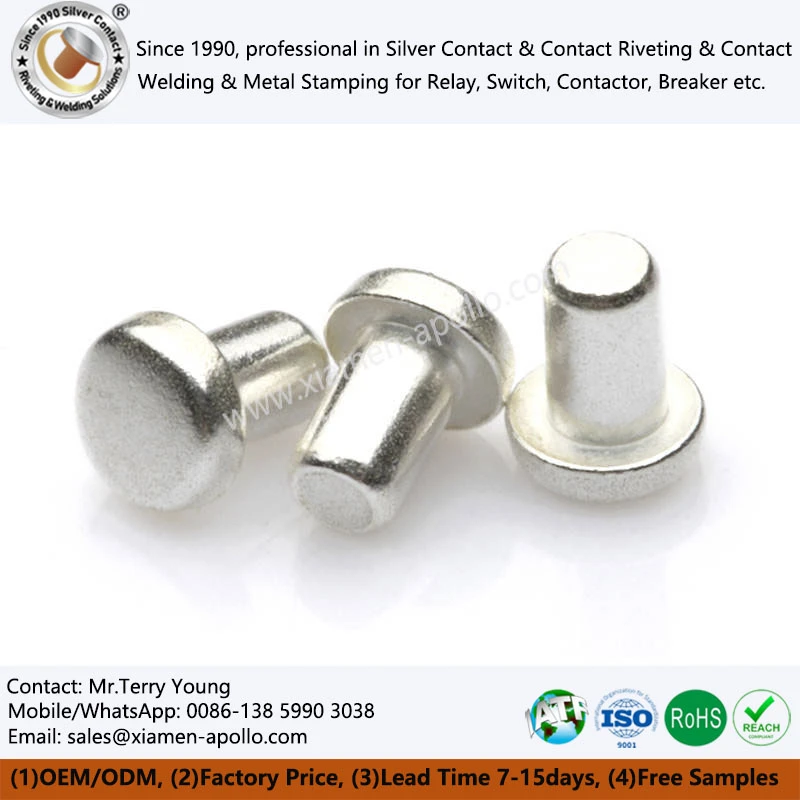
Traditional Silver electrical contacts materials, including various Silver Alloy Contacts, have been widely studied for decades. These materials typically rely on a conductive silver matrix combined with an insoluble or partially soluble phase to suppress arc energy and limit molten pool expansion. Well-known systems such as Silver cadmium oxide solid contact, Silver zinc oxide solid contact, and Silver nickel solid contact have demonstrated balanced conductivity and arc resistance, but rising power density and stricter reliability demands have exposed their limitations in certain applications.
In response, composite materials based on silver and carbon structures have gained increasing attention. By introducing a graphite framework, molten metal flow can be constrained while arc energy is partially dissipated, improving resistance to fusion welding. From an industry perspective, this approach represents a shift from purely alloy-based design toward structural control of arc behavior, offering new possibilities for next-generation Silver electrical contacts.
Microstructural analysis shows that the distribution and continuity of the silver phase play a decisive role in welding behavior. In materials with a higher proportion of continuous silver networks, the molten area formed under arc exposure tends to be larger, increasing the probability of fusion. Conversely, a controlled dispersion of silver within a stable matrix can effectively reduce weld cross-sectional area, lowering the resulting welding force. This finding is especially relevant for Solid Silver Contacts, where conductivity advantages must be balanced against welding risk.
Experimental observations under increasing current loads indicate that welding does not occur below a critical threshold. Once exceeded, welding force rises rapidly with current, highlighting the importance of current control in system design. Compared with conventional oxide-based materials, silver–carbon composites exhibit significantly lower welding forces even under higher current levels, suggesting superior performance in demanding switching environments. This behavior is particularly valuable in applications such as Silver contacts for Relay, Silver contacts for Breaker, and Silver contacts for MCCB, where repeated high-load switching is unavoidable.
Surface morphology after arc exposure further confirms the influence of material structure. Smaller and more uniformly distributed erosion zones correspond to lower welding forces and better durability. In contrast, materials with uneven phase distribution tend to show secondary erosion and repeated arc activity, accelerating degradation. These insights are increasingly guiding material selection across different electrical contact types, especially in compact and high-reliability systems.
From a market and application standpoint, demand is steadily shifting toward Solid Rivet Contacts solutions that combine long electrical life with predictable failure behavior. While Pure Silver Contacts and pure Silver solid contact variants remain relevant for low-resistance requirements, they are being selectively replaced or modified in high-power environments. Hybrid approaches, including Silver Alloy Rivets and Silver Solid Contact Rivets, are now designed with greater emphasis on arc control rather than conductivity alone.

Looking ahead, the development of Silver Contact Points materials will continue to focus on microstructural optimization, reduced welding force, and improved arc erosion resistance. Advanced processing methods and material combinations are expected to further enhance the stability of Silver Contact Points and other electronic contacts used in power distribution and control systems. As electrical systems evolve toward higher efficiency and higher load density, Silver electrical for contactor materials with proven anti-welding performance will play an increasingly decisive role in ensuring operational safety and long-term reliability.
contact us
