Material Properties and Technological Breakthroughs
Tungsten discs are precision components made from tungsten metal. Their physical and chemical properties are unique among industrial materials. Pure tungsten has one of the highest melting points known, at 3422°C. This allows it to maintain stable mechanical properties even at temperatures exceeding 1200°C. Pure Tungsten Disks produced using powder metallurgy can achieve a density of 19.3 g/cm³, 2.5 times that of iron. This high density makes them ideal for counterweights in the aerospace industry, such as aircraft landing gear shock absorption systems and helicopter rotor balancing components.
In terms of material modification, the addition of alloying elements such as nickel and iron, combined with heat treatment, can reduce tungsten's room-temperature brittleness by over 40% while maintaining its high-temperature strength. The latest nanostructured Tungsten Metal Small Polished Discs 99.95% purity, manufactured using isostatic pressing and plasma sintering (CIPPAS) technology, achieve a fatigue life 37 times greater than conventional processes. They are already used in the turbine blade retaining rings of the domestically produced C929 large aircraft. This technological breakthrough significantly improves the reliability of Powder Metallurgy Tungsten Discs in extreme environments. For example, in nuclear fusion devices, gradient-structured Tungsten Steel Bar Discs have passed 6,500 hours of supercritical carbon dioxide corrosion testing, laying the foundation for the construction of future commercial nuclear fusion reactors.

Diversified Application Scenarios
1. Medical Imaging
As a core component of X-ray tubes, the Tungsten Rod Slice generates X-rays by enduring high-speed electron beam bombardment. Their high melting point and thermal conductivity ensure that the equipment will not fail due to overheating during continuous operation. In third-generation dual-source CT machines, an 80mm diameter tungsten disc anode enables a rapid scan time of 0.3 seconds and a resolution of 0.2mm, supporting precision medicine applications such as early lung cancer screening.
2. Semiconductor Manufacturing
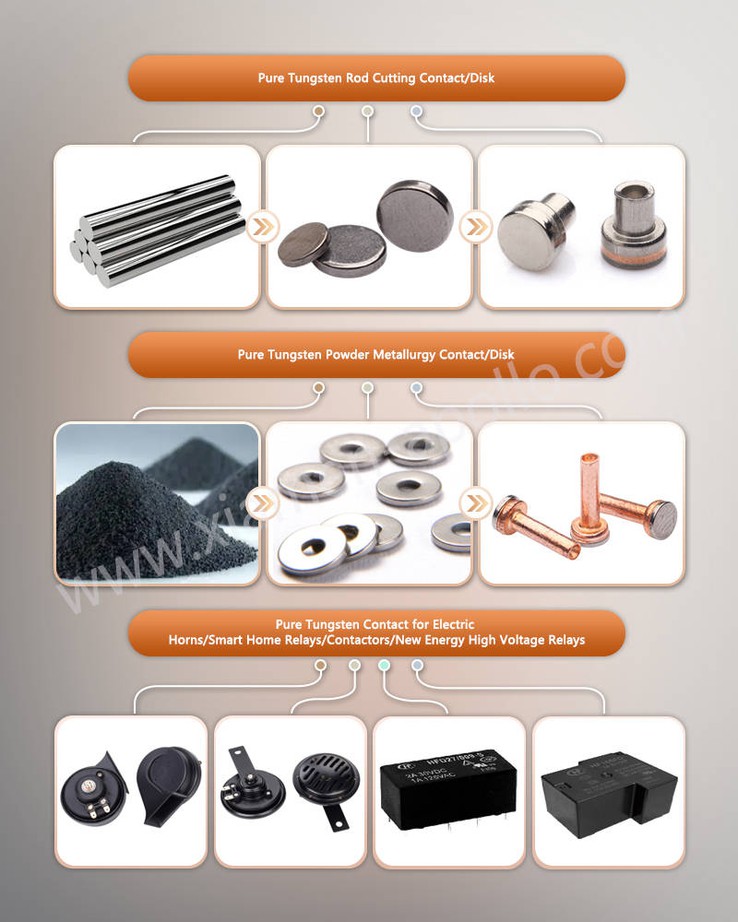
In semiconductor wafer processing, ultra-thin Pure Tungsten Disc for Car horns with a thickness of 0.1-0.5mm is used as shielding material in ion implanters. Their high density effectively blocks the scattering of high-energy ions, ensuring chip pattern accuracy within 5nm. In the photovoltaic industry, 800mm diameter Tungsten rivets for Electric horns are used in single-crystal furnace thermal systems. The domestic production rate has increased from 31% in 2020 to 78% in 2024, driving a 15% reduction in losses during photovoltaic silicon wafer cutting.
3. High-end Equipment Manufacturing
High-temperature components in aircraft engine combustion chambers utilize tungsten-based alloy discs, which maintain a tensile strength of 800 MPa in a 1600°C gas environment, extending their service life three times that of traditional nickel-based alloys. In the new energy vehicle sector, Flat Tungsten Contact Points, used as counterweights in motor rotors, can reduce NVH (noise, vibration, and harshness) levels in electric vehicles by 12 decibels, significantly improving driving comfort.

Global Industry Landscape and Market Dynamics
Global tungsten metal production will reach approximately 81,000 tons in 2024, with China accounting for 83% of this capacity. This highly concentrated supply structure stems from China's possession of 52.17% of the world's tungsten ore reserves (4.6 million tons). As the world's largest exporter of tungsten products, China's export price for high-end Pure Tungsten contacts to the EU reached a record high of $386 per kilogram in 2024. Imports into Southeast Asia surged 217% year-on-year due to a shift in demand from the tool manufacturing industry.
Regarding emerging production capacity, the Bakuta Tungsten Mine (the world's largest open-pit tungsten mine) is expected to begin production in 2025. The initial phase will contribute 6% of global tungsten production, and by 2028, when the second phase reaches full capacity, its share of production capacity will increase to 13%. This additional supply will alleviate the current global tungsten resource shortage. In 2024, the average price of wolframite concentrate (65%) reached a historical high of 146,000 yuan per standard ton.

Technological Evolution and Sustainable Development
1. Green Manufacturing Revolution
Molten salt electrolysis technology for tungsten recycling has achieved industrial application, recovering 98% of metallic tungsten from scrap tungsten products. It saves 62% energy compared to virgin tungsten production and reduces CO2 emissions by 14.2 tons per ton of recycled tungsten. By 2024, the proportion of recycled tungsten raw materials will increase to 29%, and this proportion is expected to exceed 40% by 2030.
2. Frontier Technological Breakthrough
The functionally gradient tungsten disc developed by the Chinese Academy of Sciences uses vapor deposition technology. Its density approaches the theoretical value of 19.3 g/cm³, and its tensile strength remains at 1600 MPa at 1200°C. It has passed 4000 hours of verification testing for aerospace engine hot-end components. This material breakthrough has increased China's import substitution rate in key aerospace components from 58% in 2020 to 73% in 2024.
3. Policy-Driven Innovation
China's "Strategic Mineral Resources Security Project Implementation Plan (2025-2030)" lists high-purity tungsten products as a key development category, and the Ministry of Finance has allocated 5 billion yuan in special funds to support the research and development of new tungsten-based materials. Under this policy, the industry's R&D investment intensity will increase from 3.2% in 2024 to 5.8% in 2027, accelerating the industrialization of cutting-edge technologies such as nanostructures and gradient materials.
Future Development Trends
With the rise of fourth-generation semiconductors and commercial aerospace, the application scenarios of the Motorcycle Horn Tungsten Rivet will further expand. In the manufacture of silicon carbide power devices, 12-inch diameter tungsten discs serve as substrate carriers for epitaxial growth, keeping wafer warpage within 10μm and supporting the large-scale production of automotive-grade chips. In the commercial aerospace sector, a single tungsten-based ablation-resistant nozzle ring for reusable rockets is valued at 2.4 million yuan, with a replacement cycle of 15 flights. This market is expected to generate an incremental value of 970 million yuan by 2030.
In terms of technological iteration, the application of digital twin technology has enabled dimensional tolerances within ±0.003mm during the sintering process of Solid Tungsten Contact Rivets, with a yield rate exceeding 98%. Breakthroughs in 3D printing technology have enabled the integrated molding of complex internal flow channel structures, reducing the processing cycle of aerospace nozzle rings by 60%. These technological advances will drive the tungsten products market to maintain a compound annual growth rate of 12-15% between 2025 and 2030, with the industry's total output value expected to exceed 80 billion yuan by 2030.
As a strategic mineral resource, the development of tungsten discs not only impacts the advancement of materials science but also profoundly impacts the global competitiveness of high-end manufacturing. Driven by the dual forces of the new energy revolution and industrial upgrading, this small metal disc is becoming a key cornerstone supporting the modern industrial system.
contact us