

In 2025, the global new energy vehicle (NEV) market will continue its explosive growth. In the first half of the year, NEV sales exceeded 5 million units, up 35% year-on-year. Smart home device shipments rose by 22% year-on-year, and smart grid investment hit a new high. Demand for core components like relays, contactors, and circuit breakers has surged. As the "heart" of these components, Tungsten Melting Points directly determine equipment reliability and service life.
Demand for high-reliability contacts is growing especially fast. In scenarios like high-voltage systems of NEVs and smart grid circuit breakers, traditional contact materials face unprecedented challenges. High voltage and large current cause frequent arcing, leading to contact melting, oxidation, and sharp increases in contact resistance, which seriously shorten equipment life. In this context, tungsten-based contacts have become the focus of industry technology upgrades due to their ultra-high Tungsten Contacts and excellent arc resistance.

Core Performance Requirements and Material Dilemmas
Tungsten Rivets are key components for circuit switching. Their performance must meet four core requirements:
1. Arc erosion resistance: High temperatures from arcing can melt and evaporate materials for Tungsten Contact Rivets, forming surface pits and oxide layers.
2. Anti-welding ability: Electrical Tungsten Contact Rivets are prone to fusion at high currents, causing adhesion failure.
3. Low contact resistance: Ensure efficient power transmission and reduce the heat generation of the Tungsten Point Contact.
4. High electrical and thermal conductivity: Tungsten Contacts quickly dissipate heat and lower temperature rise.
Traditional Tungsten Rivet materials like pure silver and silver-cadmium oxide perform well in medium and low-load scenarios. But in extreme scenarios like high-voltage relays for NEVs and smart grid circuit breakers, their flaws are exposed: Pure silver has a melting point of only 961°C and easily melts and loses under arcing. Silver-cadmium oxide has environmental concerns with cadmium, and its arc resistance is still insufficient. The industry of Tungsten Contact Rivets urgently needs a new material with a high melting point, high electrical conductivity, and arc erosion resistance. Tungsten's emergence provides a solution to this dilemma.
Materials Characteristics
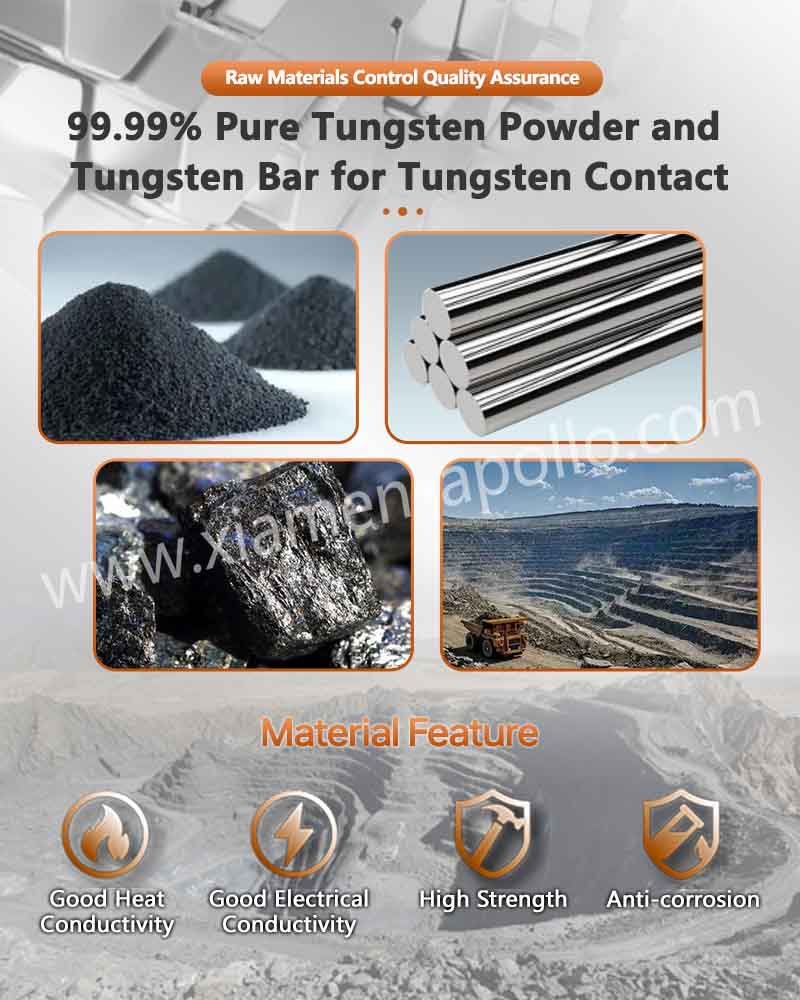
1. High Melting Point: Tungsten's high Electrical Tungsten Contact Rivets ensure stability in extremely high-temperature conditions, which is crucial for electrical equipment that operates at high temperatures.
2. High Hardness: The high hardness of Tungsten Point Contact reduces wear and extends the lifespan, which is important for electrical equipment that switches frequently.
3. Good Conductivity: Silver's conductivity, second only to copper, ensures Tungsten Contacts' excellent performance for most electrical equipment.
4. Corrosion Resistance: Tungsten Rivets are resistant to corrosion, maintaining stability in harsh environments, which is vital for outdoor or industrial electrical equipment.
Frequently Asked Questions
Q: Why are Half-Hollow Tungsten Contact Rivets increasingly used in high-voltage components for new energy vehicles and smart grids?
A: High-voltage systems in new energy vehicles and circuit breakers in smart grids are prone to arcing due to high voltage and high current. Ordinary silver and silver-cadmium oxide contacts have low melting points and are easily damaged or welded together. Silver-cadmium oxide also poses environmental risks related to cadmium. Tungsten, on the other hand, has a high melting point, is resistant to arc erosion, and is wear-resistant. Contacts made from tungsten combine conductivity and high-temperature resistance, making them suitable for heavy-duty applications.
Q: What are the four key material advantages of tungsten contact point rivets?
A: High melting point, high hardness, excellent conductivity, and corrosion resistance, making them suitable for electrical equipment operating under frequent switching and harsh outdoor conditions.
Q: Which downstream application areas are Tungsten Copper Electrical Contacts primarily suitable for?
A: High-voltage components for new energy vehicles, smart home electrical control accessories, smart grid circuit breakers, high-voltage relays, and other components.
contact us
Contacts have become the inevitable choice for high-load scenarios due to the high melting point of tungsten and the conductivity of silver. We will continue to deepen material science and precision manufacturing, and provide more reliable and cost-effective solutions for Tungsten Melting Points to global customers, promoting technological progress and sustainable development of the industry.
We welcome global partners to consult product parameters, sample testing, and bulk order cooperation. Contact us to get Tungsten Copper Rivet Electrical Contact solutions matching your new energy vehicle and smart grid application needs.
