Precision current measurement in modern smart meters, power distribution units, and EV high‑voltage systems relies on EBW Manganese Copper Shunt capable of sustaining high thermal and electrical stress. The core performance of these components depends directly on the transition zone between copper terminals and the central resistance alloy. Manganin (typically CuNi12Mn2 or CuNi13Mn3) is widely adopted as the resistance material. It features a near‑zero temperature coefficient of resistance (TCR), low thermoelectric electromotive force versus copper, and stable mechanical performance under continuous electrical load, complying with IEC 62053‑21 and IATF 16949 standards.

Electrical and Thermal Physics: Why Manganin Dominates Electron Beam Welding Shunt Resistor shunt Design
Precision shunt resistors need stable resistance across a wide operating temperature range from minus 40 degrees Celsius to plus 125 degrees Celsius. Ordinary copper has a large positive temperature coefficient of resistance, so it cannot be used for DC sensing when ambient temperature and self‑heating fluctuate. Manganin solves this problem. Within the temperature range of 20 degrees Celsius to 50 degrees Celsius, its temperature coefficient of resistance can be kept within plus or minus 20 parts per million per Kelvin, and it shows excellent long‑term resistance drift performance under continuous current.
| Material Property | Manganin (Cu86Ni12Mn2) | Pure Copper (ETP) | Constantan (CuNi40) |
|---|---|---|---|
| Electrical Resistivity at 20℃ | 43‑48 micro‑ohm·centimeter | 1.72 micro‑ohm·centimeter | 50 micro‑ohm·centimeter |
| Temperature Coefficient of Resistance (TCR) | ±20 ppm/K (20‑50℃) | +3930 ppm/K | ±40 ppm/K |
| Thermal EMF vs Copper (0‑100℃) | Less than 1.0 micro‑volt/K | 0 | Greater than 40 micro‑volt/K |
| Tensile Strength | 450‑700 MPa (hard temper) | 200‑250 MPa | 400‑500 MPa |
Low thermal electromotive force against copper is very important. Mismatched thermoelectric voltage will produce DC offset error in high‑precision energy meters and fail to meet accuracy requirements of Class 0.2S and Class 0.5S.
Advanced Manufacturing: Electron Beam Welding (EBW) and Progressive Die Stamping
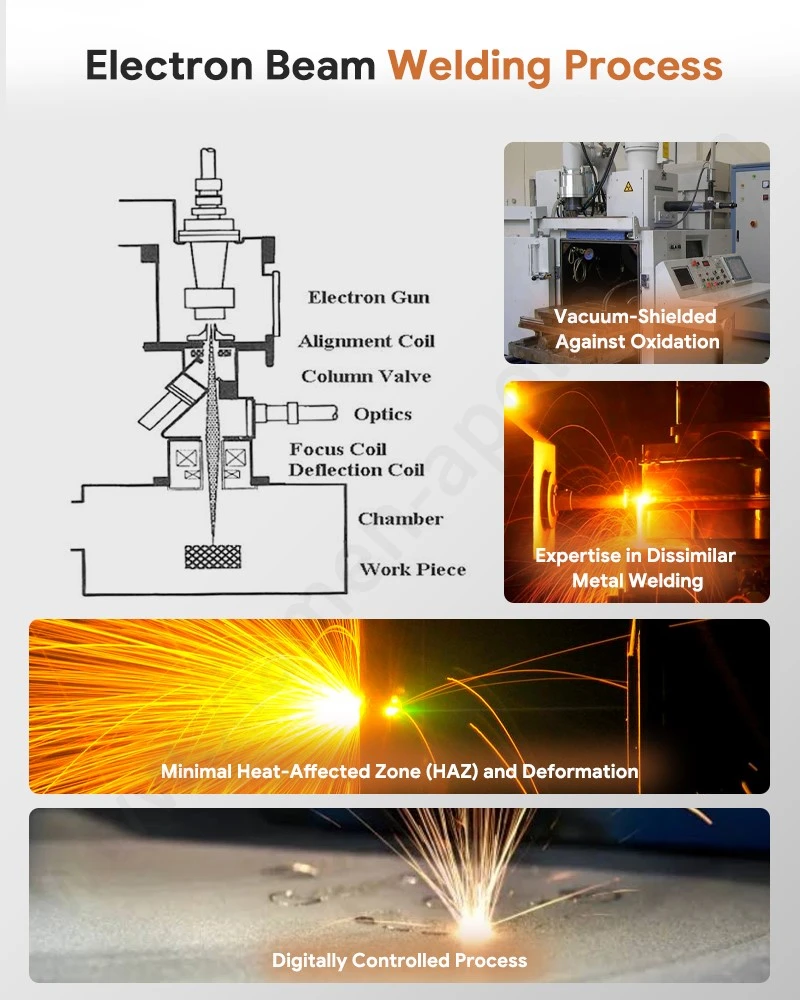
High‑performance shunt resistors depend not only on raw materials but also on reliable metallurgical bonding. Traditional resistance welding tends to create high contact resistance and oxide inclusions at welding interfaces. Xiamen Apollo Electric adopts high‑vacuum electron beam welding combined with progressive die stamping to guarantee mechanical strength and electrical performance.
Vacuum EBW Energy Density: Focused electron beam delivers extremely high energy density, fusing manganin alloy and copper terminals together. The heat-affected zone is strictly controlled within 0.15 millimeters.
Stamping Tolerances: Progressive stamping dies hold dimensional tolerances of plus or minus 0.005 millimeters for terminal pitch and slot position, compatible with automated SMT and wave‑soldering production lines for direct PCB mounting.
Shear Strength Performance: The destructive shear strength of the welded bimetallic strip reaches or exceeds 150 MPa, exceeding structural requirements for current‑carrying assemblies defined in ASTM B85‑03.
Consult Our Electrical Engineers Today
Engineering Guidelines for Shunt Integration and Circuit Protection
When designing manganin shunt resistors for power meters, battery management systems, and industrial relays, procurement and R&D engineers shall pay attention to key operating constraints:
Creepage and Clearance Distance: Maintain a minimum 4.0‑millimeter clearance between high‑current power terminals and low‑voltage sensing lines, complying with IEC 60947‑1 for 600‑volt working conditions to prevent dielectric breakdown.
Power Derating Requirement: Continuous operating power shall not exceed 70 percent of rated power to keep self‑heating temperature below 85 degrees Celsius and avoid long‑term resistance drift.
Parasitic Inductance Reduction: Optimize geometry with laser‑trimmed slots on the central manganin element to bring parasitic self‑inductance below 5 nanohenries, preventing phase error during AC‑DC switching measurement.
Frequently Asked Questions About Manganese Copper Resistance shunt
What is standard resistance tolerance for mass‑produced manganin shunt resistors?
With automated laser trimming and four‑terminal Kelvin resistance testing under IATF 16949 quality control, standard tolerance reaches plus or minus 1 percent, and high‑precision grades can achieve plus or minus 0.5 percent or plus or minus 0.1 percent.
How do you ensure material traceability and compliance with international standards?
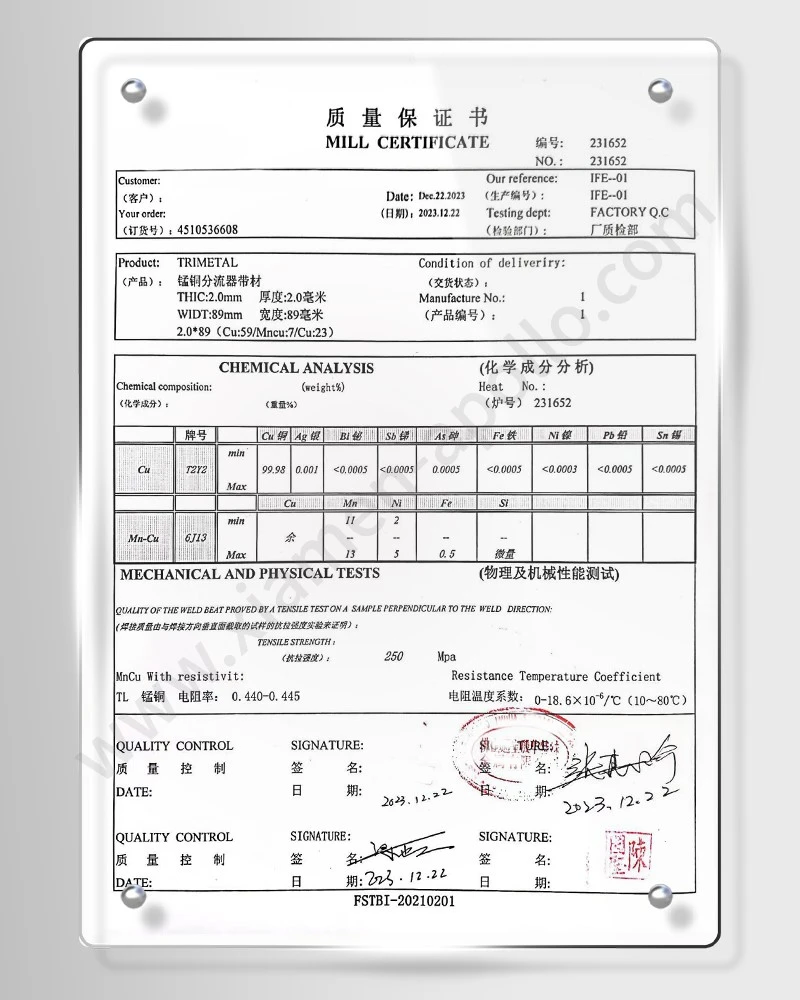
All incoming manganin raw strips are supplied with a 3.1 material test certificate according to the EN 10204 standard to verify chemical composition Cu86Ni12Mn2 and RoHS / REACH compliance. Batch identification is laser‑marked directly on components for full traceability.
What is the standard sample lead‑time for custom Manganin Shunt Resistor Shunts?
Engineering evaluation samples for custom‑geometry EBW manganin shunts will be delivered within 10 to 15 business days after 2D / 3D drawing approval and thermal finite‑element simulation validation.
contact us
Ready to obtain high‑reliability, drift‑free EBW Manganese Copper Shunt current‑sensing components for your upcoming production project? Contact Xiamen Apollo. We provide vertically integrated capacity covering electron beam welding, metal stamping, and metallurgical testing to support your OEM and ODM supply chain.