

In-Die Riveting in Metal Stamping integrates rivet fastening within a single stamping stroke to assemble copper strap conductors, eliminating secondary joining operations. Copper's electrochemical and conductive properties set hard constraints for this inline process; material selection directly controls long-term joint stability in relays, circuit breakers and high-current EV contact assemblies.
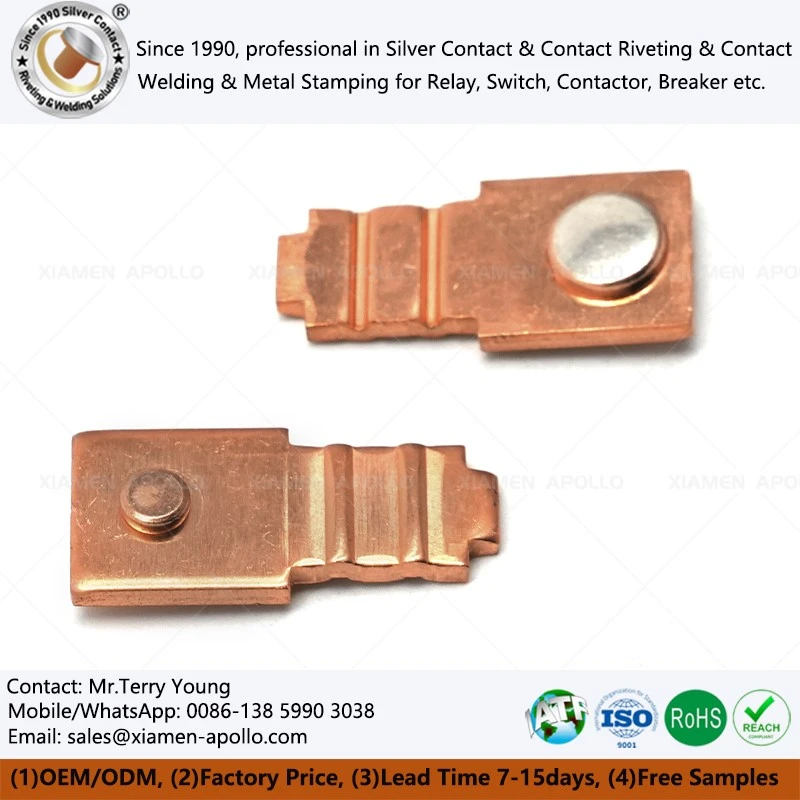
Pure copper, particularly oxygen-free copper, reaches 100% IACS conductivity. Aluminium sits near 60% IACS. At equal cross-sectional area, copper carries higher continuous current with lower temperature rise. This characteristic defines joint design rules for Copper Carrier Riveted Silver Contact Assemblies, where thermal accumulation at contact interfaces remains a dominant failure mode.
Copper's standard electrode potential delivers stable corrosion performance under atmospheric and groundwater exposure. Galvanic corrosion risk still appears when copper is paired with dissimilar fastener metals in the presence of electrolytes. In-Die Riveting cannot compensate for incompatible material pairs; all mating components must be specified with galvanic series alignment before die build. Copper forms a passive oxide layer that slows further oxidation, unlike active metals such as aluminium, which forms a rigid insulating oxide that increases contact resistance over cycling.
Material ductility is a critical process input for Electrical Contact Riveting Assembly. Copper's high elongation allows cold deformation during rivet upset without cracking. Silver holds higher conductivity, but raw material cost and formability limits prevent broad use in volume stamping lines. Copper strip can be rolled to thin gauges and formed into terminal geometries that fit compact stamping dies. This balance of conductivity, plastic flow and corrosion resistance keeps copper strap the baseline conductor for inline riveted stamping.

Process parameters for Silver In-Die Riveting Connections must align with copper material temper. Hard-temper copper resists deformation and raises the risk of incomplete rivet head formation. Soft annealed copper supports consistent rivet upset, yet carries higher risk of creep under sustained clamping load and thermal cycling. Engineers need to lock temper, strip thickness and rivet compressive force at the drawing stage to control contact resistance across production batches.
Contact resistance in In-Mold Silver Riveting Contacts depends on rivet preload, surface finish, oxide level and number of contact points. Higher preload from properly formed rivets breaks through surface films and reduces constriction resistance. Overloading during rivet upset can introduce microcracks in copper, creating sites for localized corrosion after field exposure. Torque testing for discrete fasteners does not translate directly; inline rivet joints require pull testing and millivolt drop validation under rated current.
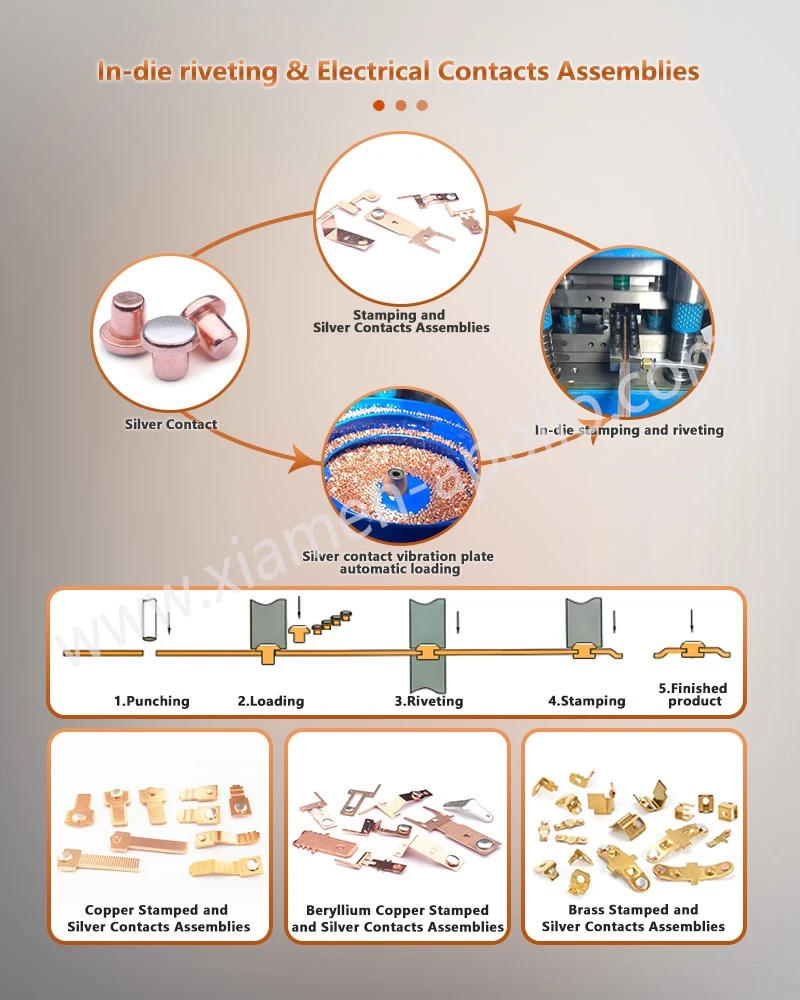
Copper strap does not outperform alternative materials on every single metric. Its value comes from a balanced set of properties suitable for high-volume stamping with integrated riveting. Aluminium offers weight and cost advantages but demands larger cross-sections and surface treatment to manage oxide growth. Composite conductive materials remain limited by process compatibility with standard stamping and in-die rivet tooling.
Rising production volumes for low-voltage control gear and EV HVDC contact assemblies increase demand for stable, repeatable inline joining. Silver Alloy Contact Riveting Parts reduce handling variation compared to manual or secondary riveting, but performance gains only hold when copper grade, temper, and surface condition are fully controlled.
Submit your assembly drawings and load cycle requirements to review In-Die Riveting in Metal Stamping feasibility for copper strap conductors. We run first-article validation on contact resistance, pull-out strength and corrosion compatibility before tool release for relay, circuit breaker and EV high-current components.
contact us
