

In the grand landscape of modern high-end manufacturing, every breakthrough in materials science propels the progress of industrial civilization. Among numerous non-ferrous metal alloys, one material, renowned for its superior comprehensive performance, is hailed as the "King of Non-ferrous Elastic Materials"-beryllium copper alloys, particularly high-strength copper-based alloys represented by CuBe2 (corresponding to the American standard C17200). This material exhibits astonishing stability in extreme environments. From deep-sea probes to high-precision aerospace instruments, from the minute vibrations of mobile phones to the sensors in car airbags, beryllium copper alloys for Beryllium Copper Spring Contacts, with their unique physicochemical properties, support the precision backbone of modern industry.
The core appeal of beryllium copper alloys lies in their unique chemical composition and microstructure. It is not a simple mixture of metals, but a precisely designed precipitation-hardening alloy. Its main matrix is copper, typically exceeding 98%, which endows it with excellent electrical and thermal conductivity, similar to pure copper. However, what truly transforms it is the addition of 1.7% to 2.5% beryllium, along with trace amounts of auxiliary elements such as nickel, cobalt, and iron. Beryllium is a highly reactive element; its solid solubility in a copper matrix decreases sharply with decreasing temperature. This characteristic is the fundamental reason why beryllium-copper alloys can achieve ultra-high strength through heat treatment. After solution treatment (quenching), beryllium atoms are forcibly "frozen" in the copper lattice, forming a supersaturated solid solution. Subsequent aging treatment causes these supersaturated beryllium atoms to precipitate as nanoscale particles. These tiny particles, like countless tiny nails, firmly anchor the dislocation movement in the lattice, thereby causing the Beryllium Copper Stampings material's strength and hardness to increase exponentially.
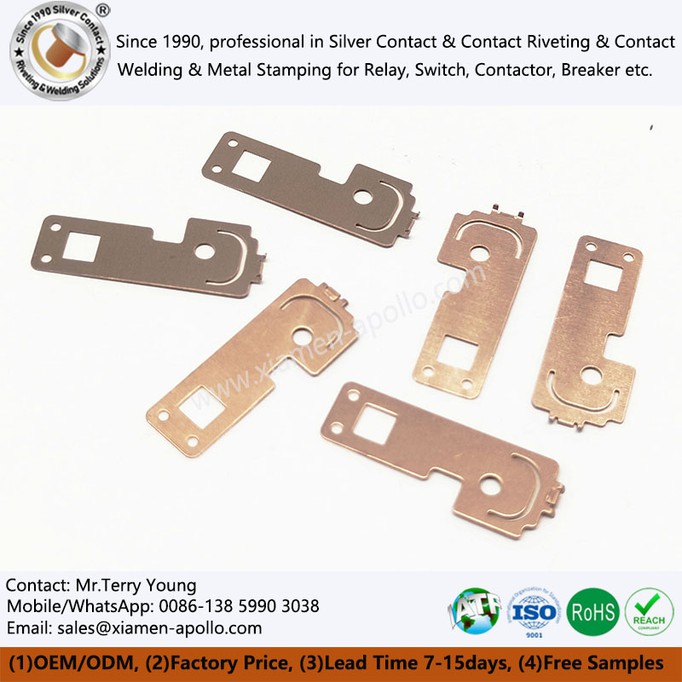
In terms of physical properties, CuBe2 alloy exhibits a remarkable balance of strength and flexibility. After age hardening treatment, its tensile strength can easily exceed 1100 MPa, even reaching 1400 MPa, a value approaching that of high-strength alloy steel. Its hardness reaches HRC 36-46, meaning it possesses excellent wear resistance and can withstand high-load friction and impact. However, unlike brittle steel, beryllium copper retains the toughness of copper, with an elastic modulus of approximately 128 GPa, exhibiting an extremely high elastic limit and minimal elastic hysteresis. This characteristic allows it to quickly recover its original shape after repeated deformation, with almost no permanent deformation, making it an ideal material for BeCu electrical contact springs. Furthermore, despite high-strength alloying, its conductivity remains above 22%–28% IACS, far exceeding that of stainless steel and other high-strength structural materials, solving the heat generation problem of high-stress components in conductive applications.
Corrosion resistance is another major advantage of beryllium copper alloys. In harsh environments such as chemical plants, marine environments, and oil extraction, ordinary metals often struggle to withstand the harsh conditions. However, CuBe2 alloys exhibit extremely high chemical stability in air, fresh water, and even seawater. They possess strong resistance to intergranular corrosion and are resistant to impact corrosion, exhibiting excellent resistance to many industrial environments, including seawater, dilute acids and phosphoric acid solutions. This excellent corrosion resistance, coupled with their non-magnetic nature and spark-free impact properties, makes them an indispensable key material in the manufacture of C17200 Beryllium Copper Stamping. In flammable and explosive hazardous environments, beryllium copper tools serve as the last line of defense for safe production.
In terms of processing performance, beryllium copper alloys exhibit excellent plasticity. In the solution-treated state, they are very soft, with an elongation exceeding 20%, enabling complex cold working processes such as deep drawing, bending, spinning, and hydroforming. This allows manufacturers to process them into complex shapes of Beryllium Copper Alloy. After machining, heat treatment achieves the final high-strength state. This "soft-to-hard" processing characteristic provides great freedom for the manufacture of precision parts. Furthermore, it possesses excellent weldability, achieving reliable connections through brazing, fusion welding, and resistance welding, facilitating the assembly of electronic and electrical components.
The applications of beryllium copper alloys cover almost all high-end manufacturing industries. In the aerospace field, it is used to manufacture diaphragms for aircraft control systems, springs for braking systems, and elastic elements for inertial navigation systems. These beryllium copper springs require absolute dimensional stability under extreme temperature changes and severe vibrations, making beryllium copper the optimal choice. In the automotive industry, with the rise of new energy vehicles, the requirements for materials in high-voltage connectors and sensors are becoming increasingly stringent. Beryllium copper alloys, with their high conductivity and high stress relaxation resistance, have become the preferred material for automotive relay moving springs and connectors.
In the electronics and electrical fields, the applications of beryllium copper are ubiquitous. From smartphone battery contacts and SIM card springs to high-frequency connectors in 5G base stations and beryllium copper spring contacts for precision relays, beryllium copper alloys play a crucial role. Especially with the trends of miniaturization and high frequency, materials must simultaneously meet the requirements of ultra-fine wire diameter processing, high contact pressure, and low contact resistance. Beryllium copper alloys have a long fatigue life, capable of maintaining stable mechanical performance over an exceptionally high number of operating cycles, which is crucial for ensuring the reliability of NGK Beryllium Copper Stamping.
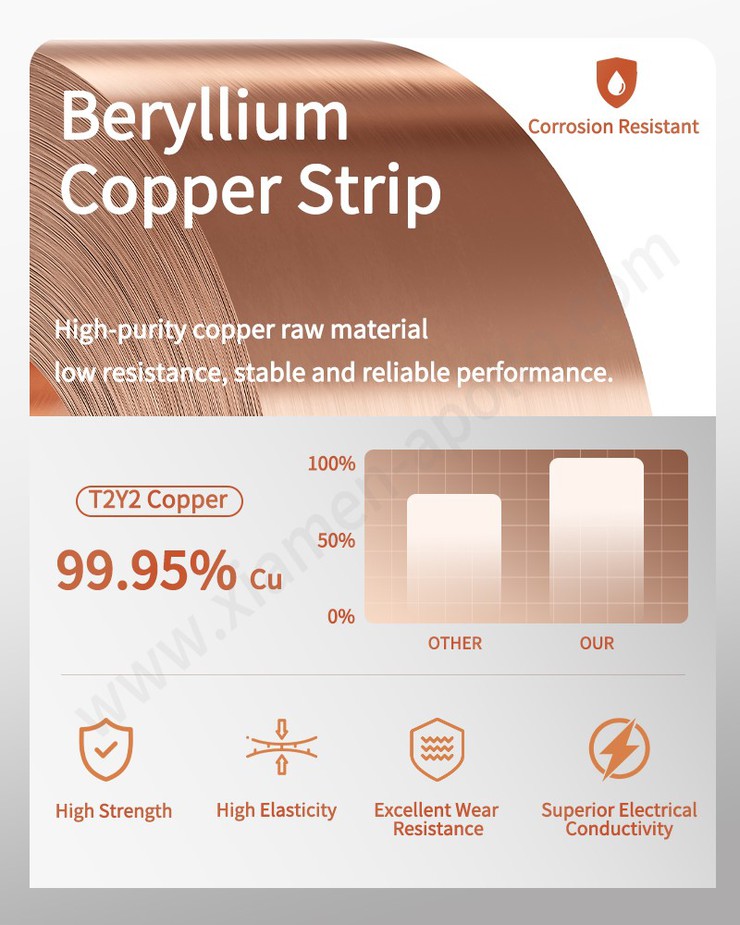
However, the preparation of beryllium copper alloys is no easy task. Its production process involves highly sophisticated techniques such as vacuum melting and electroslag remelting to ensure that impurity content is controlled at extremely low levels. While the addition of beryllium brings superior performance, it also poses challenges to production safety. Beryllium dust is toxic, therefore, strict dust removal and protective measures must be in place during melting, grinding, and cutting. This also results in the cost of beryllium copper alloys being significantly higher than that of ordinary copper alloys, limiting their application primarily to high-value-added, high-reliability beryllium copper sheet stamping.
In conclusion, CuBe2 beryllium copper alloys, with their high strength, high conductivity, corrosion resistance, non-magnetic and spark-free properties, and excellent elasticity, have become an irreplaceable strategic material in modern industry. Whether in the darkness of the deep sea, the vacuum of space, or in the electronic devices we use daily, it silently and crucially safeguards the stable operation of systems. With the advancement of Industry 4.0 and smart manufacturing, the performance requirements for BeCu sheet fabrication materials will further increase, and beryllium copper alloys will undoubtedly demonstrate their superior performance in a wider range of fields.
Frequently Asked Questions
1. What is the difference between CuBe2 (C17200) and ordinary copper alloys?
CuBe2 is far superior to ordinary copper alloys in terms of high strength, elasticity, and fatigue resistance, while still maintaining high electrical conductivity for Beryllium Copper Stamping for Electrical Connector.
2. Why do beryllium copper alloys for Terminal Copper Beryllium Stamping Parts exhibit high elasticity?
This is primarily due to the precipitation hardening mechanism; precipitated phases impede dislocation movement, giving the material a high elastic limit.
3. How does beryllium copper for Beryllium Copper Sheet Metal Stamping Parts perform in high-temperature or corrosive environments?
It exhibits excellent corrosion resistance and dimensional stability, making it suitable for marine and industrial environments.
Contact Us
If you are looking for high-performance beryllium copper alloy solutions or need customized beryllium copper sheet metal forming for complex operating conditions, please feel free to contact us. Our team of technical experts will provide you with professional material selection advice and process optimization solutions to help you overcome design bottlenecks and achieve outstanding upgrades in product performance.
