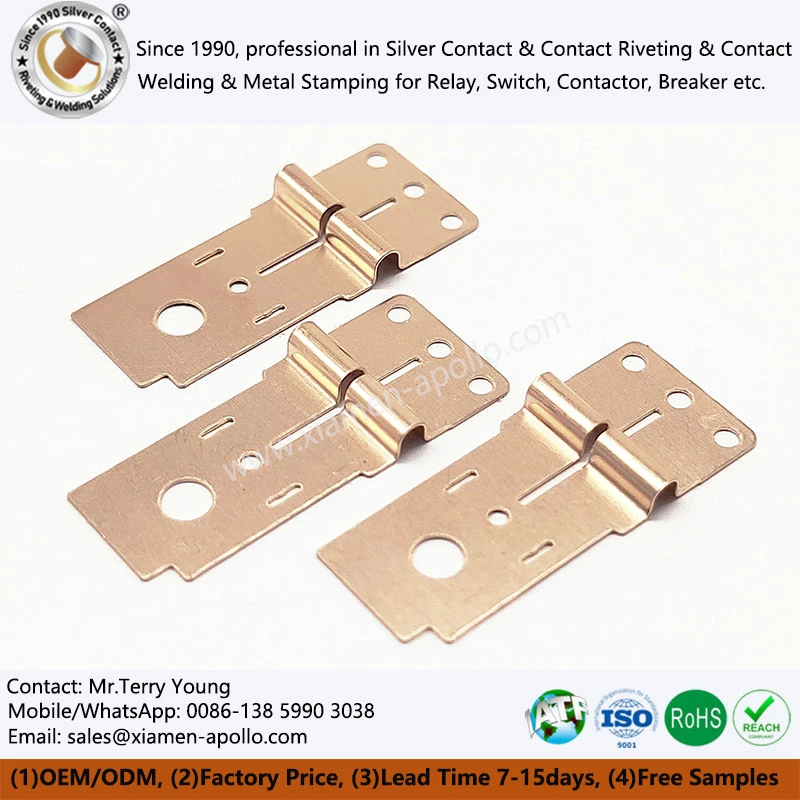
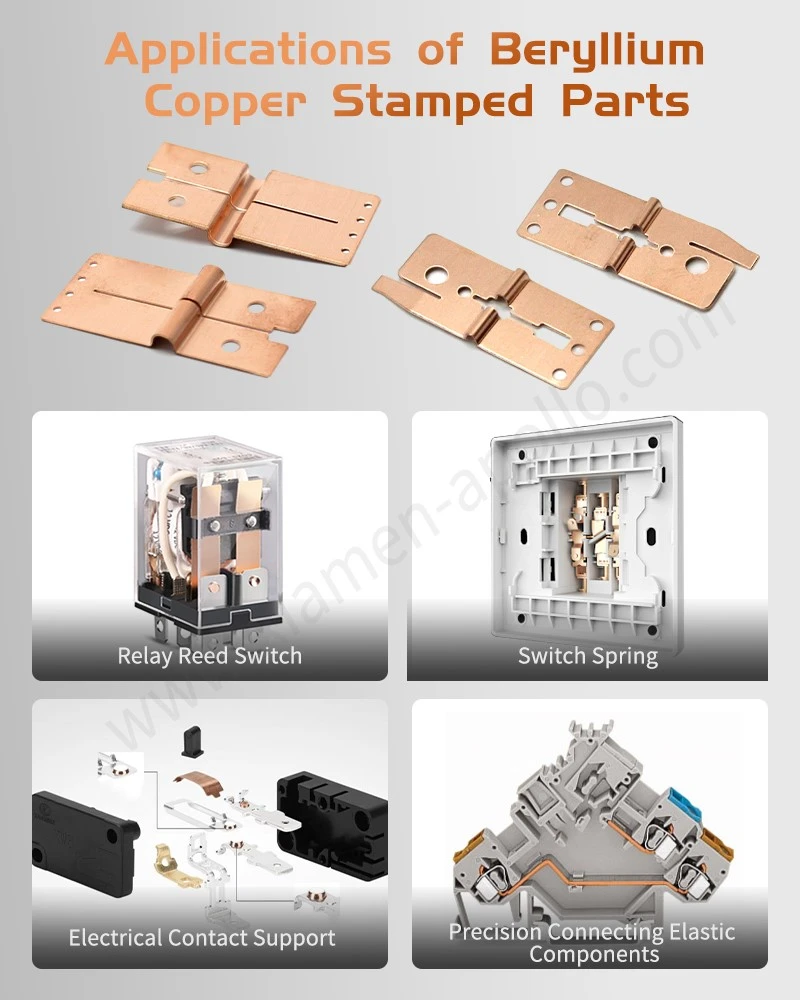
A Beryllium Copper Stamping Electrical Spring carries the contact function inside relays, miniature circuit breakers and high-voltage DC contactors, and the alloy grade decides the current rating before the die is cut. The low-beryllium grade - 0.8–1.2% Be with chromium and boron additions, known as C7025 - reaches ≥1100 MPa tensile strength at 42.2 MS/m conductivity, which converts to roughly 72.8% IACS, so a 0.2 mm strip finger can hold rated contact force and still stay under the terminal temperature limit. What follows is the process detail that keeps those datasheet numbers intact from coil to finished spring: strip condition, die parameters, aging cycle, and the inspection points that catch a drifting lot before it reaches your assembly line.
Chemistry and the Hardening Path That Sets Spring Force
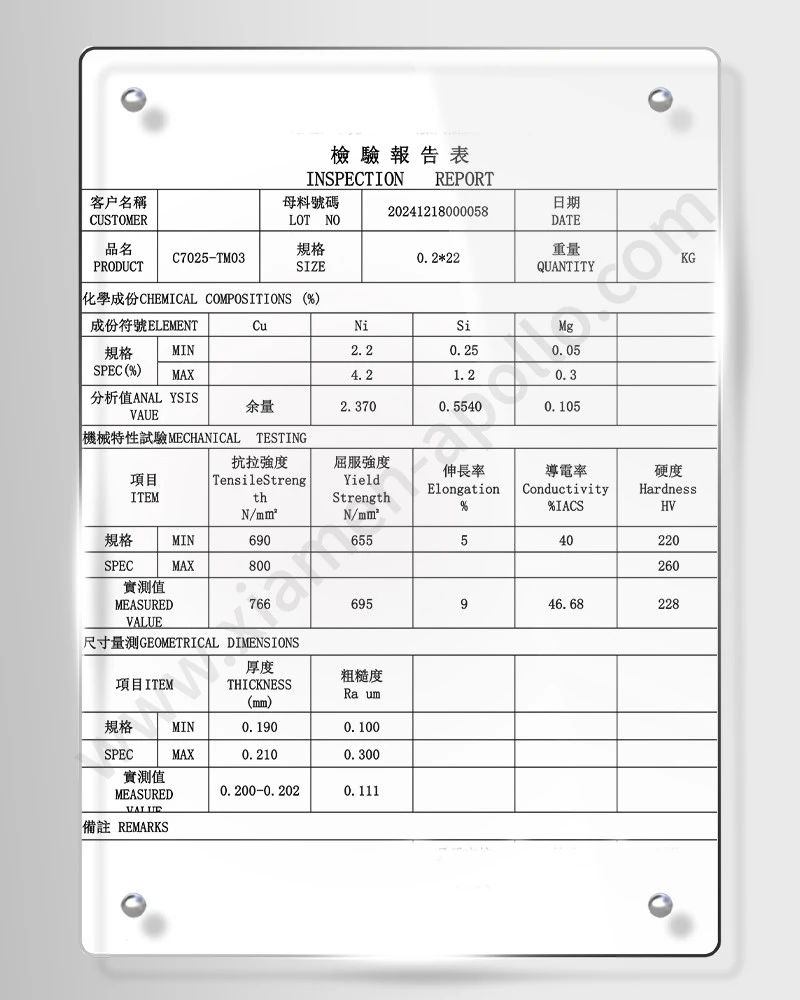
The alloy is a precipitation-hardening copper. Copper forms the matrix and carries the current. Beryllium at 0.8–1.2% is the strengthening element; it enters the matrix as a supersaturated solid solution during solution treatment and later precipitates as fine intermetallic particles, chiefly CuBe, during aging. Those particles pin dislocation movement, and that is the physical origin of the yield strength a Beryllium Copper Spring Contacts needs. Chromium raises corrosion resistance by building a dense surface oxide that slows attack from moisture and mild electrolytes. Boron refines grain size, which makes the deformation behaviour of thin strip more uniform across the coil width - a direct benefit for progressive-die work, where one edge of the strip can otherwise form differently from the other.
| Element | Content | Function in a stamped spring |
|---|---|---|
| Cu | Balance | Conductive matrix, formability |
| Be | 0.8–1.2% | Precipitation hardening, elastic limit |
| Cr | Minor addition | Surface oxide, corrosion resistance |
| B | Minor addition | Grain refinement, uniform forming |
Two consequences follow for the buyer. First, strength arrives after forming, not before, so the BeCu Electrical Contact Spring can be stamped in a soft condition and hardened in the cavity. Second, the supplier's aging furnace is as much a part of the specification as the strip purchase order. A mill certificate quoting 1100 MPa means nothing if the parts are aged at the wrong soak.
Property Envelope for Beryllium Copper Spring Design
| Property | Value from mill test data | Design consequence |
|---|---|---|
| Tensile strength | ≥1100 MPa | Contact force at small deflection |
| Hardness | HB 180–220 | Wear at the mating point, insert life |
| Elongation | ≥1% | Bend radius limit, crack margin |
| Electrical conductivity | 42.2 MS/m | Joule heating at rated current |
| Thermal conductivity | 315 W/(m·K) | Heat removal from the contact bridge |
| Density | Copper-alloy range, near 8.2–8.3 g/cm³ | Mass budget in multi-pole assemblies |
The conductivity figure is the commercial argument for this grade against the higher-beryllium CuBe2 family. At 42.2 MS/m the alloy dissipates resistive heat at roughly three times the rate of a 18–28% IACS contact alloy, so a Beryllium Copper Flat Spring of the same cross-section runs cooler at the same current, or carries more current at the same temperature rise. The trade is peak strength: CuBe2 reaches higher tensile values, C7025 gives up some of that in exchange for conduction and a lower beryllium content. For relay and contactor contact springs sized by temperature rise rather than by force alone, the conductivity wins.
Spring force itself follows the cantilever relation F = 3EIδ/L³, with E the elastic modulus, I the section inertia, δ the deflection at the contact point and L the effective finger length. Because the section inertia of strip scales with the cube of thickness, thickness tolerance is a force tolerance. Specify strip thickness to the tightest band your process can hold, and measure force at the deflected height, not at free length.
Strip Condition and the Forming Sequence
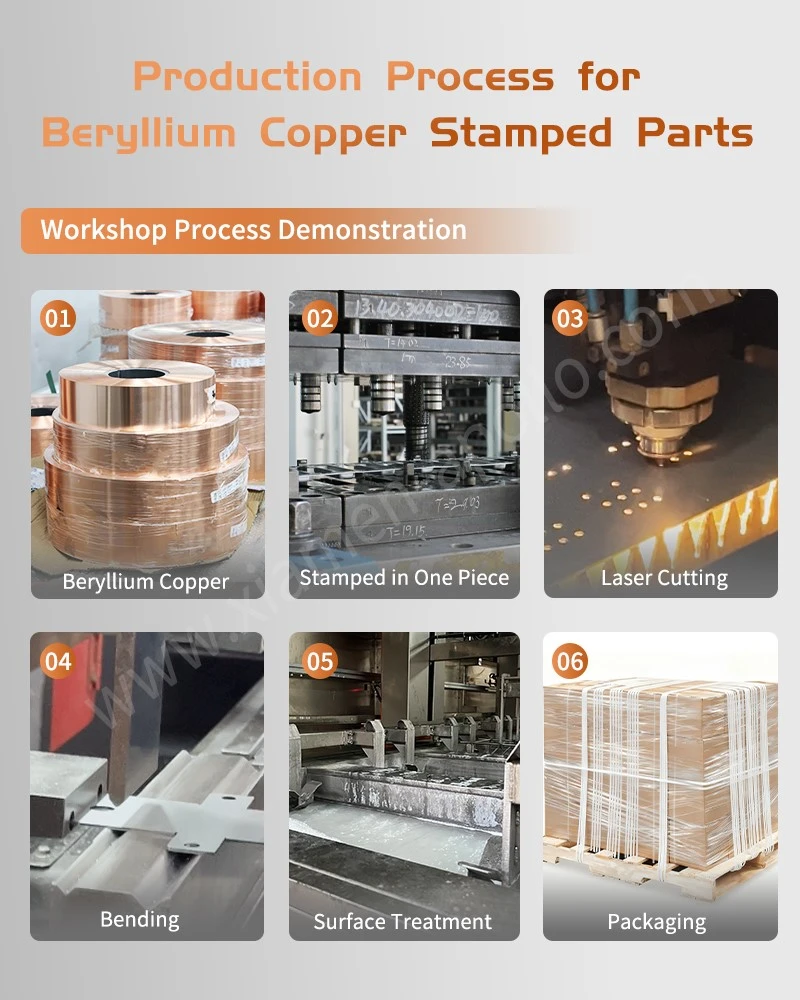
Cold working is performed after solution annealing, when the strip is ductile and can be rolled, stamped, drawn or bent. In practice the plant receives strip in one of two conditions:
- Solution annealed, soft. Best for geometry with tight radii and multiple forming stations. Form first, then age to final strength. This route puts the hardening step under the stamper's control and allows force trimming by adjusting the aging soak.
- Cold rolled to temper, then aged after forming. Higher incoming strength, less formability, but a shorter process route for simple cantilever fingers.
Work hardening accumulates during cold forming. Once the accumulated strain is high enough, an intermediate anneal at 775–800 °C for 1–2 hours followed by furnace cooling restores ductility and relieves internal stress before the next operation. Skipping it shows up as edge cracking on the following station, and the scrap appears two stations downstream from the actual cause.
For hot forming, the billet is heated to 650–825 °C with a soak of 0.5–2 hours depending on section size. That window is narrow compared with steel, so furnace uniformity and transfer time both matter. Cast sections are coarse-grained and always require solution treatment plus aging afterwards.
Die Design for Beryllium Copper Strip
Beryllium copper has a high yield strength relative to its elastic modulus, which means pronounced springback. The die must overbend, or include a calibration station that coins the bend zone to a controlled angle. Correcting angle by raising press tonnage deforms the section and shifts contact force; it does not fix the angle.
Bend orientation is the second control. Set the bend line across the rolling direction. A bend parallel to the rolling direction puts the outer fibre under transverse tension and raises the risk of edge cracking in thin strip.
Burr direction is the third, and it is a contact-quality item, not a cosmetic one. Keep the burr away from the mating face. A raised burr concentrates current into a small area, which raises local temperature and promotes material transfer between the Custom Beryllium Copper Flat Spring and the mating blade.
For blanking, specify clearance and burr height on the drawing and verify them at first article. Tooling for 1100 MPa strip is normally carbide with a wear-resistant coating, run with filtered, chlorine-free lubricant. Beryllium-bearing swarf stays out of the recirculation loop.
Safety point for the shop floor: solid strip poses no inhalation risk, but grinding, dry sanding or dry blasting generates beryllium-containing dust. Keep all material removal wet and duct the dust to a collection unit.
Aging After Stamping
The strengthening step for formed parts:
| Stage | Parameter |
|---|---|
| Solution treatment | 760–790 °C, 15–60 min by section thickness, then water or oil quench |
| Aging | 260–425 °C, 2–4 hours, air or furnace cool |
| Intermediate anneal (cold work route) | 775–800 °C, 1–2 hours, furnace cool |
Aging temperature moves two properties in opposite directions. Raising temperature or extending soak grows the precipitate and lifts strength and hardness, while elongation falls. Lower temperature keeps more ductility at slightly lower strength. The usable window is therefore defined by the part, not by a generic recipe: a finger that must survive a 90° bend after aging needs a different soak from a flat contact blade.
Furnace practice decides reproducibility. Atmosphere should be vacuum or high-purity nitrogen with a low dew point so the surface stays clean for plating. Thin parts bow unless they are fixture-supported or dead-weight loaded. Verify each lot on hardness plus conductivity, because conductivity tracks the overaging side of the curve and hardness alone will not reveal an overcooked batch.
Contact Resistance and the Plating Stack
The base alloy does not touch the mating surface. The plating system does. Nickel underplate acts as a diffusion barrier and stops copper from migrating into the gold layer during reflow and field service; gold on the contact area holds the low, stable resistance the application expects. Any tarnish, stamping lubricant residue or oxide left on the strip before plating becomes a blister or a resistance drift later. Specify pre-clean, acid activation and a nickel strike, and require an adhesion check after a reflow simulation.
Stress Relaxation and Cycle Life
Two limits govern BeCu Electrical Contact Spring service. Mechanical fatigue governs a part that flexes on every operation. Stress relaxation governs a part that sits compressed at temperature for years. The second limit is the one that quietly fails a contactor after two years in the field, and it is governed by the temperature at the contact bridge, not the ambient rating on the nameplate.
Test relaxation at the working deflection, on a real formed part, at the actual interface temperature. A free-length coupon gives a different answer. Where the application runs hot, the design lever is lower working stress or a change of grade; plating thickness and contact geometry will not recover force that the alloy has already lost.
Where the Part Is Specified
| Application | Why this grade fits |
|---|---|
| Relay and contactor contact springs | Stable force at low deflection, low heat at the bridge |
| Miniature circuit breaker moving contacts | Wear resistance at HB 180–220 with spring retention |
| HVDC contactor and EV power contacts | 42.2 MS/m conduction plus force retention under thermal load |
| Switch and socket contact blades | Corrosion resistance from the chromium oxide layer |
| Instrument and sensor springs | Non-magnetic behaviour with repeatable force |
In electrical assemblies, the Beryllium Copper Springs is also the tolerance absorber. Housing moulding tolerance, blade position and plating thickness all stack into the contact gap, and the spring deflection is what closes the error. That is why stamped contact springs are bought to a measured force window rather than to a drawing dimension alone.
contact us
Please submit your drawings for custom Beryllium Copper Stamping Electrical Spring-including specifications for elasticity, electrical current, and operating temperature-at your earliest convenience. Our engineering team will prioritize your project for DFM (Design for Manufacturing) review and the production of initial samples.