Brass Metal Stamping Components are made from copper-zinc strip that is blanked, pierced and formed in progressive dies. The process works because alpha brass combines high elongation with enough tensile strength to hold a formed shape after ejection. A 0.8 mm C26000 strip in the annealed condition will reach 40% elongation or more, and a well-built die will blank it at 60 to 120 strokes per minute with burrs under 10% of sheet thickness. Those three numbers, alloy temper, stroke rate and burr height, decide whether a program runs profitably or bleeds out in secondary operations.
The limits are equally specific. Brass work-hardens as it deforms, so a drawn cup that needs 60% reduction in one hit will crack unless it starts with the right grain size and gets an intermediate anneal. High-zinc grades lose zinc in wet service and need inhibition. Formed parts that see ammonia or amine vapors crack along grain boundaries unless they are stress-relieved. This article sets out the metallurgy, the grade map, the tooling window, the defect controls and the sourcing checks that engineering and purchasing teams need before they release a drawing.
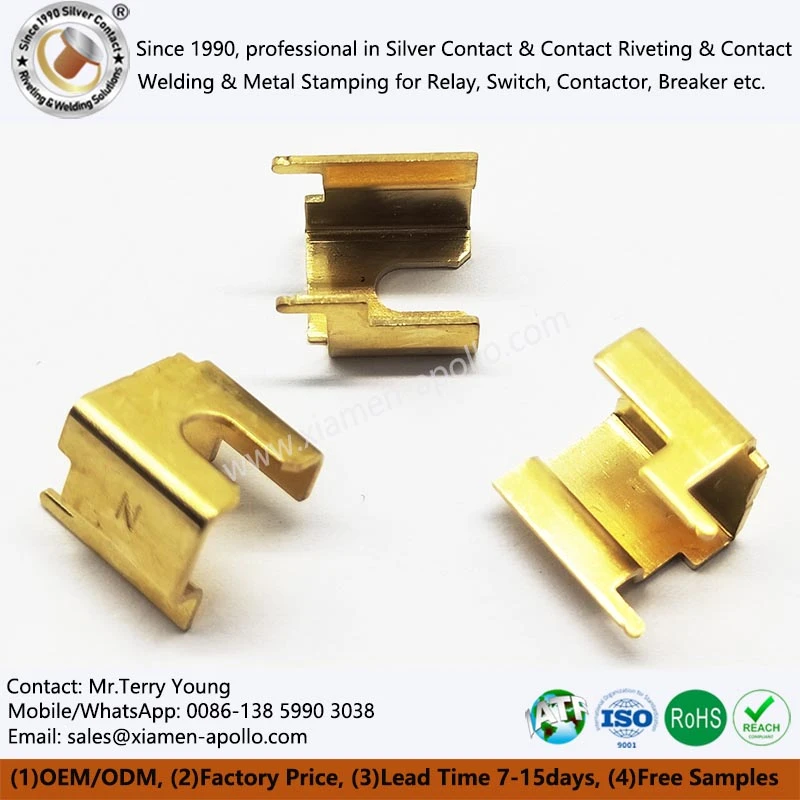
Why brass responds to stamping
Brass is a substitutional alloy of copper and zinc. Zinc content runs from about 5% to 45% in commercial wrought grades. Crystal structure changes with that number, and the structure governs formability.
Below roughly 37% zinc the alloy is alpha, a single-phase face-centred cubic solid solution. Alpha brass is soft, ductile and highly workable at room temperature. It deep draws, flanges, coins and bends without cracking. Above 37% zinc, beta phase appears, and the alloy becomes duplex. Duplex brass is stronger and cheaper per kilogram, but it is harder and less forgiving in a draw, and it needs hot working or generous anneals to reach complex geometry.
Two mechanical facts matter on the press floor. First, brass strain-hardens fast. Yield strength in annealed C26000 sits near 100 to 150 MPa; after 50% cold reduction it can exceed 400 MPa, while elongation drops below 10%. Any part that exceeds the safe reduction in a single station must be split into two draws with an interstage anneal at 480 to 650 degrees Celsius. Second, brass is thermally conductive, around 120 W/m·K for 70/30 strip, so it heats and cools quickly in a high-speed die. That behaviour supports fast stroking, and it also means lubricant choice and die cooling deserve attention on thin gauge and tight-pitch layouts.
Grain size is the variable most often ignored in quotations and most often responsible for field failures. For deep drawing and severe forming, an ASTM grain size of 9 to 11, roughly 0.015 to 0.030 mm, gives the best balance of stretch and surface finish. Coarse grains produce orange-peel texture and premature necking. Too fine a grain raises yield strength and promotes cracking at the die entry radius. Strip buyers should specify grain size, temper and directionality, not just alloy and thickness.
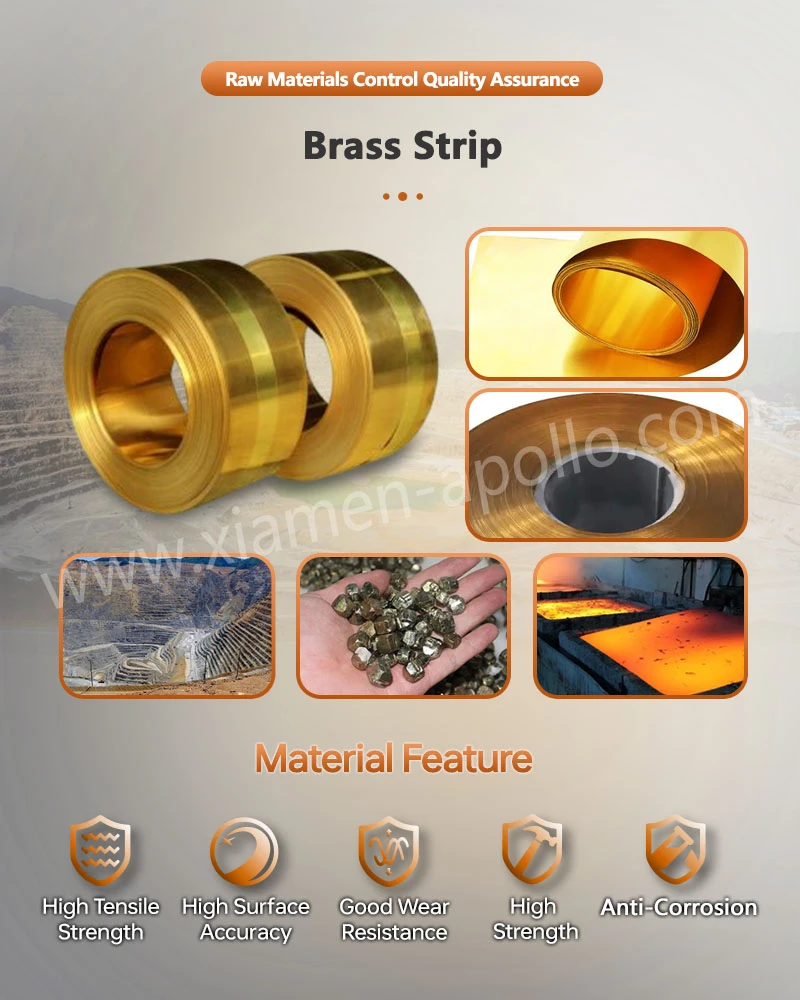
Grade map for Electrical Brass Terminal Contact Accessories
Grade choice is a cost and function decision, and the four families below cover most programs.
C26000, cartridge brass, 70Cu-30Zn. The reference grade for severe forming. Annealed tensile strength lands around 300 to 370 MPa with elongation above 40%. It suits deep-drawn shells, shielding cans, lamp bases and multi-station progressive work where the material must survive several reductions. It is not the cheapest option and it machines poorly if a secondary turning step is needed.
C26800 and C27200, yellow brass, 65Cu-35Zn and 63Cu-37Zn. These sit near the alpha limit. They offer higher strength than C26000 at lower metal cost and still form well in moderate draws. Most electrical terminals, contact bridges and connector shells use this band. Watch springback on tight bend radii, because yield strength rises as zinc rises.
C28000, Muntz metal, 60Cu-40Zn. Duplex structure, higher strength, lower cost, poorer cold ductility. It is used for hot-stamped or heavily annealed parts, architectural hardware and larger structural brackets where a small number of forming hits is acceptable.
C36000, free-cutting brass, 61.5Cu-35.5Zn-3Pb. Lead addition breaks chips for screw machining. It also improves blanking behaviour, which makes it attractive for high-volume pierced parts that later get tapped or turned. Lead restrictions under potable water and electronics rules limit its use, and buyers should confirm the applicable exemption before specifying it.
Two further points belong in the grade decision. Arsenical grades with 0.02% to 0.08% arsenic resist dezincification in wet service and belong in valves, fittings and marine-adjacent hardware. Beryllium-free high-strength variants and phosphor bronze are often substituted where thermal or spring requirements exceed what brass delivers, and a competent stamper will flag that trade-off at the DFM stage rather than after tooling is cut.
Tooling window: clearance, radii and strip layout
Die clearance drives edge quality, burr and tool wear. For brass strip in the 0.2 to 1.5 mm range, a clearance of 5% to 8% of thickness per side produces a clean shear band with a small burr and acceptable punch life. Going below 5% raises peak load and accelerates punch wear without buying much edge quality. Going above 10% pulls a heavy burr and a torn fracture zone that shows up as a folded lip on the finished part.
Form radii should stay at or above one thickness for inside bends in annealed strip, and at or above 1.5 thicknesses in half-hard temper. Tighter radii concentrate strain and drive cracking at the bend line, particularly when the bend line runs parallel to the rolling direction. Rotating the strip layout so severe bends cross the grain reduces cracking risk at zero material cost. This is one of the cheapest improvements available on a brass program.
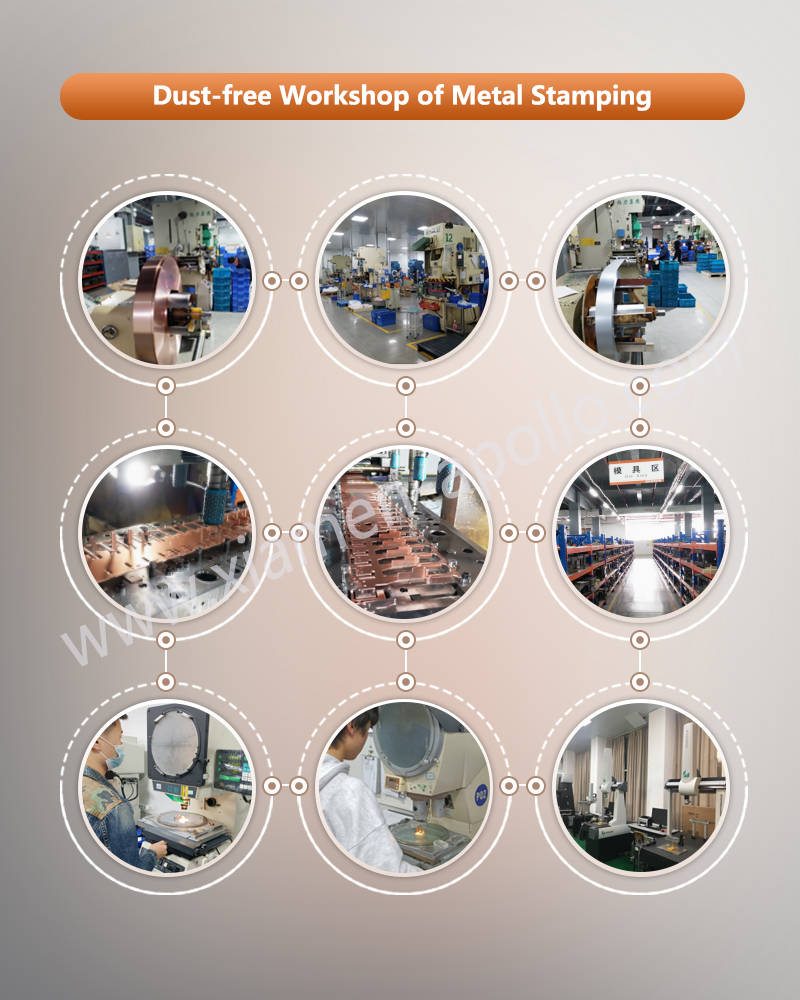
Progressive dies for Stamped Brass Brackets typically run 12 to 24 stations. The layout should separate piercing and forming where possible, use a carrier that survives the full stroke, and place the final cutoff so that no station re-strikes a formed feature. Piloting deserves the same rigour as the forming work. Two pilots, one round and one rectangular, control strip walk better than a single pilot on thin gauge, and pilot holes should be pierced in the first station and never re-pierced later.
Strip feed accuracy of plus or minus 0.02 mm is realistic on modern presses with servo feed and a cam-driven pilot release. Formed-dimension tolerance of plus or minus 0.05 mm is routine; plus or minus 0.02 mm is achievable on critical pierced features at 0.5 mm thickness with a stable strip and controlled press deflection. Anything tighter than that should be questioned before it is quoted, because the cost curve is steep and the process capability may not support it across a full coil.
Defects that decide field reliability
Dezincification. In duplex and high-zinc alpha brasses exposed to chlorinated water or seawater, zinc dissolves preferentially and leaves a porous copper sponge that loses strength without visible warning. It is a service-life issue, not a stamping issue, but it is specified at the alloy stage. Wet-service parts need arsenical or otherwise inhibited grades, and the drawing should say so.
Stress corrosion cracking. Ammonia, amines and some cleaning residues attack stressed brass along grain boundaries. Residual stress from forming and coining is enough to trigger it. A stress-relief anneal at 250 to 300 degrees Celsius for one to two hours, run after the last forming hit and before plating, removes most of the risk. Programs that skip it because the part looks fine at final inspection tend to discover the problem in a customer's warranty claim.
Orange peel and necking. Coarse grain shows up as a rough surface on drawn walls and as early wall thinning. Specify grain size, and verify incoming coils with a metallographic check on first article and periodic audits.
Burr and sliver control. Burr height above 10% of thickness interferes with plating adhesion and with connector insertion force. Slivers from a worn punch release into the die and mark subsequent parts. Both are tool-maintenance signals, and both should be tracked as a trend rather than checked as a pass or fail.
Springback. Brass retains meaningful elastic recovery, and bend angles drift as tooling wears. Overbend the form by 2 to 5 degrees and plan for a adjustment shim in the die, rather than chasing the angle at tryout.
Cost, material utilization and sourcing checks
Material is the dominant cost line in Cold Stamped Brass Components, often half or more of the piece price, and copper pricing moves independently of the fabricator's control. Three levers reduce it. Nesting and strip layout that raise utilization from 50% to 65% cut material cost far more than a few percent off the conversion rate. Thickness rationalization matters equally, because gauge is usually specified thicker than the function requires. Wall-thinning analysis on a stamped terminal frequently shows that 0.6 mm will meet the current-carrying and insertion-force requirements that were written for 0.8 mm.
Purchasing should ask five questions before releasing a brass program. Does the fabricator specify grain size and temper directionality on the strip purchase order, or only alloy and thickness? Can they show a strip layout with measured utilization? Do they run stress relief in house, or is it an outside step with added lead time? Is there a documented dezincification position for wet-service parts? And does first-article inspection report burr height, grain size and formed-dimension capability, or only nominal dimensions?
A stamper who answers those five points with data will hold tolerance through a full coil and a second tool build. One who answers with assurances will not. Brass is a forgiving material, and that forgiveness hides weak process control longer than most metals do. For connectors, terminals, relay components, contacts, shielding hardware and fluid-system fittings, Multi-Bend Brass Stamping Terminals remain the cost-effective answer, provided the grade, grain and clearance are specified together and verified in the first article.
contact us
Send the Precision Brass Stamping Parts drawing, the annual volume, the temper requirement and the service environment together, and request a strip layout with utilization and a DFM note on grain direction before tooling is released. Decisions made at that stage cost nothing. Decisions made after the die is cut cost everything.