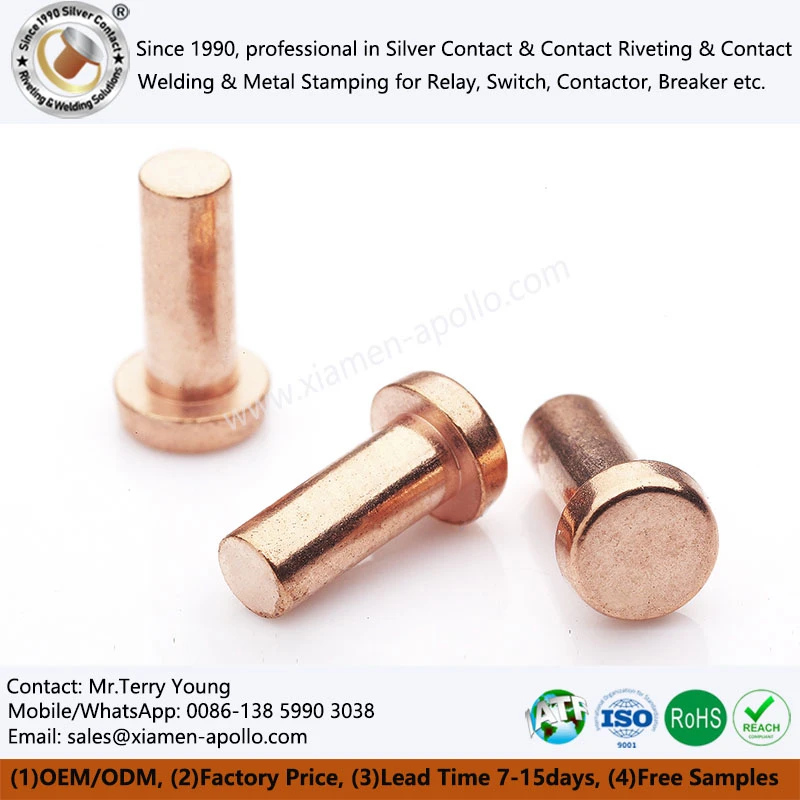
Round Head Metal Copper Rivets are a typical category of cold-headed parts. They feature a rounded head and a solid cylindrical shank, and are generally manufactured from pure copper, brass, or copper alloys. These parts are formed at room temperature from wire stock through processes such as upsetting and extrusion methods that require no heating and involve virtually no material removal. The following sections outline the forming principles, equipment requirements, process flow, technical limitations, material specifications, quality control, cost structure, industry trends, and common defects associated with these components, providing essential guidance for engineering and procurement professionals during the selection process.
Basic Principles of the Cold-Heading Process
Cold-heading relies on the plastic deformation capacity of metal at room temperature. Under the application of external force, the metal's crystal lattice shifts along slip planes, allowing the material to change shape without fracturing. Through operations such as upsetting, extrusion, and punching, the tooling constrains the wire stock within a die cavity to achieve the desired geometry. The process adheres to the principle of constant volume; the volume of the material remains essentially unchanged throughout the deformation. For Rivet-type Solid Copper Contacts, the head's dimensions-including diameter, height, and fillet radii-are determined by the geometry of the die cavity. Copper exhibits excellent plasticity and low resistance to deformation, allowing for significant shape changes in a single operation. Because work-hardening accumulates with each deformation step, intermediate annealing (softening) may be required.
Key Equipment for the Cold-Heading Process
The cold-heading machine is the primary piece of equipment. Single-station machines are suitable for parts with simple geometries, while multi-station machines can perform a continuous sequence of operations-such as shearing, upsetting, extrusion, and finishing-making them ideal for copper rivets with rounded heads or stepped shanks. The equipment consists of a wire-feeding mechanism, a shearing unit, a transfer system, and forming dies. Auxiliary equipment includes wire decoilers, straightening units, lubrication systems, and in-line inspection devices. Since copper wire has a relatively soft surface, it is susceptible to scratching during straightening and feeding; therefore, the condition of guide rollers and gripping components must be inspected regularly.
Specific Process Flow of Cold Heading
Material Preparation: Select the copper grade and wire diameter according to the technical drawings. The incoming material surface must be free of oxide scale, scratches, and peeling.
Straightening and Feeding: Coiled wire is straightened by a straightening unit and then advanced into the die zone by feed rollers at a fixed step length.
Shearing: The wire is cut into blanks of a specified length; the cut ends must be smooth, and weight deviation must be kept within the tolerances permitted by the process.
Forming: The blank undergoes a sequence of operations within a multi-station die-upsetting, pre-forming, head finishing, and shank shaping. For Copper Rivet Contact Elements, the head and shank are formed in a single setup, with coaxiality ensured by the die's guiding mechanism.
Post-Processing: Depending on requirements, processes such as softening annealing, barrel plating, or passivation may be applied. Annealing temperature and duration are determined by the specific copper grade to prevent grain coarsening.

Technical Characteristics of the Cold Heading Process
High Material Utilization: Cold heading is a near-net-shape or chipless forming process; material loss is primarily limited to the sheared ends. For Pure Copper Electrical Contact Rivets, material utilization typically exceeds 90%.
Alteration of Mechanical Properties: Work hardening increases strength and hardness while reducing plasticity; for parts intended for riveting, the degree of hardening must be carefully controlled.
High Efficiency: Multi-station cold-heading machines can produce anywhere from dozens to hundreds of parts per minute.
Consistent Precision: Dimensions are determined by the dies, ensuring high consistency across batches; maintaining head roundness and shank diameter tolerances is straightforward.
Suitable for Mass Production: The amortized cost of the dies decreases as production volume increases, leading to lower unit costs for larger batches.
Material Selection for Cold Heading
Copper rivets are commonly manufactured from T2 or TU1 pure copper (oxygen-free copper), H62 brass, or certain tin bronzes. Pure copper offers excellent electrical and thermal conductivity along with high plasticity, making it ideal for round-head designs that require significant deformation. Brass provides higher strength and offers a favorable balance between formability and machinability. Copper with high oxygen content is prone to cracking along grain boundaries during the upsetting process; therefore, for parts requiring significant deformation at the head, low-oxygen or oxygen-free copper should be selected. The material temper-soft (annealed), half-hard, or hard-must be clearly specified. Properties such as tensile strength, elongation, and grain size (post-annealing) all influence the limits of formability. When selecting material for Solid Copper Rivet Connection Components, one must weigh riveting strength, electrical conductivity requirements, and cost, rather than focusing solely on the unit price of the raw material.

Quality Control in the Cold-Heading Process
Incoming material inspection should cover chemical composition, tensile strength, elongation, grain size, and surface quality. Process control involves monitoring upsetting pressure, forming speed, lubrication conditions, and die temperature. Inspection of finished parts includes checking head diameter, head height, shank diameter, total length, roundness, surface defects, and conducting riveting tests. Cracking at the rivet head and dimensional drift in the shank often occur as dies approach the end of their service life; therefore, the cumulative number of strokes per die should be recorded during routine inspections. Inspection criteria must be clearly defined on the engineering drawings, with agreement reached on the specific measuring tools, sampling frequency, and acceptance standards to ensure both the supplier and the customer are aligned.
Consult Our Electrical Engineers Today
Economic Analysis of the Cold-Heading Process
Cold-heading requires a higher initial investment than machining, primarily due to the costs of the cold-heading machine and the dies. However, it offers low material waste and fewer processing steps, leading to a decrease in per-unit cost as production volume increases. For standardized components like Copper Contact Points, high annual volumes (in the millions of units) allow for the rapid amortization of tooling costs. Conversely, at lower volumes, the costs associated with die setup and trial runs become disproportionately high. In such cases, it is essential to evaluate the expected die life against the actual order volume to determine whether the cold-heading process is a viable manufacturing route.
Development Trends in Cold-Heading
The manufacturing sector is increasingly demanding higher precision for copper fasteners. Consequently, cold-heading technology is evolving toward achieving greater dimensional accuracy and accommodating more complex head geometries. The transition from high-speed steel to cemented carbide and coated tooling solutions has extended tool life and reduced the frequency of die changes. Servo-driven cold-heading machines allow for adjustable stroke and pressure parameters, enabling fine-tuning of the head-forming curve for Pure Copper Solid Contact based on the specific condition of the material. Furthermore, the shift toward low-volatility, recyclable lubricants has helped lower both workshop emissions and cleaning costs.
Common Issues and Solutions in the Cold-Heading Process
Head Cracking: Often caused by high oxygen content in the copper, insufficient lubrication, or excessive deformation in a single step. Solutions include switching to a different material batch, adjusting lubrication, or incorporating an intermediate annealing step.
Head Folding: Typically resulting from an uneven blank end face or an improperly proportioned pre-forming die cavity; this requires dressing the shear edges and adjusting the pre-forming dimensions.
Off-center Head: Usually due to wear in the die guidance system or misalignment during feeding; this necessitates checking the clearance of the guide sleeves and the accuracy of the feed pitch.
Shank Diameter Out-of-Tolerance: Caused by die wear or fluctuations in material hardness; this requires replacing die inserts based on the number of strokes and ensuring consistent incoming material quality.
Surface Scratches: Often caused by burrs in the feed channels or hoppers; these contact surfaces should be polished. Most defects in Solid Electrical Copper Contacts are linked to material condition and die wear; tracking these two factors in daily records will significantly accelerate the troubleshooting process.
Cold-heading is the primary method for forming copper rivets, with the process window constrained by material condition, tooling configuration, and lubrication parameters. When evaluating supply options for Rivet-type Solid Copper Contacts, it is best to first confirm the material grade and condition, the number of die stations, and the inspection criteria before discussing pricing and lead times; this approach will yield a more realistic assessment.
contact us
If you require batch validation for the consistency and electrical conductivity of Round Head Metal Copper Rivet, please submit your drawings and requirements. As the primary manufacturer, we can promptly provide sample proposals and production schedules.