Copper Contact Components remain widely used in relay switching systems because of their electrical conductivity, thermal conductivity and compatibility with precision metal forming processes. Their performance depends not only on the copper grade but also on contact geometry, surface condition, contact pressure and operating current.
In low-voltage electrical equipment, Electrical Copper Contacts are commonly incorporated into relay assemblies, control switches and power distribution devices. These components provide conductive paths between electrical circuits and must maintain stable contact resistance under repeated switching operations. Material selection therefore requires consideration of current-carrying capacity, temperature rise, mechanical loading and the electrical characteristics of the application.
Material Properties Influence Electrical Contact Performance
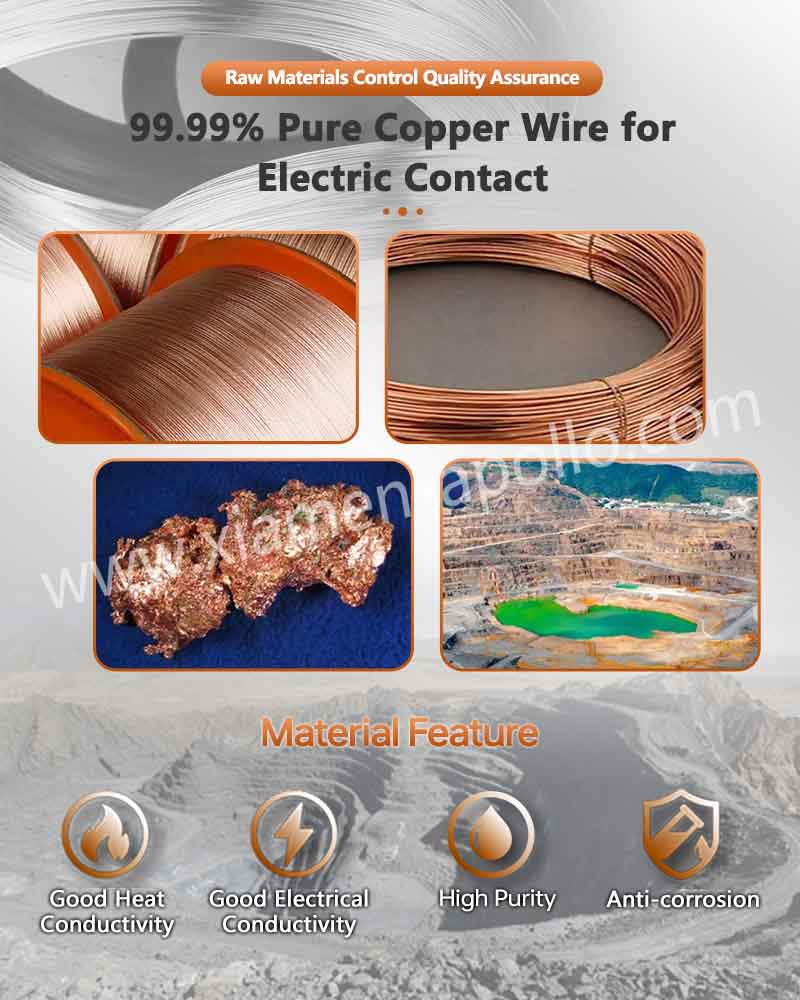
Copper has a high electrical conductivity, making it suitable for components that require low-resistance current transmission. Its thermal conductivity also helps transfer heat away from localized contact areas. However, the actual temperature rise depends on contact resistance, current density, contact force and heat dissipation conditions within the assembled device.
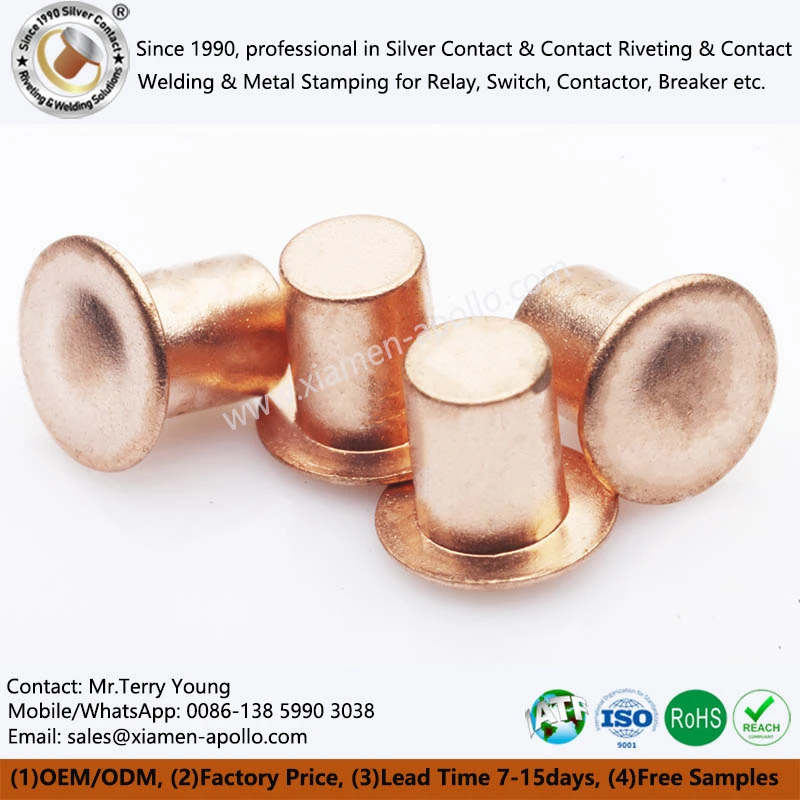
For applications requiring a defined contact shape and connection structure, Copper Electrical Contacts can be manufactured from different copper grades according to conductivity, strength and forming requirements. Oxygen-free copper and commercially pure copper are potential material options, while brass and other copper alloys may be selected when higher mechanical strength or machinability is required.
Surface oxidation is another factor affecting contact performance. Copper exposed to air can develop copper oxide films, which may increase electrical contact resistance. Unlike the oxide layers formed by some other metals, copper oxides do not necessarily provide a stable, low-resistance electrical interface. Contact design, surface finishing and environmental protection must therefore be considered together.
Manufacturing Developments in Copper Rivet Contact Production
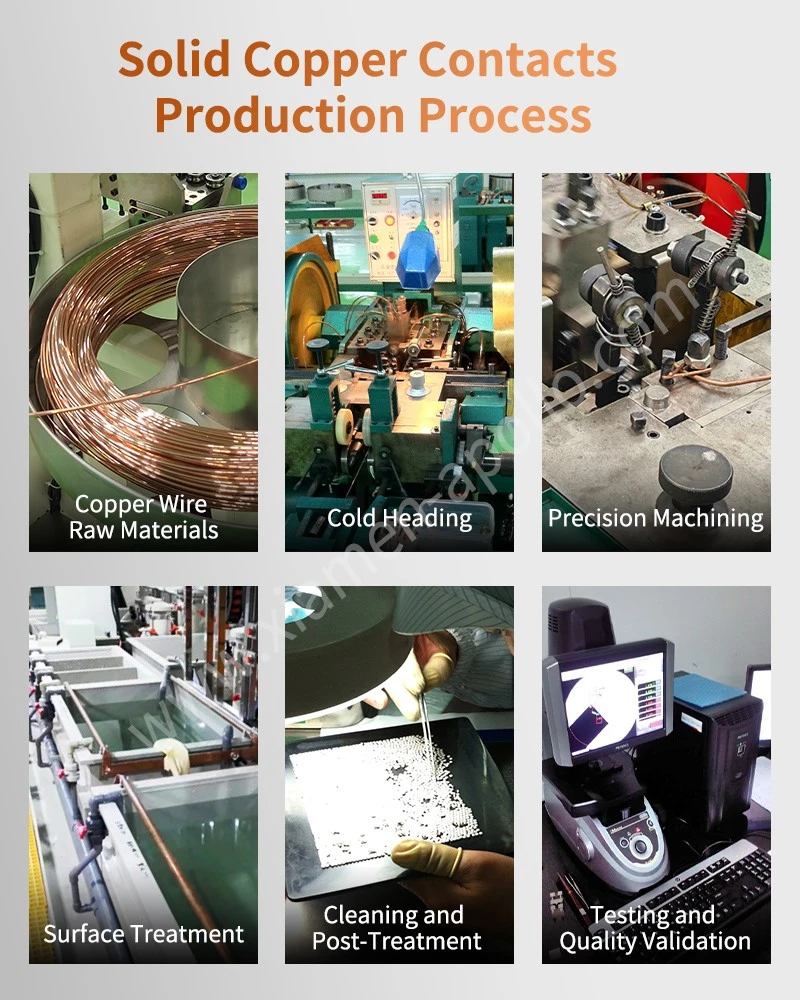
The manufacturing of Rivet-type Solid Copper Contacts generally involves material preparation, blanking, stamping, forming, machining and surface finishing. The selected process depends on component geometry, dimensional tolerances, production volume and the required mechanical properties.
For riveted contact structures, Electrical Copper Rivet Contacts are produced through processes such as wire cutting, cold heading and precision forming. Dimensional consistency, head geometry and shank integrity directly affect assembly accuracy and the stability of the mechanical connection.
In applications where the contact must be manufactured from a single piece of copper, Solid Copper Rivet structures provide an integrated contact design without a separate joined contact head. This configuration can simplify the component structure and eliminate the interface associated with separately joined materials. However, its suitability depends on the required contact geometry, current rating and mechanical loading.
Surface treatment is also an important manufacturing consideration. Silver plating may be used to improve surface conductivity and reduce contact resistance, while nickel plating can provide a barrier layer in applications where diffusion resistance or surface protection is required. The appropriate coating must be evaluated according to operating temperature, switching frequency and contact environment.
Application Requirements Across Electrical and Industrial Equipment
Copper Rivet Contact Elements are used in household appliances, industrial control systems, automotive electrical equipment and power distribution assemblies. Their selection depends on the electrical load, switching frequency, mechanical structure and expected service conditions.
In relay and switch assemblies, Copper Switch Contacts are used to establish and interrupt electrical connections. For low-voltage control circuits, contact geometry and contact force influence switching stability. In higher-current applications, thermal management and resistance at the contact interface become more significant design considerations.
Automotive electrical systems also use copper-based contact structures in relay assemblies, power distribution units and control modules. These applications require components that meet dimensional requirements while maintaining suitable electrical and mechanical characteristics under vibration, temperature variation and repeated operation.
In industrial equipment, Red Copper Contacts are considered when high electrical conductivity is a primary material requirement. Their application may include relay terminals, conductive connection structures and switching assemblies. Where the contact surface is exposed to repeated electrical arcing, however, the use of uncoated copper must be evaluated carefully because material erosion and oxidation can affect long-term switching performance.
High-Current Switching Places Greater Demands on Contact Design
As electrical equipment moves toward higher power density and more compact switching structures, contact components face increasing demands for current-carrying capacity and thermal management.
High Conductivity Copper Contacts are suitable for conductive components where minimizing bulk electrical resistance is important. Nevertheless, high material conductivity alone does not determine the overall performance of a contact assembly. Contact pressure, surface roughness, effective contact area and connection resistance also influence the electrical characteristics of the complete component.
For relay assemblies with integrated conductive and mechanical functions, Pure Copper Electrical Contact Rivets must meet both electrical and dimensional requirements. Precision stamping, forming and secondary machining help control component thickness, flatness, hole position and assembly interfaces. These parameters are particularly important in compact relay structures where small dimensional deviations may affect contact alignment and switching behavior.
One-Piece Contact Structures and Manufacturing Integration
One-piece contact designs offer an alternative to assemblies consisting of separately manufactured and joined conductive parts. By integrating the contact geometry into a single copper component, manufacturers can reduce the number of joining interfaces and simplify certain assembly operations.
One-piece Solid Copper Contacts are generally considered for applications where structural integration, material consistency and simplified component assembly are important. Their production may involve precision stamping, cold heading or machining, depending on the component's geometry and material thickness.
However, one-piece construction is not automatically suitable for every switching application. Where electrical arcing, contact welding or severe contact erosion is expected, engineers may need to consider dedicated contact materials such as silver-based electrical alloys or composite contact structures. The selection should be based on the actual electrical load and switching duty rather than conductivity alone.
Quality Control and Maintenance Requirements
Quality control for Red Copper Contact Rivets for Relays should cover raw material composition, dimensional accuracy, surface condition and mechanical integrity. Electrical conductivity testing and dimensional inspection help verify material and manufacturing consistency, while visual inspection can identify burrs, scratches, deformation and surface contamination.
During equipment maintenance, inspection should focus on contact wear, oxidation, discoloration, mechanical deformation and abnormal temperature rise. Cleaning methods must be compatible with the contact material and surface coating. Excessive abrasion may remove protective plating or alter the designed contact geometry.
Operating current should also remain within the rated limits of the relay or switching device. Overloading, insufficient contact pressure and repeated switching under unsuitable electrical conditions can accelerate contact degradation. Maintenance intervals should therefore be determined by operating conditions, switching frequency and equipment manufacturer's specifications.

Industry Outlook: Material Selection and Precision Manufacturing
The development of relay contact components is increasingly influenced by miniaturization, higher current density and more demanding electrical operating conditions. These trends are driving continued improvements in copper material processing, precision stamping, cold heading and surface treatment technologies.
At the same time, manufacturers are placing greater emphasis on material utilization, production consistency and recycling. Copper's recyclability makes material recovery an important consideration in the manufacturing and end-of-life management of electrical components.
Future development will depend on matching copper grades, contact structures and manufacturing processes to specific electrical requirements. For relay manufacturers and electrical equipment designers, the key engineering considerations remain conductivity, contact resistance, temperature rise, mechanical stability and switching durability.
contact us
For custom Copper Contact Components, contact our manufacturing facility-equipped with capabilities in precision stamping, cold heading, riveting, and surface finishing-to receive technical assessments, rapid prototyping, and solutions for mass production.